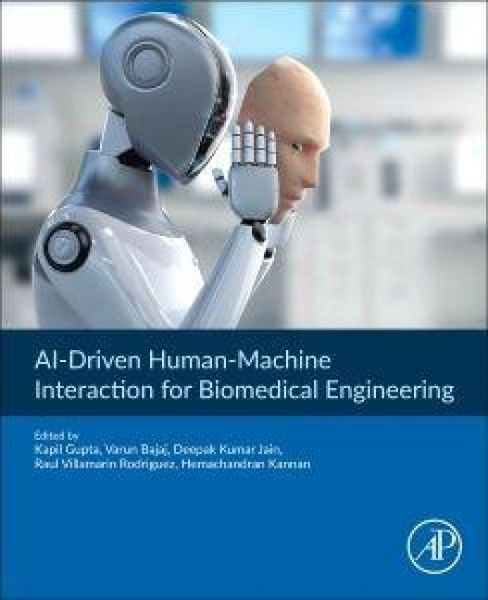
Produktbild: Ai-Driven Human-Machine Interaction for Biomedical Engineering

Ai-Driven Human-Machine Interaction for Biomedical Engineering Concepts, Applications, and Methodologies

189,99 €

inkl. gesetzl. MwSt., Versandkostenfrei


Beschreibung

Produktdetails

Einband

Taschenbuch

Erscheinungsdatum

22.04.2026

Herausgeber

Gupta Kapil + weitere

Verlag

Elsevier

Seitenzahl

382

Maße (L/B/H)

23,4/19/2,2 cm

Gewicht

450 g

Sprache

Englisch

ISBN

978-0-443-44638-2

Beschreibung

Portrait

Dr. Kapil Gupta earned his Ph.D. from the Indian Institute of Information Technology, Design and Manufacturing (IIITDM), Jabalpur, India. He served as an Assistant Professor in Electronics and Communication Engineering at Oriental College of Technology, Bhopal, from 2013 to 2020. He holds a B.E. with Honors in Electronics and Communication Engineering and an M.Tech. in Nano Technology. His research interests encompass signal processing in biomedical applications, time-frequency analysis, artificial intelligence, and cardiovascular systems. Dr. Gupta has published extensively in reputed journals and serves as a reviewer for IEEE and Elsevier. He has organized numerous national and international conferences and has been involved in various technical committees.

Dr. Varun Bajaj is an Associate Professor in Electronics and Communication Engineering at Maulana Azad National Institute of Technology Bhopal, India, starting January 2024. Previously, he served at the Indian Institute of Information Technology, Design and Manufacturing (IIITDM) Jabalpur from 2014 to 2024, initially as an Assistant Professor and later as an Associate Professor. He earned his Ph.D. in Electrical Engineering from IIT Indore in 2014, following an M.Tech. in Microelectronics and VLSI Design in 2009, and a B.E. in Electronics and Communication Engineering in 2006. Dr. Bajaj holds various editorial roles, including Associate Editor for the IEEE Sensor Journal and Subject Editor-in-Chief for IET Electronics Letters. A Senior Member of IEEE since 2020, he actively reviews for numerous journals and has delivered over 50 expert talks. He has received multiple awards for his research and has been recognized among the top 2% of researchers globally by Stanford University from 2020 to 2023.

Dr. Deepak Kumar Jain is an Associate Professor at the School of Control Science and Engineering at Dalian University of Technology, China, since July 2023. Previously, he was an Assistant Professor at Chongqing University of Posts and Telecommunications. He earned his Bachelor of Engineering in 2010 and a Master of Technology in 2012 from Indian institutions, followed by a Ph.D. at the University of Chinese Academy of Sciences in 2018, supported by the CAS-TWAS Presidential Fellowship. Recognized as a "Foreign Expert" by the Shandong Taian Administration, Dr. Jain has also served as an Adjunct Professor at Symbiosis International University in India. He has approximately fifty publications with a citation count of 3000 and has contributed to numerous peer-reviewed journals. A senior member of IEEE, he is involved in several editorial roles and conferences, including delivering keynote talks internationally. His research focuses on deep learning, machine learning, pattern recognition, and computer vision.

Dr. Raul Villamarin Rodriguez is the Vice President of Woxsen University, where he holds the Steven Pinker Professorship in Cognitive Psychology and the Classavo Chair in Integrative Research and Digital Learning. He is also an Adjunct Professor at Universidad del Externado in Colombia and serves on the International Advisory Boards of IBS Ranepa in Russia and the University of Pécs Faculty of Business and Economics. Dr. Rodriguez represents India on the PRME i5 Expert Pedagogy Group and holds a Ph.D. in Artificial Intelligence and Robotics Process Automation in Human Resources. His expertise includes machine learning, deep learning, natural language processing, and quantum artificial intelligence. He is a registered expert in these fields with the European Commission and was nominated for the Forbes 30 Under 30 Europe 2020 list. Dr. Rodriguez has co-authored two reference books, published over 70 research papers, and is a regular contributor to various magazines on analytics and emerging technologies. He also serves as a journal reviewer and associate editor for several publications, including IEEE.

Dr. Hemachandran Kannan is a Professor in the Department of Artificial Intelligence & Business Analytics at Woxsen University, India, where he holds the Zita Zoltay Paprika Chair in Decision Sciences and Business Economics, as well as the Course5i Chair in Business Analytics and Machine Learning. With 15 years of teaching and 5 years of research experience, he is a dedicated educator skilled in AI and Business Analytics. After earning a Ph.D. in Embedded Systems, Dr. Kannan shifted his focus to interdisciplinary research. He has served as a resource person at numerous national and international conferences and has lectured on AI and Business Analytics topics. Recognized as Best Faculty at Woxsen University (2021-2022) and Ashoka Institute of Engineering & Technology (2019-2020), he has expertise in Natural Language Processing, Computer Vision, and autonomous systems.

Produktdetails

Einband

Taschenbuch

Erscheinungsdatum

22.04.2026

Herausgeber

Verlag

Elsevier

Seitenzahl

382

Maße (L/B/H)

23,4/19/2,2 cm

Gewicht

450 g

Sprache

Englisch

ISBN

978-0-443-44638-2

Herstelleradresse

Libri GmbH
Europaallee 1
36244 Bad Hersfeld
DE

Email: gpsr@libri.de

Ein neues Kapitel für Ihre Bücher

Ein neues Kapitel für Ihre Bücher

Schenken Sie Ihren alten Schätzen ein zweites Leben: Einfach Barcode scannen, Versandetikett ausdrucken, Bücher verschicken und Thalia Geschenkkarte erhalten.

Jetzt verkaufen
Jetzt verkaufen

Kundinnen und Kunden meinen

0 Bewertungen

Informationen zu Bewertungen

Zur Abgabe einer Bewertung ist eine Anmeldung im Konto notwendig. Die Authentizität der Bewertungen wird von uns nicht überprüft. Wir behalten uns vor, Bewertungstexte, die unseren Richtlinien widersprechen, entsprechend zu kürzen oder zu löschen.

Die Bewertungen sind nach Format, Anzahl Sterne und Datum sortiert.

Verfassen Sie die erste Bewertung zu diesem Artikel

Helfen Sie anderen Kund*innen durch Ihre Meinung

Kundinnen und Kunden meinen

0 Bewertungen filtern

Weitere Artikel finden Sie in

  • Produktbild: Ai-Driven Human-Machine Interaction for Biomedical Engineering
  • 1. Basics, Constraints, and Future Potential of Machine Learning in HMI
    2. Human-Computer Interaction for Cardiac Feedback: A Physics-Guided Deep Learning Approach
    3. Classification of Steady State Visual Evoked Potentials in Brain-Computer Interface systems using Python
    4. Contactless Vital Sign Monitoring Through Intelligent Human-Machine Interaction (HMI): A Systematic Review of Image- and Video-Based Techniques
    5. AI-driven Scalable Software Architecture for Enhancing Human-Machine Interaction in Biomedical Data Ecosystems
    6. AI-Driven Depression Detection Using EEG Signal Determinants and MTO
    7. EEG-Driven Machine Learning for Recognition of Emergency Numbers for Crisis Readiness: A Translational Study
    8. Suppression of Artifacts from EEG Signals using Quadratic Relative Error based LMS (QRE-LMS) Algorithm
    9. Two-Stage Verification for Multi-Instance Feature Selection in Dental Anomaly Detection: A CNN-GRU Approach with Explainable AI and Optimization Techniques
    10. Performance Evaluation of Vision Transformers for AI-driven Diagnosis of Bleeding Detection in Wireless Endoscopy Bleeding
    11. Human Machine Interface In Healthcare Imaging And Medical Treatments
    12. State-of-the-art methods for diagnosis of acute leukemia: A survey
    13. Optimized Feature Subsets for Characterizing Fetal QRS Complexes in Non-Invasive Abdominal ECG Recordings
    14. Multimodal AI in Human-Computer Interaction: Transforming Medical Feedback Delivery
    15. Computer Vision for AI-Driven Human-Machine Interaction and Enhanced Diagnosis
    16. Human-Machine Interaction in AI-Assisted Medical Diagnosis: Challenges and Future Directions