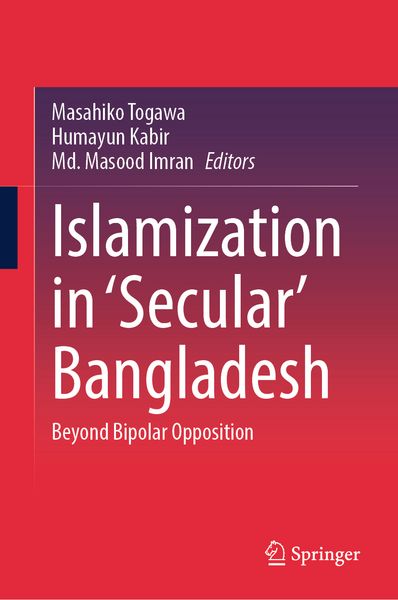
Islamization in ‘Secular’ Bangladesh Beyond Bipolar Opposition
-
- Englisch ausgewählt
133,99 €
UVP
149,79 €
inkl. gesetzl. MwSt.,
Beschreibung
Produktdetails
Einband
Gebundene Ausgabe
Erscheinungsdatum
11.05.2026
Abbildungen
XII, 301 p. 5 illus., 2 illus. in color.
Herausgeber
Masahiko Togawa + weitereVerlag
SpringerSeitenzahl
301
Maße (L/B/H)
24,1/16/2,3 cm
Gewicht
639 g
Sprache
Englisch
ISBN
978-3-032-16084-3
This volume adds to the increasingly important debate on religion and modernity and their complex interplay in Muslim-majority societies. Taking up the case of Bangladesh, the discussions are highly topical given the recent upsurges in the country. The volume offers a comprehensive perspective on the changing dynamics of Islamization and secularization processes in Bangladeshi society and deconstructs the binary opposition between religion and secular modernity as inapplicable not just to Bangladesh but also to Muslim societies elsewhere.
The contributors mostly apply anthropological approaches to cover four broad themes: transformation of identity beyond Islamization and secularization; Islamic movements in democratic arena; Islamic culture in public sphere; and beyond polarization of women’s liberation and Islamization. They cast light on religion and modernity, identity politics, development, globalization, the digital space, Islamic movements, and gender identity and patriarchal structure in Bangladesh. The incisive analyses of the cases and themes presented here will help readers understand how Islamization intersects with secularization/modernity in Bangladesh, within the broader South Asian sociopolitical context. The volume is of interest to scholars of Bangladesh studies, and historians, anthropologists, feminists, political scientists, and researchers of South Asia. Policy makers and development and non-governmental professionals will also benefit from the issues, cases, and myriad examples incorporated in this volume.
Ein neues Kapitel für Ihre Bücher
Ein neues Kapitel für Ihre Bücher
Schenken Sie Ihren alten Schätzen ein zweites Leben und erhalten dafür eine Thalia Geschenkkarte.
Noch keine Bewertungen vorhanden
Verfassen Sie die erste Bewertung zu diesem Artikel
Helfen Sie anderen Kundinnen und Kunden durch Ihre Meinung.
Kurze Frage zu unserer Seite
Vielen Dank für Ihr Feedback
Wir nutzen Ihr Feedback, um unsere Produktseiten zu verbessern. Bitte haben Sie Verständnis, dass wir Ihnen keine Rückmeldung geben können. Falls Sie Kontakt mit uns aufnehmen möchten, können Sie sich aber gerne an unseren Kund*innenservice wenden.
zum Kundenservice