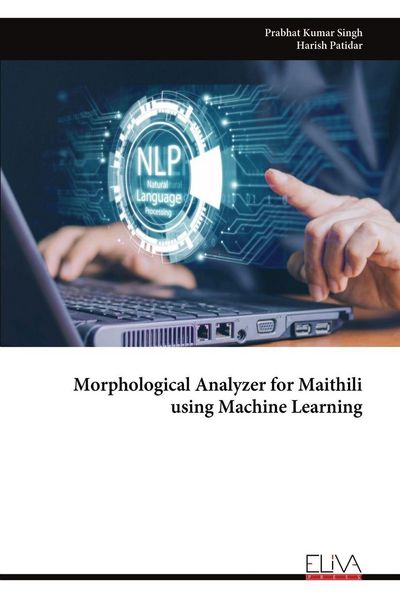
Morphological Analyzer for Maithili using Machine Learning
-
- Englisch ausgewählt
63,99 €
inkl. gesetzl. MwSt.,
Beschreibung
Produktdetails
Einband
Taschenbuch
Erscheinungsdatum
05.12.2025
Verlag
Eliva PressSeitenzahl
150
Maße (L/B/H)
22,9/15,2/0,8 cm
Gewicht
228 g
Sprache
Englisch
EAN
9789999329897
I n the ever-expanding landscape of Natural Language Processing (NLP), the ability to dissect and understand the building blocks of a language is a foundational step. While powerful tools for morphological analysis exist for globally dominant languages like English, a vast number of the world's languages, particularly those with rich oral traditions and distinct linguistic structures, have been left behind in the digital revolution. This is especially true for Maithili, a language spoken by millions across the Mithila region of India and Nepal, yet one that has remained largely underrepresented in the digital sphere. The development of a robust morphological analyzer for Maithili is not just a technological feat; it is a critical step toward preserving and promoting its unique heritage in the modern age. Morphological analysis is the process of breaking down words into their constituent morphemes-the smallest units of meaning. For a language like Maithili, with its complex system of verb conjugations, case markers, and grammatical agreements, this task is particularly challenging. A word like "¿¿¿¿¿" (pähaich¿) must be broken down to its root, "¿¿" (päha), meaning "to read," and the suffix "-¿¿¿" (-aich¿), which denotes the first-person singular present tense. Similarly, "¿¿¿¿¿¿¿¿¿¿¿¿¿¿¿" (vidy¿rth¿har¿le) contains the base word "¿¿¿¿¿¿¿¿¿¿" (vidy¿rth¿) for "student," the plural marker "-¿¿¿" (-har¿), and the case marker "-¿¿" (-le) that indicates the agent of an action. Accurately parsing these structures is essential for any advanced language processing application. Traditional rule-based approaches, which rely on manually created dictionaries and a fixed set of grammatical rules, often fall short when dealing with Maithili. Its extensive irregularities, nuanced phonetic shifts, and a wide array of dialectal variations make it difficult to create a comprehensive and scalable rule set. Any small change or new word would require a manual update to the system, making it brittle and high-maintenance. This is where the power of machine learning provides a transformative solution.
Ein neues Kapitel für Ihre Bücher
Ein neues Kapitel für Ihre Bücher
Schenken Sie Ihren alten Schätzen ein zweites Leben: Einfach Barcode scannen, Versandetikett ausdrucken, Bücher verschicken und Thalia Geschenkkarte erhalten.
Jetzt verkaufenKundinnen und Kunden meinen
Verfassen Sie die erste Bewertung zu diesem Artikel
Helfen Sie anderen Kund*innen durch Ihre Meinung
Kurze Frage zu unserer Seite
Vielen Dank für Ihr Feedback
Wir nutzen Ihr Feedback, um unsere Produktseiten zu verbessern. Bitte haben Sie Verständnis, dass wir Ihnen keine Rückmeldung geben können. Falls Sie Kontakt mit uns aufnehmen möchten, können Sie sich aber gerne an unseren Kund*innenservice wenden.
zum Kundenservice