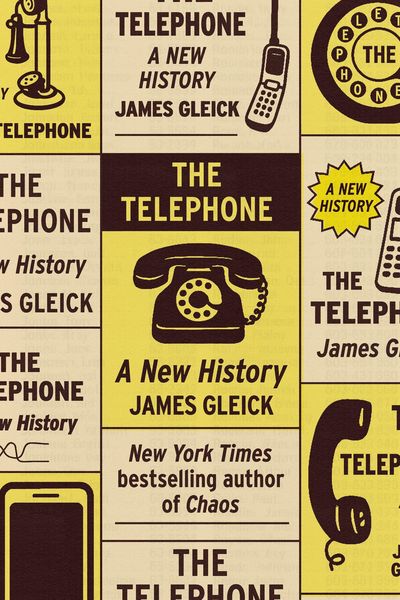
The Telephone A New History
-
- Hardcover ausgewählt
- Taschenbuch
- eBook
-
Sprache:Englisch
29,99 €
inkl. gesetzl. MwSt.,
Beschreibung
Produktdetails
Einband
Gebundene Ausgabe
Erscheinungsdatum
10.11.2026
Verlag
Farrar, Straus and GirouxSeitenzahl
544
Maße (L/B/H)
22,9/15,2/2,5 cm
Gewicht
454 g
Sprache
Englisch
ISBN
978-0-374-61894-0
From the bestselling author of Chaos and The Information, a sweeping history of the instrument that created modern life.
In 1876, Alexander Graham Bell spoke the words "Mr. Watson-come here-I want to see you" into a contraption he called the telephone, and for the first time a voice was carried along a wire. For a century, this feat has been celebrated as a triumph of individual ingenuity and vision. In fact, the invention was a contest replete with bribery, fraud, and speculation, and no one, not even its inventors, realized what it was good for or how ubiquitous it would become.
Over the next century, the phone would prove less an invention than a continuous revolution. It would teach us new words (starting with the once-unfamiliar "hello" and "goodbye") and a new way to speak, with instant reaction, instant feeling, instant possibilities. It would create an all-female profession-the operator-that by 1920 outnumbered nurses and waitresses put together. It would enable the skyscraper, the world war, the assembly line, and the multinational corporation. And the Bell Telephone Company would become the largest monopoly in history: the sole owner of every phone in America. The science that Bell Labs created around the telephone, from pulsing wires to glowing vacuum tubes to the electronic transistor, would usher in the Information Age.
Along the way, the telephone changed human nature. It augmented our bodies, a prosthetic extension of mouth and ear. It gave us the party line, the busy signal, dial tones, wiretapping, the late-night D.J., and the booty call. It magnified the possibilities of government, of business, of friendship, of love.
For a while, the revolution was so successful that it made telephones themselves seem natural, eternal. They settled into the background, on bedside tables, desks, and kitchen walls; in subways and on corners; in novels, movies, songs, and on TV. No one could remember life without them.
Today we are more dependent than ever on little objects called phones, although their ability to make "telephone calls" is incidental. The phone book and the phone booth may be vanishing from memory, but as James Gleick shows, the telephone's legacy is deeply ingrained-in our networks and our sophistication about networks, in the primacy of information, in the need for connection. Gleick is celebrated for his uncanny ability to make complex ideas vivid, understandable, and concrete. In The Telephone: A New History, he gives us a revelation: a story of technological breakthroughs that is also a universal history of intimate life.
Ein neues Kapitel für Ihre Bücher
Ein neues Kapitel für Ihre Bücher
Schenken Sie Ihren alten Schätzen ein zweites Leben: Einfach Barcode scannen, Versandetikett ausdrucken, Bücher verschicken und Thalia Geschenkkarte erhalten.
Jetzt verkaufenKundinnen und Kunden meinen
Verfassen Sie die erste Bewertung zu diesem Artikel
Helfen Sie anderen Kund*innen durch Ihre Meinung
Kurze Frage zu unserer Seite
Vielen Dank für Ihr Feedback
Wir nutzen Ihr Feedback, um unsere Produktseiten zu verbessern. Bitte haben Sie Verständnis, dass wir Ihnen keine Rückmeldung geben können. Falls Sie Kontakt mit uns aufnehmen möchten, können Sie sich aber gerne an unseren Kund*innenservice wenden.
zum Kundenservice