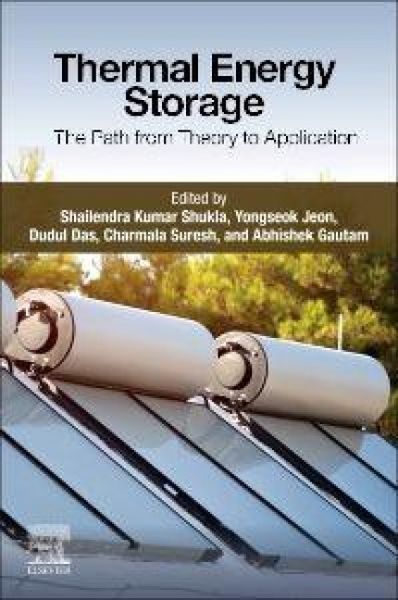
Produktbild: Thermal Energy Storage
Vorbesteller Neu

Thermal Energy Storage The Path from Theory to Application

209,99 €

inkl. gesetzl. MwSt., Versandkostenfrei


Beschreibung

Produktdetails

Einband

Taschenbuch

Erscheinungsdatum

01.11.2026

Herausgeber

Abhishek Gautam + weitere

Verlag

Elsevier

Seitenzahl

400

Maße (L/B)

22,9/15,2 cm

Gewicht

450 g

Sprache

Englisch

ISBN

978-0-443-45759-3

Beschreibung

Portrait

Shailendra Kumar Shukla is currently a Professor in Indian Institute of Technology, Varanasi, India. He was the former Pro-Vice Chancellor of Ranchi University and has worked in the field of Thermal Engineering and Renewable Energy Technology since last 22 years. He is founder Coordinator of Centre For Energy and Resources Development (CERD), IIT(BHU) and Coordinator of CST UP Incubation Centre for Grass-Root Innovators at Mechanical Engineering Department, IIT(BHU), Varanasi. He completed his Masters in Energy Studies and Ph.D. in Solar Thermal Engineering at Indian Institute of Technology, Delhi, India. He is a recognized guide for M.Tech. and Ph. D. in Thermal and Energy Engineering in Indian Institute of Technology (Banaras Hindu University), Uttar Pradesh Technical University, Lucknow and NITTTR, Chandigarh. He has developed research Collaborations with Asian Institute of Technology, Bangkok, University of Leeds, UK and University of Technology, Mauritius, GIFU University, Japan in the field of Thermal Engineering and Renewable Energy Technology. He is a Visiting Professor under MHRD Govt. of India, Secondment to Asian Institute of Technology, Bangkok and University of Technology, Mauritius. He has delivered number of invited talks in International conferences/symposiums/ workshops on various issues in the field of Renewable Energy and Alternate Fuel Technologies. He is a member of Post Graduate and Research Committee, Mechanical Engineering Department IIT (BHU), Varanasi since October 2013. He was also nominated as Principal Member of Expert Group in Mechanical Engineering Sectional Committees (MED-39) and MED-04, of Bureau of Indian Standard (BIS), Govt. of India, New Delhi.

Prof. Yongseok Jeon is Associate Professor in the Department of Mechanical Engineering, Ajou University, Republic of Korea. He is Director for the Thermal Energy & Refrigeration Lab and active in the fields of energy storage systems, thermal management systems and advanced refrigeration & HVAC systems. He is also an Editorial Director for the Thermal Engineering Department of the Korean Society of Mechanical Engineers and Korean Society of Power Machinery Engineers. He has several research projects funded by the National Research Foundation of Korea. He has published 37 research papers in high impact SCI/Scopus Journals, 2 book chapters and also has 2 international and 4 domestic patents.

Dr. Dudul Das is currently working as Marie Curie Fellow at James Watt School of Engineering, University of Glasgow. He has done his PhD from IIT Guwahati in 2020. His research is of an interdisciplinary nature, and he is keen to investigate the underlying mechanisms of various complex phenomena in Thermal Energy Storage and Renewable Energy systems from different perspectives by means of theoretical, numerical, and experimental techniques. He serves as a reviewer of several international journals.

Dr Charmala Suresh is currently working as a Postdoctoral Researcher at the National Korea Maritime and Ocean university, School of Mechanical Engineering. His research is mainly focused on application of phase change materials in thermal systems and buildings for sustainable future. He had worked as a Post Doctoral Fellow in the Department of Mechanical Engineering, Indian Institute of Technology Bombay on thermal energy storage systems. Dr. Suresh obtained his Ph.D. from Indian Institute of Technology Roorkee, where he worked on the field of thermal energy storage in combined sensible-latent thermal storage. Dr. Suresh has contributed to research papers in reputed international journals and also serves as a peer reviewer for reputed international journals.

Dr Abhishek Gautam has worked as a Postdoctoral Researcher at the City University of Hong Kong on Energy Efficiency and Clean Energy Technologies. He had worked as a Post Doctoral Fellow in the Department of Mechanical Engineering, Indian Institute of Technology Bombay on the non-conventional desalination system and solar powered cold storage system. Dr. Gautam obtained his Ph.D. from Indian Institute of Technology Roorkee, where he worked on the field of thermal energy storage in packed bed storage systems Dr. Gautam has contributed research papers in reputed international journals.

Produktdetails

Einband

Taschenbuch

Erscheinungsdatum

01.11.2026

Herausgeber

Verlag

Elsevier

Seitenzahl

400

Maße (L/B)

22,9/15,2 cm

Gewicht

450 g

Sprache

Englisch

ISBN

978-0-443-45759-3

Herstelleradresse

Libri GmbH
Europaallee 1
36244 Bad Hersfeld
DE

Email: GPSR Kontakt

Ein neues Kapitel für Ihre Bücher

Ein neues Kapitel für Ihre Bücher

Schenken Sie Ihren alten Schätzen ein zweites Leben: Einfach Barcode scannen, Versandetikett ausdrucken, Bücher verschicken und Thalia Geschenkkarte erhalten.

Jetzt verkaufen
Jetzt verkaufen

Noch keine Bewertungen vorhanden

Verfassen Sie die erste Bewertung zu diesem Artikel

Helfen Sie anderen Kundinnen und Kunden durch Ihre Meinung.

Kundinnen und Kunden meinen

Bewertungen (0)

  • Produktbild: Thermal Energy Storage
  • Part 1: Introduction to Thermal Energy Storage
    1.1 Overview, Historical Development and Evolution of TES
    1.2 Basic Concepts of Thermodynamics
    1.3 Heat Transfer Concepts Involved in TESs
    1.4 General Aspects of Fluid Flow Involved in TESs

    Part 2: Different Methods of Thermal Energy Storage
    2.1 Sensible TESs
    2.2 Latent TESs
    2.3 Thermo-Chemical TESs
    2.4 Hybrid Thermal Energy Storage

    Part 3: Useful Approaches for TES Problems
    3.1 Predictive Modelling Techniques
    3.2 Numerical Techniques
    3.3 Experimental Techniques
    3.4 3-D Printing for TES
    3.5 Different Software Tools

    Part 4: Applications of TES in Different Sectors
    4.1 Introduction to Thermal Batteries
    4.2 TES in Building Sector
    4.3 TES in Power Generation and Decentralized Electrification
    4.4 TES in Food Supply Chain
    4.5 TES in Data Centres and Electronic Cooling

    Part 5: Market Outlook, Environmental Benefits, and Future Trends
    5.1 Maturity and Cost Effectiveness of TESs
    5.2 Role of TES Integration for a Sustainable Future
    5.3 Current Status of Market Adaptability
    5.4 Different Case Studies

    Part 6: Conclusions and Future Recommendations