Gutscheinbedingungen

Gültig bis 19.08.2026 | Gültig für Spielzeug, Filme, Musik, Software, Games, Elektronik, Geschenke & Trends, Schreibwaren, Hörbücher und Hörbuch-Downloads (außer Abo & Shelfies), gebrauchte Bücher, nicht preisgebundene Bücher und Kalender | Einlösbar unter thalia.de und in der Thalia App | Click & Collect nur mit Online-Zahlung (Paypal/Kreditkarte) vorab | Einzelne Artikel können ausgeschlossen sein | Nicht kombinierbar mit anderen Gutscheinen oder Preisaktionen | Nur einmal pro Einkauf einlösbar | Gutschein wird auf max. 500€ Bestellwert angerechnet | Keine Barauszahlung | Digitale Hörbücher nur für Android  | Nicht gültig für preisgebundene Artikel (aufgrund der Buchpreisbindung sind Gutscheine nicht auf Bücher, eBooks, Presse einlösbar), tolino eReader & Zubehör, Abonnements & Flatrates, Geschenkkarten, Versandkosten und Services

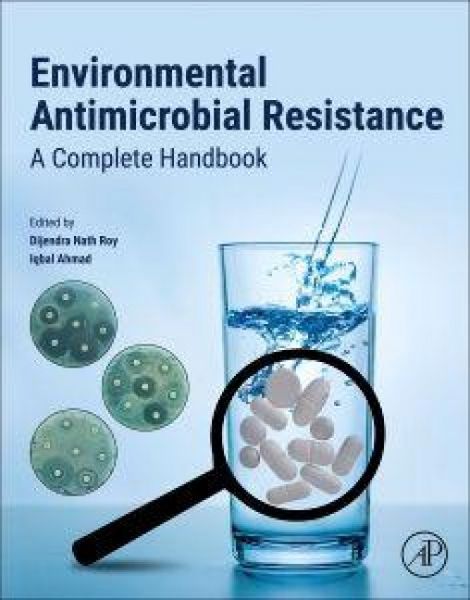
Produktbild: Environmental Antimicrobial Resistance
Vorbesteller Neu

Environmental Antimicrobial Resistance A Complete Handbook

194,99 €

inkl. gesetzl. MwSt., Versandkostenfrei


Beschreibung

Produktdetails

Einband

Taschenbuch

Erscheinungsdatum

18.11.2026

Herausgeber

Dijendra Nath Roy + weitere

Verlag

Elsevier

Seitenzahl

345

Maße (L/B)

23,5/19,1 cm

Gewicht

449 g

Sprache

Englisch

ISBN

978-0-443-45142-3

Beschreibung

Portrait

Dr. Dijendra Nath Roy completed his PhD from CSIR-Indian Institute of Chemical Biology, Kolkata, under the Jadavpur University of India and postdoctoral research at the National University of Singapore (NUS), Singapore. Dr. Roy started his career as an Assistant Professor in the Department of Bioengineering at the National Institute of Technology- Agartala, Tripura, India, in 2013, and presently, he is working as an Assistant Professor in the Department of Biotechnology at the National Institute of Technology - Raipur, Chhattisgarh, India. He has more than 25 peer-reviewed international publications along with being engaged as principal/co-principal investigator of more than five national projects on antimicrobial resistance and drug development funded by national agencies like the Department of Science and Technology (DST, Govt. of India), Department of Biotechnology (DBT, Govt. of India), Indian Council of Medical Research (ICMR, Govt. of India), etc. Dr. Roy has delivered numerous invited lectures at several international meetings in France, Belgium, Netherlands, Singapore, Malaysia, Thailand, Bangladesh, Maldives, and India. Dr. Roy has already been engaged in the guidance of five Ph.D. students in the field of antimicrobial resistance and drug development. Additionally, Dr. Roy has already contributed his enormous knowledge of antimicrobial drug resistance by publishing several artciels and two international books for academicians.

Dr. Iqbal Ahmad has been a senior professor in the Department of Agricultural Microbiology at Aligarh Muslim University, India, He has more than 250 peer-reviewed international publications along with being engaged as Principal/co-principal investigator of many national/international projects on Applied and Environmental Microbiology. His research work has been cited more than 21000 times as per Google Scholar Records. He has been a visiting Professor at Umm Al-Qura University, Makkah, Saudi Arabia, since 2016.

He has a lot of experience working on antimicrobial resistance among pathogenic bacteria from medical and environmental sources. His recent research interest in tackling the environmental AMR problem in India is supported by the Department of Biotechnology, New Delhi, in collaboration with the British Government, UK Research and Innovation (UKRI)/NERC. Dr. Ahmad has delivered numerous invited lectures at national/international meetings and guided more than 20 Ph.D. students in the field of environmental and Applied Microbiology. Additionally, Dr. Ahmad has already contributed his enormous microbiology and drug resistance knowledge by publishing 09 international books for academicians.

Produktdetails

Einband

Taschenbuch

Erscheinungsdatum

18.11.2026

Herausgeber

Verlag

Elsevier

Seitenzahl

345

Maße (L/B)

23,5/19,1 cm

Gewicht

449 g

Sprache

Englisch

ISBN

978-0-443-45142-3

Herstelleradresse

Libri GmbH
Europaallee 1
36244 Bad Hersfeld
DE

Email: GPSR Kontakt

Ein neues Kapitel für Ihre Bücher

Ein neues Kapitel für Ihre Bücher

Schenken Sie Ihren alten Schätzen ein zweites Leben und erhalten dafür eine Thalia Geschenkkarte.

Jetzt verkaufen
Jetzt verkaufen

Noch keine Bewertungen vorhanden

Verfassen Sie die erste Bewertung zu diesem Artikel

Helfen Sie anderen Kundinnen und Kunden durch Ihre Meinung.

Kundinnen und Kunden meinen

Bewertungen (0)

Weitere Artikel finden Sie in

  • Produktbild: Environmental Antimicrobial Resistance
  • 1. An introduction to environmental antimicrobial resistance phenomenon
    2. Global scenario on antimicrobial resistance
    3. Fate and transport of antimicrobial drugs in the environment and living organisms
    4. Role of the human community in environmental antimicrobial resistance
    5. Role of animals in environmental antimicrobial resistance
    6. Role of hospitals in environmental antimicrobial resistance
    7. Role of pharmaceutical industries in environmental antimicrobial resistance
    8. Role of agricultural plants and agricultural lands in environmental antimicrobial resistance
    9. Role of municipal waste sites in environmental antimicrobial resistance
    10. Environmental drivers for AMR selection, coresistance, and gene dissemination
    11. Detection of environmental antimicrobial resistance
    12. Bacterial Plasmids: Role in emergence and dissemination of AMR genes in the environmental setting
    13. Impact of emergent drug-resistant bacteria
    14. Impact of emergent drug-resistant fungi
    15. Impact of emergent drug-resistant virus
    16. Impact of emergent drug-resistant protozoa
    17. Management of environmental antimicrobial resistance
    18. Advanced genomic approaches for resistance management
    19. Role of Environmental Health in the management of antimicrobial resistance
    20. Case studies from diverse geographic regions
    21. Impact of Covid-19 on environmental microbial resistance
    22. Policies on addressing environmental antimicrobial resistance