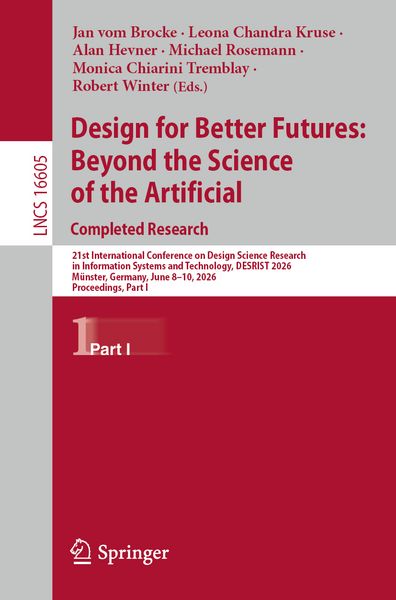
Design for Better Futures: Beyond the Science of the Artificial. Completed Research 21st International Conference on Design Science Research in Information Systems and Technology, DESRIST 2026, Münster, Germany, June 8–10, 2026, Proceedings, Part I
-
- Taschenbuch ausgewählt
- eBook
-
Sprache:Englisch
-
Verlag:Springer
- Springer 62,99 €
- Springer 79,99 € ausgewählt
79,99 €
inkl. gesetzl. MwSt.,
Beschreibung
Produktdetails
Einband
Taschenbuch
Erscheinungsdatum
02.06.2026
Abbildungen
XXIII, 426 p. 62 illus., 39 illus. in color.
Herausgeber
Jan vom Brocke + weitereVerlag
SpringerSeitenzahl
426
Maße (L/B/H)
23,5/15,5/2,5 cm
Gewicht
686 g
Sprache
Englisch
ISBN
978-3-032-28315-3
The two-volume main proceedings set LNCS 16605 and 16606 constitutes the refereed main proceedings of the 21st International Conference on Design Science Research in Information Systems and Technology, DESRIST 2026, which was held in Münster, Germany, during June 8–10, 2026.
Given the large number of high-quality contributions, the 2026 proceedings are published in three volumes: LNCS 16605 and 16606 as main proceedings include all accepted full papers, while LNCS 16607 contains all accepted of Prototypes and Research-in-Progress Proceeding papers. DESRIST 2026 received a total of 231 submissions across all tracks and formats. The 48 full papers included in these main proceedings were carefully reviewed and selected from 108 full research paper submissions.
The papers presented in LNCS 16605 and 16606 as main proceedings are organized in the following topical sections:
Part I : Design for Better Futures: Beyond the Science of the Artificial (Theme Track); “From Insight to Impact” (General Track); The Future of Financial Services; Future of Data-Driven and AI-Enabled Design; Future of Healthcare and Wellbeing.
Part II : Future of Design and Entrepreneurship; Future of Responsible and Sustainable Design; Future of Design Science Education; Future of Design Science Methodology; Future of Ecosystems for Design Science Research.
Ein neues Kapitel für Ihre Bücher
Ein neues Kapitel für Ihre Bücher
Schenken Sie Ihren alten Schätzen ein zweites Leben und erhalten dafür eine Thalia Geschenkkarte.
Noch keine Bewertungen vorhanden
Verfassen Sie die erste Bewertung zu diesem Artikel
Helfen Sie anderen Kundinnen und Kunden durch Ihre Meinung.
Kurze Frage zu unserer Seite
Vielen Dank für Ihr Feedback
Wir nutzen Ihr Feedback, um unsere Produktseiten zu verbessern. Bitte haben Sie Verständnis, dass wir Ihnen keine Rückmeldung geben können. Falls Sie Kontakt mit uns aufnehmen möchten, können Sie sich aber gerne an unseren Kund*innenservice wenden.
zum Kundenservice