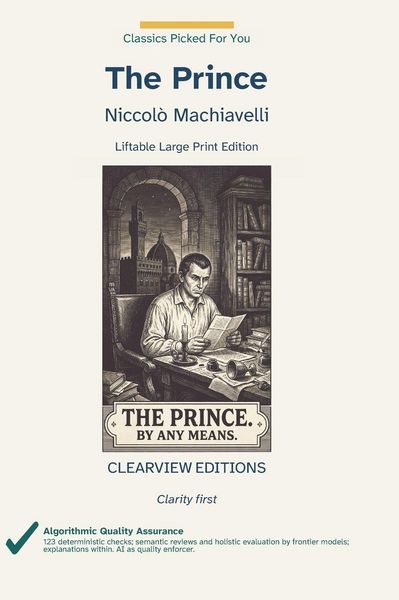
The Prince A Clearview Large Print Edition
-
- Hardcover ausgewählt
- Taschenbuch
- eBook
- Hörbuch
-
Sprache:Englisch
-
Verlag:W. Frederick Zimmerman
- Arcturus Publishing 12,99 €
- Hachette Book Group USA 14,09 €
- John Wiley & Sons Inc 14,39 €
- Quarto Publishing Group 18,99 €
- Curated Collection Publishing 16,99 €
- Ingram Publishers Services 11,99 €
- Arcturus Publishing Ltd 11,59 €
- 12th Media Services 16,99 €
- Wilder Publications 22,99 €
- Everyman's Library Hardback 21,99 €
- Macmillan Publishers International 13,99 €
- Prakash Books 12,99 €
- 1828 Press 13,99 €
- Ancient Wisdom Publications 17,99 €
- Simon & Brown 19,99 €
- W. Frederick Zimmerman 39,99 € ausgewählt
- Penguin Books Ltd 21,99 €
- Gröls Verlag 17,90 €
39,99 €
inkl. gesetzl. MwSt.,
Beschreibung
Produktdetails
Einband
Gebundene Ausgabe
Erscheinungsdatum
19.09.2026
Verlag
W. Frederick ZimmermanSeitenzahl
342
Maße (L/B/H)
25,4/17,8/2,1 cm
Gewicht
811 g
Übersetzt von
W. K. Marriott
Sprache
Englisch
ISBN
978-1-60888-819-1
Niccolò Machiavelli's The Prince examines how rulers acquire states, hold them, and lose them. Written from the experience of Renaissance Italian politics, it sets practical questions against examples from ancient and recent history. Hereditary rule, newly acquired territories, military force, political reputation, and the loyalty of subjects become subjects for sustained inquiry. Machiavelli asks what a ruler can control, what must be anticipated, and what happens when policies meet circumstances for which they were not designed.
The book's twenty-six chapters move from the different kinds of principalities to the means of establishing authority within them. Machiavelli distinguishes rulers who depend on their own arms and abilities from those raised by another person's power or by fortune. He considers the risks of mercenary and auxiliary soldiers, the relation between rulers and peoples, and the difficulty of maintaining an order that has only recently been created. Historical examples serve as arguments to examine rather than as a continuous narrative.
Later chapters address the qualities for which princes are praised or blamed: generosity and parsimony, cruelty and mercy, honesty and deception. The famous discussion of whether it is better to be loved or feared appears within a wider analysis of hatred, contempt, security, and public appearance. Machiavelli repeatedly tests the distance between conduct that looks admirable and conduct that preserves political power. His blunt language invites disagreement as well as attention; readers can consider both the force of his observations and the human costs of the choices he describes.
Reputation, ministers, advisers, and flatterers also receive separate treatment. The closing chapters return to the loss of states, the influence of fortune, and the possibility of acting decisively in changing conditions. The final exhortation brings the argument back to Italy. Across the work, the relationship between judgment and circumstance remains central: success depends not simply on possessing a fixed set of virtues, but on understanding the situation in which action is taken.
This edition presents W. K. Marriott's English translation, identified in the title-page credit and source note. It retains the source's biographical prefatory material, historical Introduction, Dedication, and all twenty-six chapters. Two further writings accompany the main work: the account of the methods adopted by Duke Valentino and The Life of Castruccio Castracani of Lucca. These additional texts allow readers to encounter further examples of political maneuver, military action, personal ambition, and the construction of a ruler's reputation.
The source and edition note identifies Project Gutenberg Ebook No. 1232. The historical prose, including its prefatory and supplementary material, is preserved in its existing order. The Prince was first published in 1532. Clearview's publisher notes are distinguished from the historical text.
The Clearview Editions casebound volume uses a 7 by 10 inch page, 18-point Atkinson Hyperlegible Next type, and 27-point line spacing. Ragged-right setting and line endings without automatic word division provide a spacious layout for argument, quotation, and historical example. Contents and chapter divisions support pausing at a natural boundary and returning to a particular topic. This large-print edition offers a readable setting for close study, discussion, or a first encounter with a work whose questions about power, judgment, and responsibility remain open to each reader's examination.
Ein neues Kapitel für Ihre Bücher
Ein neues Kapitel für Ihre Bücher
Schenken Sie Ihren alten Schätzen ein zweites Leben und erhalten dafür eine Thalia Geschenkkarte.
Noch keine Bewertungen vorhanden
Verfassen Sie die erste Bewertung zu diesem Artikel
Helfen Sie anderen Kundinnen und Kunden durch Ihre Meinung.
Kurze Frage zu unserer Seite
Vielen Dank für Ihr Feedback
Wir nutzen Ihr Feedback, um unsere Produktseiten zu verbessern. Bitte haben Sie Verständnis, dass wir Ihnen keine Rückmeldung geben können. Falls Sie Kontakt mit uns aufnehmen möchten, können Sie sich aber gerne an unseren Kund*innenservice wenden.
zum Kundenservice