• Produktbild: Nonmonotonic and Inductive Logic
  • Produktbild: Nonmonotonic and Inductive Logic
Band 659

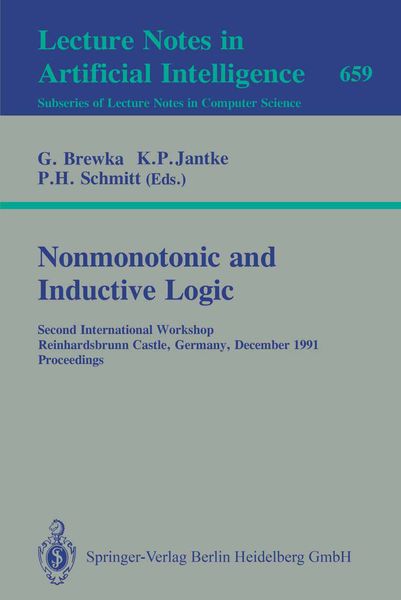
Nonmonotonic and Inductive Logic Second International Workshop, Reinhardsbrunn Castle, Germany, December 2-6, 1991. Proceedings

49,99 €

inkl. gesetzl. MwSt., Versandkostenfrei


Beschreibung

Produktdetails

Einband

Taschenbuch

Erscheinungsdatum

26.02.1993

Abbildungen

X, 338 p.

Herausgeber

Gerhard Brewka + weitere

Verlag

Springer Berlin

Seitenzahl

338

Maße (L/B/H)

23,5/15,5/1,9 cm

Gewicht

528 g

Auflage

1993

Sprache

Englisch

ISBN

978-3-540-56433-1

Beschreibung

Produktdetails

Einband

Taschenbuch

Erscheinungsdatum

26.02.1993

Abbildungen

X, 338 p.

Herausgeber

Verlag

Springer Berlin

Seitenzahl

338

Maße (L/B/H)

23,5/15,5/1,9 cm

Gewicht

528 g

Auflage

1993

Sprache

Englisch

ISBN

978-3-540-56433-1

Herstelleradresse

Springer-Verlag GmbH
Tiergartenstr. 17
69121 Heidelberg
DE

Email: ProductSafety@springernature.com

Ein neues Kapitel für Ihre Bücher

Ein neues Kapitel für Ihre Bücher

Schenken Sie Ihren alten Schätzen ein zweites Leben und erhalten dafür eine Thalia Geschenkkarte.

Jetzt verkaufen
Jetzt verkaufen

Noch keine Bewertungen vorhanden

Verfassen Sie die erste Bewertung zu diesem Artikel

Helfen Sie anderen Kundinnen und Kunden durch Ihre Meinung.

Kundinnen und Kunden meinen

Bewertungen (0)

  • Produktbild: Nonmonotonic and Inductive Logic
  • Produktbild: Nonmonotonic and Inductive Logic
  • A tutorial on Nonmonotonic Reasoning.- On the sample complexity of various learning strategies in the probabilistic PAC learning paradigms.- More about learning elementary formal systems.- A polynomial time algorithm for finding finite unions of tree pattern languages.- Towards efficient inductive synthesis: Rapid construction of local regularities.- Deductive generalization in a default logic setting.- Deduction with supernormal defaults.- Multi-agent learning: Theoretical and empirical studies.- Predicate synthesis from formal specifications: Using mathematical induction for finding the preconditions of theorems.- Dual types of hypotheses in inductive inference.- All I know about Tweety.- Monotonic versus non-monotonic language learning.- Normal form results for default logic.- Retrieval in case-based reasoning using preferred subtheories.- Interactive synthesis of process flowcharts.- Probabilistic inference of approximations.