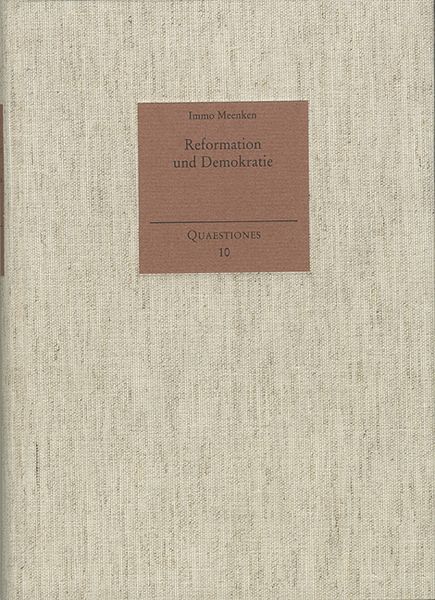
Reformation und Demokratie Zum politischen Gehalt protestantischer Theologie in England 1570-1660
-
- Deutsch ausgewählt
48,00 €
inkl. gesetzl. MwSt.,
Beschreibung
Produktdetails
Einband
Gebundene Ausgabe
Erscheinungsdatum
01.01.1996
Herausgeber
Eckhart HolzboogVerlag
Frommann-holzboogSeitenzahl
380
Maße (B/H)
17,8/24,5 cm
Gewicht
884 g
Auflage
1
Sprache
Deutsch
ISBN
978-3-7728-1599-7
This study aims at descibing the democratic impact of the English Reformation in a comprehensive and systematic manner. Its main topics are constituted by Anglicanism, Puritanism and the radical Reformation. Its analysing-levels are the institutions and the proceedings, the ideas and finally the values set up and practised by the various protestant confessions.
To sum up, Puritanism and religious radicalism can be called democratic especially concerning their institutional system and procedure, that is to say, concerning church government. Theology and parish life of their churches have doubtless contributed a lot to forming a common consciousness and an empirical horizon proper to democratic progress. Nevertheless, Puritans and religious radicals were less democrats than revolutionaries always prepared to usurp theological reasoning. Basic concepts and values of their religious theories must be qualified as authoritarian, elitarian and intolerant.
On the other hand, Anglicanism, as an episcopal system, was certainly not democratic. Yet some theologians of the established church managed to overcome such mental obstacles as named before. They could do so, because they shared a more positive view of man than their Puritan and radical colleagues who used to be obsessed by an overarching belief in hereditary sin and human frailty. Of course, faith still kept the central place in Anglican theology, too, but to some extent it made way for reason as a human quality. By consequence, the tension of searching the truth somewhat slackened. To be a christ in seventeenth-century Anglicanism had a practical meaning and signified more than to belief in a certain dogma. Anglican faith implied ideas of human dignity and human performance which, in turn, entailed a due respect to one’s fellow-man as a personal being in the above sense. Thus, contemporary Anglican thinking was featured by some fundamental individual and social values of modern democracy.
Ein neues Kapitel für Ihre Bücher
Ein neues Kapitel für Ihre Bücher
Schenken Sie Ihren alten Schätzen ein zweites Leben und erhalten Sie dafür eine Thalia Geschenkkarte.
Noch keine Bewertungen vorhanden
Verfassen Sie die erste Bewertung zu diesem Artikel
Helfen Sie anderen Kundinnen und Kunden durch Ihre Meinung.
Kurze Frage zu unserer Seite
Vielen Dank für Ihr Feedback
Wir nutzen Ihr Feedback, um unsere Produktseiten zu verbessern. Bitte haben Sie Verständnis, dass wir Ihnen keine Rückmeldung geben können. Falls Sie Kontakt mit uns aufnehmen möchten, können Sie sich aber gerne an unseren Kund*innenservice wenden.
zum Kundenservice