KI-Beratung Beta

  • Produktbild: Machine Learning: ECML-95
  • Produktbild: Machine Learning: ECML-95
Band 912

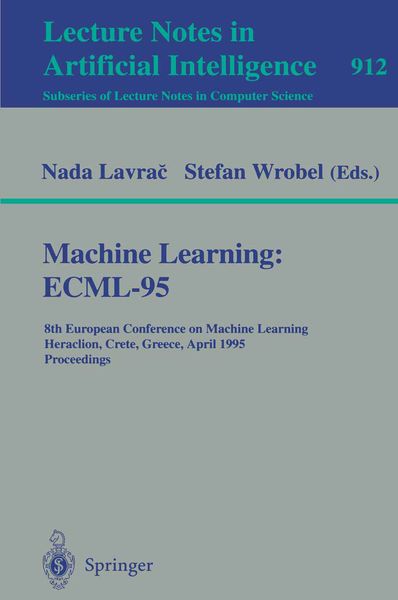
Machine Learning: ECML-95 8th European Conference on Machine Learning, Heraclion, Crete, Greece, April 25 - 27, 1995. Proceedings

49,99 €

inkl. gesetzl. MwSt., Versandkostenfrei


Beschreibung

Produktdetails

Einband

Taschenbuch

Erscheinungsdatum

05.04.1995

Abbildungen

XII, 376 p.

Herausgeber

Nada Lavrač + weitere

Verlag

Springer Berlin

Seitenzahl

376

Maße (L/B/H)

23,5/15,5/2,1 cm

Gewicht

587 g

Auflage

1995

Sprache

Englisch

ISBN

978-3-540-59286-0

Beschreibung

Produktdetails

Einband

Taschenbuch

Erscheinungsdatum

05.04.1995

Abbildungen

XII, 376 p.

Herausgeber

Verlag

Springer Berlin

Seitenzahl

376

Maße (L/B/H)

23,5/15,5/2,1 cm

Gewicht

587 g

Auflage

1995

Sprache

Englisch

ISBN

978-3-540-59286-0

Herstelleradresse

Springer-Verlag KG
Sachsenplatz 4-6
1201 Wien
AT

Email: ProductSafety@springernature.com

Ein neues Kapitel für Ihre Bücher

Ein neues Kapitel für Ihre Bücher

Schenken Sie Ihren alten Schätzen ein zweites Leben und erhalten Sie dafür eine Thalia Geschenkkarte.

Jetzt verkaufen
Jetzt verkaufen

Noch keine Bewertungen vorhanden

Verfassen Sie die erste Bewertung zu diesem Artikel

Helfen Sie anderen Kundinnen und Kunden durch Ihre Meinung.

Kundinnen und Kunden meinen

Bewertungen (0)

  • Produktbild: Machine Learning: ECML-95
  • Produktbild: Machine Learning: ECML-95
  • Reasoning and learning in probabilistic and possibilistic networks: An overview.- Problem decomposition and the learning of skills.- Machine learning in the world wide web.- Abstract computer models: Towards a new method for theorizing about adaptive agents.- Learning abstract planning cases.- The role of prototypicality in exemplar-based learning.- Specialization of recursive predicates.- A distributed genetic algorithm improving the generalization behavior of neural networks.- Learning non-monotonic logic programs: Learning exceptions.- A comparative utility analysis of case-based reasoning and control-rule learning systems.- A minimization approach to propositional inductive learning.- On concept space and hypothesis space in case-based learning algorithms.- The power of decision tables.- Pruning multivariate decision trees by hyperplane merging.- Multiple-Knowledge Representations in concept learning.- The effect of numeric features on the scalability of inductive learning programs.- Analogical logic program synthesis from examples.- A guided tour through hypothesis spaces in ILP.- JIGSAW: Puzzling together RUTH and SPECTRE (Extended abstract).- Discovery of constraints and data dependencies in relational databases (Extended abstract).- Learning disjunctive normal forms in a dual classifier system (Extended abstract).- The effects of noise on efficient incremental induction (Extended abstract).- Analysis of Rachmaninoff's piano performances using inductive logic programming (Extended abstract).- Handling real numbers in ILP: A step towards better behavioural clones (Extended abstract).- Simplifying decision trees by pruning and grafting: New results (Extended abstract).- A tight integration of pruning and learning (Extended abstract).- Decision-tree based neural network (Extended abstract).- Learning recursion with iterative bootstrap induction (Extended abstract).- Patching proofs for reuse (Extended abstract).- Adapting to drift in continuous domains (Extendedabstract).- Parallel recombinative reinforcement learning (Extended abstract).- Learning to solve complex tasks for reactive systems (Extended abstract).- Co-operative Reinforcement Learning by payoff filters (Extended abstract).- Automatic synthesis of control programs by combination of learning and problem solving methods (Extended abstract).- Analytical learning guided by empirical technology: An approach to integration (Extended abstract).- A new MDL measure for robust rule induction (Extended abstract).- Class-driven statistical discretization of continuous attributes (Extended abstract).- Generating neural networks through the induction of threshold logic unit trees (Extended abstract).- Learning classification rules using lattices (Extended abstract).- Hybrid classification: Using axis-parallel and oblique subdivisions of the attribute space (Extended abstract).- An induction-based control for genetic algorithms (Extended abstract).- Fender: An approach to theory restructuring(extended abstract).- Language series revisited: The complexity of hypothesis spaces in ILP (Extended abstract).- Prototype, nearest neighbor and hybrid algorithms for time series classification (Extended abstract).