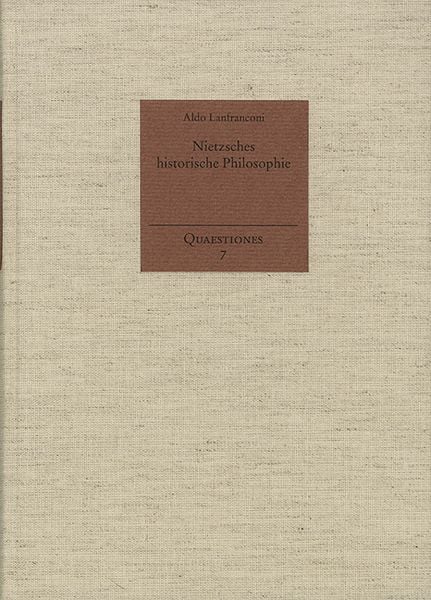
Nietzsches historische Philosophie
-
- Deutsch ausgewählt
46,00 €
inkl. gesetzl. MwSt.,
Beschreibung
Produktdetails
Einband
Gebundene Ausgabe
Erscheinungsdatum
01.01.2001
Herausgeber
Eckhart HolzboogVerlag
Frommann-holzboogSeitenzahl
186
Maße (L/B/H)
1,7/17,5/25 cm
Gewicht
505 g
Auflage
1. Auflage
Sprache
Deutsch
ISBN
978-3-7728-1690-1
The present study does not postulate any new interpretation of Nietzsche´s philosophical deliberations but analyses their various self-statements, the emphasis, however, being on one in particular: At the beginning of Human All-too-Human, Nietzsche rejects »metaphysical« philosophising in favor of a »historical« one. He returns to this repeatedly and affirms it. There is no doubt that this self-statement provides an important key to an understanding of Nietzsche´s philosophy. And in fact any interpretation of the concept of historical philosophy, if pursued sufficiently carefully and sufficiently deeply, will come up with a number of characteristics which are common to those figures called Nietzsche.
With Nietzsche, historical philosophy means neither the history of philosophy nor the philosophy of history, unless it be history in the broadest and most comprehensive sense of the term. Nietzsche´s historical philosophy expressly draws on the becoming as its sphere of thought. The focal point is actually the becoming of the inner world, the internalisation and processing of experiences into new instruments for the interpretation of experience. The central idea behind historical philosophy is a historical investigation of the conditions for a human understanding of both the self and the world. These conditions are not interpreted as the forms of a pure, universal and constant structure of human reason but above all as the marks and monuments of those who emerged victorious from earlier conflicts over the issue of interpretation. Nietzsche´s texts are accounts of travels into this inner world – more or less common to us all – of historically shaped models of interpretation. It is no accident that lurking behind the »metaphysical need« they also discover quite different needs; and in the ruins of metaphysical philosophy they discover the sometimes gruesome instruments of torture and sheer endless experimental fields which once enabled man to introduce ultimate truth, meaning and conceptual clarity into his world (and to immortalise this in an imaginary gallery of philosophical figures).
Ein neues Kapitel für Ihre Bücher
Ein neues Kapitel für Ihre Bücher
Schenken Sie Ihren alten Schätzen ein zweites Leben und erhalten dafür eine Thalia Geschenkkarte.
Noch keine Bewertungen vorhanden
Verfassen Sie die erste Bewertung zu diesem Artikel
Helfen Sie anderen Kundinnen und Kunden durch Ihre Meinung.
Kurze Frage zu unserer Seite
Vielen Dank für Ihr Feedback
Wir nutzen Ihr Feedback, um unsere Produktseiten zu verbessern. Bitte haben Sie Verständnis, dass wir Ihnen keine Rückmeldung geben können. Falls Sie Kontakt mit uns aufnehmen möchten, können Sie sich aber gerne an unseren Kund*innenservice wenden.
zum Kundenservice