KI-Beratung Beta

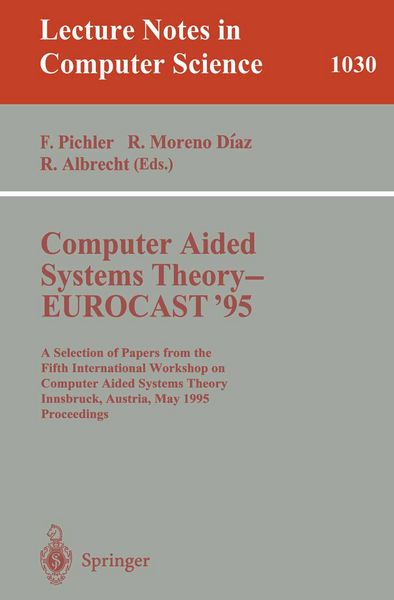
  • Produktbild: Computer Aided Systems Theory - EUROCAST '95
  • Produktbild: Computer Aided Systems Theory - EUROCAST '95
Band 1030

Computer Aided Systems Theory - EUROCAST '95 A Selection of Papers from the Fifth International Workshop on Computer Aided Systems Theory, Innsbruck, Austria, May 22 - 25, 1995. Proceedings

49,99 €

inkl. gesetzl. MwSt., Versandkostenfrei


Beschreibung

Produktdetails

Einband

Taschenbuch

Erscheinungsdatum

24.01.1996

Abbildungen

XIII, 547 p.

Herausgeber

Franz Pichler + weitere

Verlag

Springer Berlin

Seitenzahl

547

Maße (L/B/H)

23,5/15,5/3 cm

Gewicht

838 g

Auflage

1996

Sprache

Englisch

ISBN

978-3-540-60748-9

Beschreibung

Produktdetails

Einband

Taschenbuch

Erscheinungsdatum

24.01.1996

Abbildungen

XIII, 547 p.

Herausgeber

Verlag

Springer Berlin

Seitenzahl

547

Maße (L/B/H)

23,5/15,5/3 cm

Gewicht

838 g

Auflage

1996

Sprache

Englisch

ISBN

978-3-540-60748-9

Herstelleradresse

Springer-Verlag KG
Sachsenplatz 4-6
1201 Wien
AT

Email: ProductSafety@springernature.com

Ein neues Kapitel für Ihre Bücher

Ein neues Kapitel für Ihre Bücher

Schenken Sie Ihren alten Schätzen ein zweites Leben und erhalten Sie dafür eine Thalia Geschenkkarte.

Jetzt verkaufen
Jetzt verkaufen

Noch keine Bewertungen vorhanden

Verfassen Sie die erste Bewertung zu diesem Artikel

Helfen Sie anderen Kundinnen und Kunden durch Ihre Meinung.

Kundinnen und Kunden meinen

Bewertungen (0)

  • Produktbild: Computer Aided Systems Theory - EUROCAST '95
  • Produktbild: Computer Aided Systems Theory - EUROCAST '95
  • On the structure of discrete systems.- Identification and recognition through shape in complex systems.- A logical approach to system construction.- Task management system.- Toward a unified theory of discrete event systems.- Intersensorial transformations: General systems description and implications.- Proving system properties by means of trigger-graph and Petri nets.- Refinement mapping for general (discrete event) systems theory.- A system-theoretic approach to planning and programming.- Equality of functions in CAST.- Basins of attraction estimation through symbolic graphical computing techniques.- Temporal and functional verification of a symbolic representation of complex systems.- Modelling differential equations by basic information technology means.- System theoretic aspects of software architectures.- A language for describing complex-evolutive software systems.- An architecture for process modelling and execution support.- A formal semantics for a graphical model representation in system design.- A user-interface for a microsystems high-level simulator.- CAST extensions to DASME to support Generalized Information Theory.- Symbolic computing aided design of nonlinear PID controllers.- Discrete Event simulation in an environment for Temporal Expert Systems.- TOMSPIN — a tool for modelling with stochastic petri nets.- Hybrid evolutionary programming: The tools for CAST.- Automatic induction of DEVS structures.- Systems Engineering and infrastructures for open computer based systems.- Object-oriented high level modeling of complex systems.- Multifacetted, object oriented modeling in the transportation domain.- EaSy-Sim: A tool environment for the design of complex, real-time systems.- Systems level specification and modelling of reactive systems: Concepts,methods, and tools.- DEVS-based endomorphic agents: Control through deliberative and reactive planning.- Software processes, work flow and work cell design — Separated by a common paradigm?.- High-performance parallel computing for analyzing urban air pollution.- Performance analysis of a dual robot system using a geometric concurrency model.- Computer aided rule extraction from examples.- Cast methods for generation of non-orthogonal complete transforms.- Cast system approach for visual inspection.- Finite dimensional generalized baker dynamical systems for cryptographic applications.- of the Aristotle's final causation in CAST concept and method of incursion and hyperincursion.- A semantic logic for CAST related to Zuse, Deutsch and McCulloch and Pitts computing principles.- Validation of a model of an AGVs scheduling heuristic using radio-taxi data.- Training simulator for Garoña Nuclear Power Plant.- Supervisory control and data acquisition system for the gas flow networks.