• Produktbild: Logics in Artificial Intelligence
  • Produktbild: Logics in Artificial Intelligence
Band 838

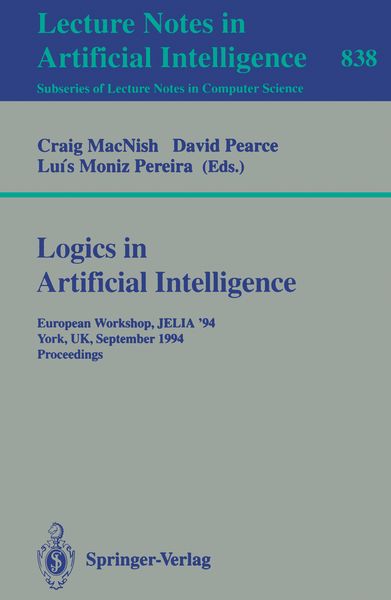
Logics in Artificial Intelligence European Workshop JELIA '94, York, UK, September 5-8, 1994. Proceedings

49,99 €

inkl. gesetzl. MwSt., Versandkostenfrei


Beschreibung

Produktdetails

Einband

Taschenbuch

Erscheinungsdatum

10.08.1994

Abbildungen

IX, 416 p.

Herausgeber

Craig MacNish + weitere

Verlag

Springer Berlin

Seitenzahl

416

Maße (L/B/H)

23,5/15,5/2,4 cm

Gewicht

651 g

Auflage

1994

Sprache

Englisch

ISBN

978-3-540-58332-5

Beschreibung

Produktdetails

Einband

Taschenbuch

Erscheinungsdatum

10.08.1994

Abbildungen

IX, 416 p.

Herausgeber

Verlag

Springer Berlin

Seitenzahl

416

Maße (L/B/H)

23,5/15,5/2,4 cm

Gewicht

651 g

Auflage

1994

Sprache

Englisch

ISBN

978-3-540-58332-5

Herstelleradresse

Springer-Verlag KG
Sachsenplatz 4-6
1201 Wien
AT

Email: ProductSafety@springernature.com

Ein neues Kapitel für Ihre Bücher

Ein neues Kapitel für Ihre Bücher

Schenken Sie Ihren alten Schätzen ein zweites Leben und erhalten dafür eine Thalia Geschenkkarte.

Jetzt verkaufen
Jetzt verkaufen

Noch keine Bewertungen vorhanden

Verfassen Sie die erste Bewertung zu diesem Artikel

Helfen Sie anderen Kundinnen und Kunden durch Ihre Meinung.

Kundinnen und Kunden meinen

Bewertungen (0)

  • Produktbild: Logics in Artificial Intelligence
  • Produktbild: Logics in Artificial Intelligence
  • From Carnap's modal logic to autoepistemic logic.- Compactness properties of nonmonotonic inference operations.- Around a powerful property of circumscriptions.- The computational value of joint consistency.- Belief dynamics, abduction, and databases.- On the logic of theory base change.- Belief, provability, and logic programs.- Revision specifications by means of programs.- Revision of non-monotonic theories.- A complete connection calculus with rigid E-unification.- Equality and constrained resolution.- Efficient strategies for Automated reasoning in modal logics.- TAS-D++: Syntactic trees transformations for Automated Theorem Proving.- A unification of ordering refinements of resolution in classical logic.- Two logical dimensions.- Prioritized autoepistemic logic.- Adding priorities and specificity to default logic.- Viewing hypothesis theories as constrained graded theories.- Temporal theories of reasoning.- Reasoning about knowledge on computation trees.- Prepositional state event logic.- Description Logics with inverse roles, functional restrictions, and n-ary relations.- On the concept of generic object: A nonmonotonic reasoning approach and examples.- Autoepistemic logic of minimal beliefs.- How to use modalities and sorts in Prolog.- Towards resource handling in logic programming: The PPL framework and its semantics.- Extending Horn clause theories by reflection principles.