KI-Beratung Beta

  • Produktbild: Advanced Information Systems Engineering
  • Produktbild: Advanced Information Systems Engineering
Band 1626

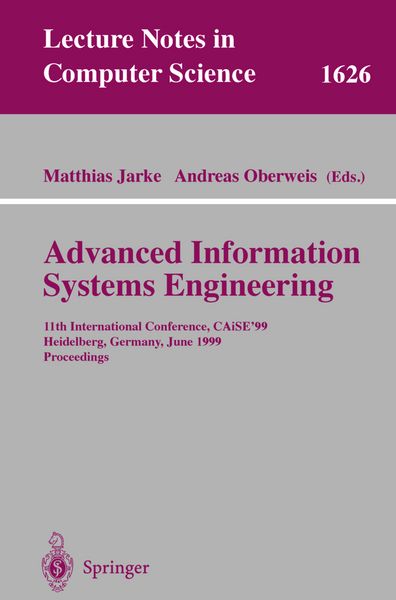
Advanced Information Systems Engineering 11th International Conference, CAiSE'99, Heidelberg, Germany, June 14-18, 1999, Proceedings

49,99 €

inkl. gesetzl. MwSt., Versandkostenfrei


Beschreibung

Produktdetails

Einband

Taschenbuch

Erscheinungsdatum

09.06.1999

Abbildungen

XIV, 486 p.

Herausgeber

Matthias Jarke + weitere

Verlag

Springer Berlin

Seitenzahl

486

Maße (L/B/H)

23,5/15,5/2,7 cm

Gewicht

750 g

Auflage

1999

Sprache

Englisch

ISBN

978-3-540-66157-3

Beschreibung

Produktdetails

Einband

Taschenbuch

Erscheinungsdatum

09.06.1999

Abbildungen

XIV, 486 p.

Herausgeber

Verlag

Springer Berlin

Seitenzahl

486

Maße (L/B/H)

23,5/15,5/2,7 cm

Gewicht

750 g

Auflage

1999

Sprache

Englisch

ISBN

978-3-540-66157-3

Herstelleradresse

Springer-Verlag KG
Sachsenplatz 4-6
1201 Wien
AT

Email: ProductSafety@springernature.com

Ein neues Kapitel für Ihre Bücher

Ein neues Kapitel für Ihre Bücher

Schenken Sie Ihren alten Schätzen ein zweites Leben und erhalten Sie dafür eine Thalia Geschenkkarte.

Jetzt verkaufen
Jetzt verkaufen

Noch keine Bewertungen vorhanden

Verfassen Sie die erste Bewertung zu diesem Artikel

Helfen Sie anderen Kundinnen und Kunden durch Ihre Meinung.

Kundinnen und Kunden meinen

Bewertungen (0)

  • Produktbild: Advanced Information Systems Engineering
  • Produktbild: Advanced Information Systems Engineering
  • Invited Talks.- The Unified Process for Component-Based Development.- From Business Process Model to Application System — Developing an Information System with the House of Business Engineering (HOBE).- Regular Papers.- CPAM, A Protocol for Software Composition.- A Process-Oriented Approach to Software Component Definition.- Configuring Business Objects from Legacy Systems.- Risk Management for IT in the Large.- Linking Business Modelling to Socio-technical System Design.- Towards Flexible and High-Level Modeling and Enacting of Processes.- Method Enhancement with Scenario Based Techniques.- Support for the Process Engineer: The Spearmint Approach to Software Process Definition and Process Guidance.- Managing Componentware Development – Software Reuse and the V-Modell Process.- Modelling Multidimensional Data in a Dataflow-Based Visual Data Analysis Environment.- Towards Quality-Oriented Data Warehouse Usage and Evolution.- Designing the Global Data Warehouse with SPJ Views.- ApplyingGraph Reduction Techniques for Identifying Structural Conflicts in Process Models.- A Multi-variant Approach to Software Process Modelling.- An Ontological Analysis of Integrated Process Modelling.- Design of Object Caching in a CORBA OTM System.- Constructing IDL Views on Relational Databases.- The Design of Cooperative Transaction Model by Using Client-Server Architecture.- A Multilevel Secure Workflow Management System.- Time Constraints in Workflow Systems.- TOGA—A Customizable Service for Data-Centric Collaboration.- A Practical Approach to Access Heterogeneous and Distributed Databases.- A Uniform Approach to Inter-model Transformations.- OTHY: Object To HYpermedia.- Modeling Dynamic Domains with ConGolog.- Towards an Object Petri Nets Model for Specifying and Validating Distributed Information Systems.- Relationship Reification: A Temporal View.- Towards a Classification Framework for Application Granularity in Workflow Management Systems.- Adaptive Outsourcing in Cross-Organizational Workflows.- Policy-Based Resource Management.- Modelling Method Heuristics for Better Quality Products.- Queries and Constraints on Semi-structured Data.- A Prototype for Metadata-Based Integration of Internet Sources.- Workflow Management Through Distributed and Persistent CORBA Workflow Objects.- Component Criteria for Information System Families.- TUML: A Method for Modelling Temporal Information Systems.- Beyond Goal Representation: Checking Goal-Satisfaction by Temporal Reasoning with Business Processes.- Design the Flexibility, Maintain the Stability of Conceptual Schemas.- Metrics for Active Database Maintainability.