KI-Beratung Beta

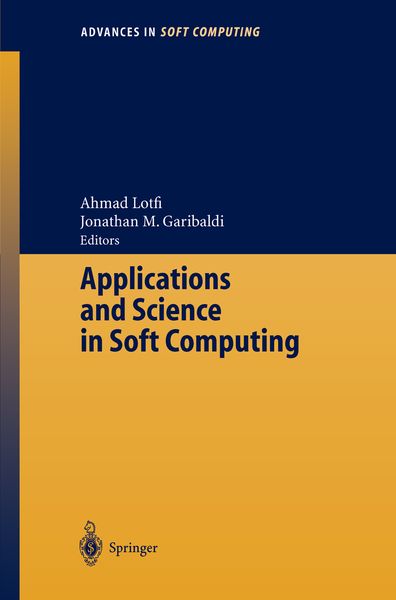
  • Produktbild: Applications and Science in Soft Computing
  • Produktbild: Applications and Science in Soft Computing
Band 24

Applications and Science in Soft Computing

213,99 €

inkl. gesetzl. MwSt., Versandkostenfrei


Beschreibung

Produktdetails

Einband

Taschenbuch

Erscheinungsdatum

18.11.2003

Abbildungen

X, 346 p. 105 illus.

Herausgeber

Ahmad Lotfi + weitere

Verlag

Springer Berlin

Seitenzahl

346

Maße (L/B/H)

23,5/15,5/2 cm

Gewicht

546 g

Auflage

2004

Sprache

Englisch

ISBN

978-3-540-40856-7

Beschreibung

Produktdetails

Einband

Taschenbuch

Erscheinungsdatum

18.11.2003

Abbildungen

X, 346 p. 105 illus.

Herausgeber

Verlag

Springer Berlin

Seitenzahl

346

Maße (L/B/H)

23,5/15,5/2 cm

Gewicht

546 g

Auflage

2004

Sprache

Englisch

ISBN

978-3-540-40856-7

Herstelleradresse

Springer-Verlag KG
Sachsenplatz 4-6
1201 Wien
AT

Email: ProductSafety@springernature.com

Ein neues Kapitel für Ihre Bücher

Ein neues Kapitel für Ihre Bücher

Schenken Sie Ihren alten Schätzen ein zweites Leben und erhalten Sie dafür eine Thalia Geschenkkarte.

Jetzt verkaufen
Jetzt verkaufen

Noch keine Bewertungen vorhanden

Verfassen Sie die erste Bewertung zu diesem Artikel

Helfen Sie anderen Kundinnen und Kunden durch Ihre Meinung.

Kundinnen und Kunden meinen

Bewertungen (0)

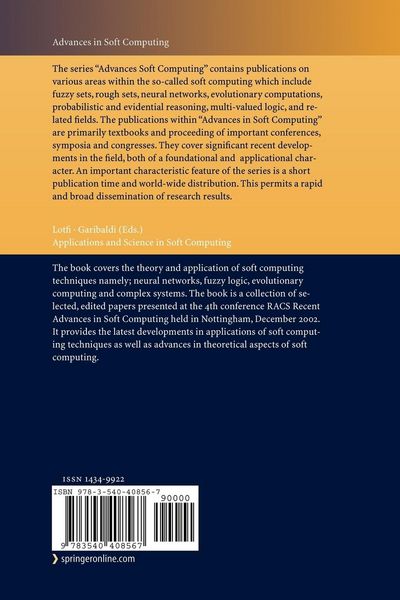
  • Produktbild: Applications and Science in Soft Computing
  • Produktbild: Applications and Science in Soft Computing
  • I — Artificial Neural Networks.- A Recurrent Self-Organizing Map for Temporal Sequence Processing.- Optimisation of Neural Network Topology and Input Parameters for Prosody Modelling of Synthetic Speech.- Using ART1 Neural Networks to Determine Clustering Tendency.- High Performance Associative Memories and Structured Weight Dilution.- Neural Network Analysis of Estimation of Data.- A Compiler and Simulator for Partial Recursive Functions over Neural Networks.- Multistage Neural Networks: Adaptive Combination of Ensemble Results.- On the Fuzzy Spatio-temporal Specification of Multimedia Synchronisation Scenarios.- II — Evolutionary Computing.- An Approach to On-line Design of Fuzzy Controllers with Evolving Structure.- Can a Parallel Agent Approach to Genetic Algorithms Reduce Search Times.- Comparison of Domination Approaches for Diploid Binary Genetic Algorithms.- New Heuristics for Flowshop Scheduling.- Temporal Rule Discovery using Genetic Programming and Specialized Hardware.- Genetic Programming with Guaranteed Constraints.- III — Fuzzy Systems.- Precisiated Natural Language and Protoforms for Human Consistent Data Mining.- Design and Synthesis of Piecewise-Linear Fuzzy Systems.- A New Ranking Method For Fuzzy FMEA.- Representing Reliability and Hesitation in Possibility Theory: A General Framework.- Noise Clustering with a Fixed Fraction of Noise.- Selective Sampling for Combined Learning from Labelled and Unlabelled Data.- IV — Hybrid and Intelligent Systems.- New Results for a Hybrid Decision Tree/Genetic Algorithm for Data Mining.- Embedding Support Vector Machines into Localised Mixtures of Experts.- Gaussian Function Approximation in Neuro-Fuzzy Systems.- Automated Configuration of Multi-Spindle Drilling Gear Machines by Sub-Domain KnowledgeProcessing and Adaptive Algorithms.- Construction of Shape-preserving First-order Takagi-Sugeno Systems via Linear-rational Spline Fuzzy Partitions.- Identification of Dynamic Cause-Effect Relations for Systems Performance Evaluation.- A Multi-layered Immune Inspired Machine Learning Algorithm.- Using Plausible Reasoning for Developing Intelligent Systems.- Towards Model-Independent Mode Detection and Characterisation of Very Long Biomedical Time Series.- Analysis of Rules Discovered by the Data Mining Process.- A Study of Query Generation Strategies for Interactive Constraint Acquisition.- A Multi-agent System as Framework for Learning Algorithms Benchmarking.- Soft Learning: A Conceptual Bridge between Data Mining and Machine Learning.- Heuristics for Kernels Adaptation in Support Vector Machines.- A Study of the Effectiveness of Detailed Balance in Avoiding Premature Convergence in PBIL.- V — Soft Computing Applications.- Application of Computational Intelligence Methods for Intelligent Modelling of Buildings.- An Adaptive Multi Embedded-Agent Architecture for Intelligent Inhabited Environments.- Constraint Neuro-Model based Predictive Control.- An Efficient Hybrid Method of Regression Tree and Fuzzy Inference for Short-term Load Forecasting in Electric Power Systems.- An Iterative Learning Control Method for a Level Control Problem.- Face Verification Using SVM: Influence of Illumination.- A Neuro-Fuzzy Technique for Scene Cut Detection from MPEG-1 Video.- Fuzzy Audio-Visual Feature Maps for Speaker Identification.- Adaptive User Agents for Intelligent Biometric Applications.- Gait Recognition by Moment Based Descriptors.- On a Large Sequence-Based Human Gait Database.