KI-Beratung Beta

  • Produktbild: Logic Programming and Nonmonotonic Reasoning
  • Produktbild: Logic Programming and Nonmonotonic Reasoning
Band 3662

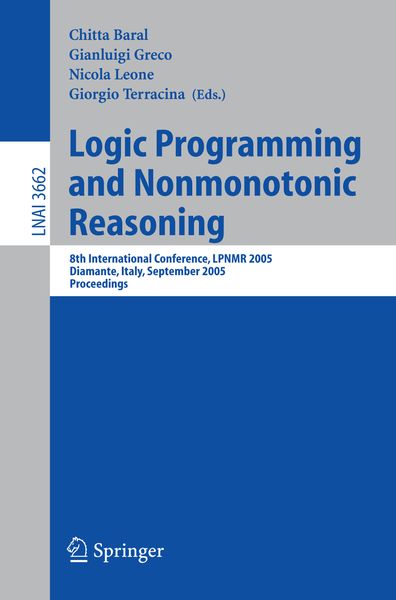
Logic Programming and Nonmonotonic Reasoning 8th International Conference, LPNMR 2005, Diamante, Italy, September 5-8, 2005, Proceedings

49,99 €

inkl. gesetzl. MwSt., Versandkostenfrei


Beschreibung

Produktdetails

Einband

Taschenbuch

Erscheinungsdatum

25.08.2005

Abbildungen

XIV, 462 p.

Herausgeber

Chitta Baral + weitere

Verlag

Springer Berlin

Seitenzahl

462

Maße (L/B/H)

23,5/15,5/2,6 cm

Gewicht

715 g

Auflage

2005

Sprache

Englisch

ISBN

978-3-540-28538-0

Beschreibung

Produktdetails

Einband

Taschenbuch

Erscheinungsdatum

25.08.2005

Abbildungen

XIV, 462 p.

Herausgeber

Verlag

Springer Berlin

Seitenzahl

462

Maße (L/B/H)

23,5/15,5/2,6 cm

Gewicht

715 g

Auflage

2005

Sprache

Englisch

ISBN

978-3-540-28538-0

Herstelleradresse

Springer-Verlag KG
Sachsenplatz 4-6
1201 Wien
AT

Email: ProductSafety@springernature.com

Ein neues Kapitel für Ihre Bücher

Ein neues Kapitel für Ihre Bücher

Schenken Sie Ihren alten Schätzen ein zweites Leben und erhalten Sie dafür eine Thalia Geschenkkarte.

Jetzt verkaufen
Jetzt verkaufen

Noch keine Bewertungen vorhanden

Verfassen Sie die erste Bewertung zu diesem Artikel

Helfen Sie anderen Kundinnen und Kunden durch Ihre Meinung.

Kundinnen und Kunden meinen

Bewertungen (0)

  • Produktbild: Logic Programming and Nonmonotonic Reasoning
  • Produktbild: Logic Programming and Nonmonotonic Reasoning
  • Invited Papers.- Nonmonotonic Reasoning in FLORA-2.- Data Integration and Answer Set Programming.- Halo I: A Controlled Experiment for Large Scale Knowledge Base Development.- ASP Foundations.- Unfounded Sets for Disjunctive Logic Programs with Arbitrary Aggregates.- Loops: Relevant or Redundant?.- Approximating Answer Sets of Unitary Lifschitz-Woo Programs.- On Modular Translations and Strong Equivalence.- ASP Extensions.- Guarded Open Answer Set Programming.- External Sources of Computation for Answer Set Solvers.- Answer Sets for Propositional Theories.- Applications.- An ID-Logic Formalization of the Composition of Autonomous Databases.- On the Local Closed-World Assumption of Data-Sources.- Computing Dialectical Trees Efficiently in Possibilistic Defeasible Logic Programming.- Actions and Causations.- An Approximation of Action Theories of and Its Application to Conformant Planning.- Game-Theoretic Reasoning About Actions in Nonmonotonic Causal Theories.- Some Logical Properties of Nonmonotonic Causal Theories.- odular-?: An Elaboration Tolerant Approach to the Ramification and Qualification Problems.- Algorithms and Computation.- Platypus: A Platform for Distributed Answer Set Solving.- Solving Hard ASP Programs Efficiently.- Mode-Directed Fixed Point Computation.- Lookahead in Smodels Compared to Local Consistencies in CSP.- Foundations.- Nested Epistemic Logic Programs.- An Algebraic Account of Modularity in ID-Logic.- Default Reasoning with Preference Within Only Knowing Logic.- Semantics.- A Social Semantics for Multi-agent Systems.- Revisiting the Semantics of Interval Probabilistic Logic Programs.- Routley Semantics for Answer Sets.- The Well Supported Semantics for Multidimensional Dynamic Logic Programs.- Application Track.- Application ofSmodels in Quartet Based Phylogeny Construction.- Using Answer Set Programming for a Decision Support System.- Data Integration: a Challenging ASP Application.- Abduction and Preferences in Linguistics.- Inference of Gene Relations from Microarray Data by Abduction.- System Track.- nomore: A System for Computing Preferred Answer Sets.- Integrating an Answer Set Solver into Prolog: - .- circ2dlp — Translating Circumscription into Disjunctive Logic Programming.- Pbmodels — Software to Compute Stable Models by Pseudoboolean Solvers.- KMonitor– A Tool for Monitoring Plan Execution in Action Theories.- The nomore++ System.- Smodels A — A System for Computing Answer Sets of Logic Programs with Aggregates.- A DLP System with Object-Oriented Features.- Testing Strong Equivalence of Datalog Programs – Implementation and Examples.- SELP – A System for Studying Strong Equivalence Between Logic Programs.- cmodels – SAT-Based Disjunctive Answer Set Solver.