KI-Beratung Beta

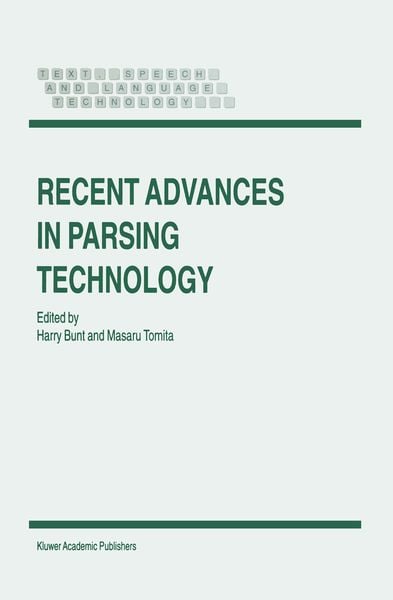
  • Produktbild: Recent Advances in Parsing Technology
  • Produktbild: Recent Advances in Parsing Technology
Band 1 - 12%

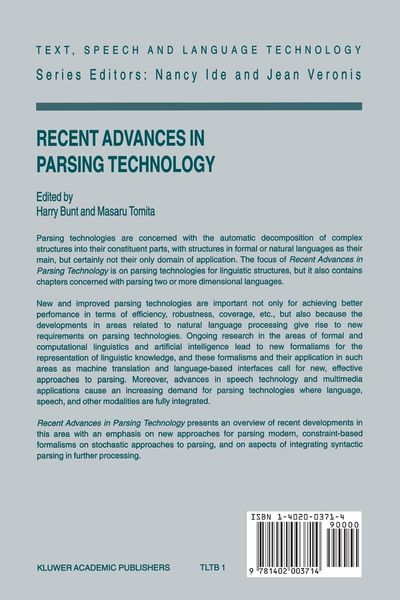
Recent Advances in Parsing Technology

12% sparen

93,99 € UVP 106,99 €

inkl. gesetzl. MwSt., Versandkostenfrei


Beschreibung

Produktdetails

Einband

Taschenbuch

Erscheinungsdatum

30.11.2001

Abbildungen

432 p.

Herausgeber

H. Bunt + weitere

Verlag

Springer Netherland

Seitenzahl

432

Maße (L/B/H)

23,5/15,5/2,4 cm

Gewicht

651 g

Auflage

Softcover reprint of the original 1st ed. 1996

Sprache

Englisch

ISBN

978-1-4020-0371-4

Beschreibung

Produktdetails

Einband

Taschenbuch

Erscheinungsdatum

30.11.2001

Abbildungen

432 p.

Herausgeber

Verlag

Springer Netherland

Seitenzahl

432

Maße (L/B/H)

23,5/15,5/2,4 cm

Gewicht

651 g

Auflage

Softcover reprint of the original 1st ed. 1996

Sprache

Englisch

ISBN

978-1-4020-0371-4

Herstelleradresse

Springer-Verlag KG
Sachsenplatz 4-6
1201 Wien
AT

Email: ProductSafety@springernature.com

Ein neues Kapitel für Ihre Bücher

Ein neues Kapitel für Ihre Bücher

Schenken Sie Ihren alten Schätzen ein zweites Leben und erhalten Sie dafür eine Thalia Geschenkkarte.

Jetzt verkaufen
Jetzt verkaufen

Noch keine Bewertungen vorhanden

Verfassen Sie die erste Bewertung zu diesem Artikel

Helfen Sie anderen Kundinnen und Kunden durch Ihre Meinung.

Kundinnen und Kunden meinen

Bewertungen (0)

  • Produktbild: Recent Advances in Parsing Technology
  • Produktbild: Recent Advances in Parsing Technology
  • 1 Parsing Technologies, and Why We Need Them.- 1.1 Parsing Technologies.- 1.2 About this book.- 2 Fully Incremental Parsing.- 2.1 Introduction.- 2.2 The Change-Update Loop.- 2.3 Reparsing.- 2.4 The Affected and Regenerated Sets.- 2.5 The Disturbance Set.- 2.6 Primitive Changes.- 2.7 Formal Properties.- 2.8 Implementation.- 2.9 Conclusions.- 3 Increasing the Applicability of LR Parsing.- 3.1 Introduction.- 3.2 Hidden left recursion and LR parsing.- 3.3 Correctness of ?-LR parsing.- 3.4 Calculation of items.- 3.5 Memory requirements.- 3.6 Conclusions.- 4 Towards a Formal Understanding of the Determinism Hypothesis in D-Theory.- 4.1 Introduction.- 4.2 D-Theory and the Determinism Hypothesis.- 4.3 Formalization.- 4.4 Consequences for the D-Theory Parsers.- 4.5 Conclusion.- 5 Varieties of Heuristics in Sentence Parsing.- 5.1 Kinds of grammar and their characteristics.- 5.2 Varieties of heuristic components in parsing sentences.- 5.3 Staged design for parsing sentences.- 5.4 Conclusion.- 6 Parsing as Dynamic Interpretation of Feature Structures.- 6.1 Introduction: the status of feature structures.- 6.2 Feature structures as formal-language expressions.- 6.3 Feature structures in the GEL language.- 6.4 Parsing as model-theoretic interpretation.- 6.5 Conclusions and future work.- 7 Proof Theory for HPSG Parsing.- 7.1 Introduction.- 7.2 An Overview of HPSG.- 7.3 Binary-branching HPSG.- 7.4 Deduction for HPSG.- 7.5 Implementation.- 7.6 Lexical entries.- 7.7 Performance.- 7.8 Conclusions.- 8 Efficient Parsing of Compiled Typed Attribute-Value Logic Grammars.- 8.1 Compiling Type Definitions.- 8.2 Compiling Basic Operations.- 8.3 Compiling Descriptions.- 8.4 Compiling Grammars and Programs.- 8.5 Extensional Types.- 8.6 Inequations.- 8.7 Type Constraints.- 8.8 Conclusion.- 9Predictive Head-Corner Chart Parsing.- 9.1 Introduction.- 9.2 Chart parsing.- 9.3 Left-corner chart parsing.- 9.4 Head-Corner chart parsing.- 9.5 Complexity analysis and further optimizations.- 9.6 Extension with feature structures.- 9.7 Related approaches.- 9.8 Conclusions.- 10 GLR* — An Efficient Noise-Skipping Parsing Algorithm for Context-Free Grammars.- 10.1 Introduction.- 10.2 The GLR* Parsing Algorithm.- 10.3 The Beam Search Heuristic.- 10.4 Parsing of Spontaneous Speech Using GLR*.- 10.5 Conclusions and Future Research Directions.- 11 Evaluation of the Tagged Text Parser, A Preliminary Report.- 11.1 Overview.- 11.2 Introduction to Tagged Text Parser.- 11.3 The TTP Time-out Mechanism.- 11.4 Parser Evaluation with Parseval.- 11.5 Evaluation of TTP.- 11.6 Conclusions.- 12 Learning to Parse with Transformations.- 12.1 Introduction.- 12.2 Transformation-based, Error-driven Learning.- 12.3 Learning Phrase Structure.- 12.4 Results.- 12.5 Sample Output.- 12.6 Assigning Nonterminal Labels.- 12.7 Conclusions.- 13 Estimation of Verb Subcategorization Frame Frequencies based on Syntactic and Multidimensional Statistical Analysis.- 13.1 Introduction.- 13.2 Method.- 13.3 Experiment on Wall Street Journal Corpus.- 13.4 Statistical Analysis.- 13.5 Conclusion and Future Direction.- 14 Monte Carlo Parsing.- 14.1 Introduction.- 14.2 The Data-Oriented Parsing Framework.- 14.3 DOP as a Stochastic Tree-Substitution Grammar.- 14.4 Parsing and Disambiguation in DOP.- 14.5 Experiments with DOP.- 14.6 Conclusions.- 15 Stochastic Lexicalized Tree-Insertion Grammar.- 15.1 Motivation.- 15.2 LTIG.- 15.3 Stochastic LTIG.- 15.4 Parsing SLTIG.- 15.5 Training an SLTIG.- 15.6 Conclusion.- 16 The Interplay of Syntactic and Semantic Node Labels in Parsing.- 16.1 State of the Art Demands.- 16.2Partial Parsing.- 16.3 Semantic Grammars.- 16.4 Parsing to Objects.- 16.5 Defining Parsing Rules Schematically.- 16.6 A Parsing Example.- 16.7 Form Rules.- 16.8 Concluding Remarks.- 17 Integration of Morphological and Syntactic Analysis based on GLR Parsing.- 17.1 Introduction.- 17.2 Morphological Analysis of Japanese.- 17.3 Generating An LR Table.- 17.4 Algorithm.- 17.5 A worked example.- 17.6 Conclusion.- 18 Structural Disambiguation in Japanese by Case Structure Evaluation based on Examples in a Case Frame Dictionary.- 18.1 Introduction.- 18.2 Selecting a Proper Case Frame.- 18.3 Structural Disambiguation using Case Structure Score.- 18.4 Experiment.- 18.5 Conclusions.- 19 Flowgraph Parsing.- 19.1 Introduction and Motivation.- 19.2 Notation and Definitions.- 19.3 Chart Parsing of Context-free Flowgraphs.- 19.4 Complexity Analysis.- 19.5 Dealing With Attributes.- 19.6 Dealing With Tie-Point Relationships.- 19.7 Chart Parsing of Structure-Sharing Flowgraphs.- 19.8 Conclusions.- 20 Predictive Parsing for Unordered Relational Languages.- 20.1 Introduction.- 20.2 Atomic Relational Grammars.- 20.3 Parsing Preliminaries.- 20.4 Preliminaries to a Parser.- 20.5 Earley-style Recognition for ARGs.- 20.6 Parse trace.- 20.7 Conclusion.