
Introduction to Fuzzy Reliability
-
- Hardcover ausgewählt
- Taschenbuch
- eBook
-
Sprache:Englisch
139,99 €
UVP
160,49 €
inkl. gesetzl. MwSt.,
Beschreibung
Produktdetails
Einband
Gebundene Ausgabe
Erscheinungsdatum
31.07.1996
Abbildungen
XVII, 311 p.
Verlag
Springer UsSeitenzahl
311
Maße (L/B/H)
24,1/16/2,4 cm
Gewicht
612 g
Auflage
1996
Sprache
Englisch
ISBN
978-0-7923-9737-3
Introduction to Fuzzy Reliability
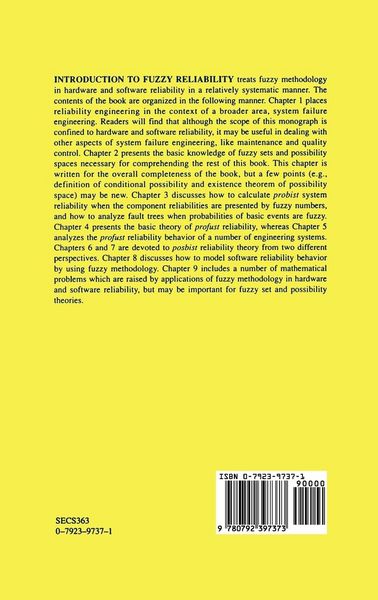
treats fuzzy methodology in hardware reliability and software reliability in a relatively systematic manner. The contents of this book are organized as follows. Chapter 1 places reliability engineering in the scope of a broader area, i.e. system failure engineering. Readers will find that although this book is confined to hardware and software reliability, it may be useful for other aspects of system failure engineering, like maintenance and quality control. Chapter 2 contains the elementary knowledge of fuzzy sets and possibility spaces which are required reading for the rest of this book. This chapter is included for the overall completeness of the book, but a few points (e.g. definition of conditional possibility and existence theorem of possibility space) may be new. Chapter 3 discusses how to calculate
probist
system reliability when the component reliabilities are represented by fuzzy numbers, and how to analyze fault trees when probabilities of basic events are fuzzy. Chapter 4 presents the basic theory of
profust
reliability, whereas Chapter 5 analyzes the
profust
reliability behavior of a number of engineering systems. Chapters 6 and 7 are devoted to
probist
reliability theory from two different perspectives. Chapter 8 discusses how to model software reliability behavior by using fuzzy methodology. Chapter 9 includes a number of mathematical problems which are raised by applications of fuzzy methodology in hardware and software reliability, but may be important for fuzzy set and possibility theories.
Ein neues Kapitel für Ihre Bücher
Ein neues Kapitel für Ihre Bücher
Schenken Sie Ihren alten Schätzen ein zweites Leben und erhalten Sie dafür eine Thalia Geschenkkarte.
Noch keine Bewertungen vorhanden
Verfassen Sie die erste Bewertung zu diesem Artikel
Helfen Sie anderen Kundinnen und Kunden durch Ihre Meinung.
Kurze Frage zu unserer Seite
Vielen Dank für Ihr Feedback
Wir nutzen Ihr Feedback, um unsere Produktseiten zu verbessern. Bitte haben Sie Verständnis, dass wir Ihnen keine Rückmeldung geben können. Falls Sie Kontakt mit uns aufnehmen möchten, können Sie sich aber gerne an unseren Kund*innenservice wenden.
zum Kundenservice