
KI-Beratung Beta

  • Produktbild: From Landscape Research to Landscape Planning
  • Produktbild: From Landscape Research to Landscape Planning
Band 12

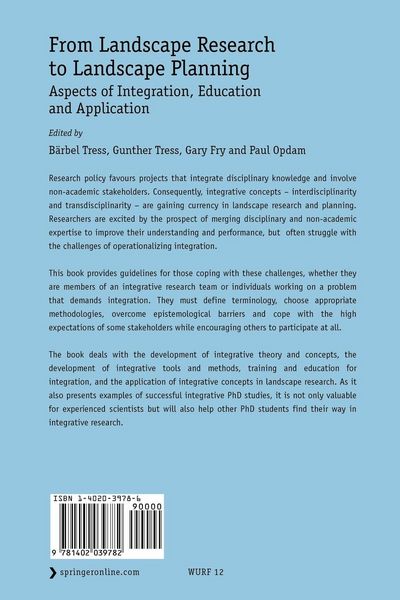
From Landscape Research to Landscape Planning Aspects of Integration, Education and Application

235,99 €

inkl. gesetzl. MwSt., Versandkostenfrei


Beschreibung

Produktdetails

Einband

Taschenbuch

Erscheinungsdatum

25.10.2005

Abbildungen

XIV, 434 p.

Herausgeber

Bärbel Tress + weitere

Verlag

Springer Netherland

Seitenzahl

434

Maße (L/B/H)

23,3/15,5/2,5 cm

Gewicht

674 g

Auflage

2006 edition

Sprache

Englisch

ISBN

978-1-4020-3978-2

Beschreibung

Produktdetails

Einband

Taschenbuch

Erscheinungsdatum

25.10.2005

Abbildungen

XIV, 434 p.

Herausgeber

Verlag

Springer Netherland

Seitenzahl

434

Maße (L/B/H)

23,3/15,5/2,5 cm

Gewicht

674 g

Auflage

2006 edition

Sprache

Englisch

ISBN

978-1-4020-3978-2

Herstelleradresse

Libri GmbH
Europaallee 1
36244 Bad Hersfeld
DE

Email: gpsr@libri.de

Ein neues Kapitel für Ihre Bücher

Ein neues Kapitel für Ihre Bücher

Schenken Sie Ihren alten Schätzen ein zweites Leben und erhalten Sie dafür eine Thalia Geschenkkarte.

Jetzt verkaufen
Jetzt verkaufen

Noch keine Bewertungen vorhanden

Verfassen Sie die erste Bewertung zu diesem Artikel

Helfen Sie anderen Kundinnen und Kunden durch Ihre Meinung.

Kundinnen und Kunden meinen

Bewertungen (0)

  • Produktbild: From Landscape Research to Landscape Planning
  • Produktbild: From Landscape Research to Landscape Planning
  • Trends in landscape research and landscape planning: implications for PhD students.- Developing integrative theory and concepts.- Defining concepts and process of knowledge production in integrative research.- From holistic landscape synthesis to transdisciplinary landscape management.- Ecosystem networks: a spatial concept for integrative research and planning of landscapes.- Integrating physical and human dynamics in landscape trajectories: exemplified at the Aulnages watershed (Québec, Canada).- Challenges of interdisciplinarity for forest management and landscape perception research.- Landscape's ocular-centrism: and beyond?.- Developing integrative tools and methods.- Bio-regional pattern and spatial narratives for integrative landscape research and design.- Theories, methods and strategies for sustainable landscape planning.- Water quality modelling for decision-making: the drinking-water watersheds of Sydney, Australia.- Integrating landscape and water resources planning with focus on sustainability.- Changing conceptualization of landscape in English landscape assessment methods.- European nature conservation policy: challenges for local implementation in Germany.- Training and education for integration.- PhD students and integrative research.- Educating the children of the mode-2 revolution.- Effective communication in integrative projects.- Ten steps to success in integrative research projects.- How to publish a peer-reviewed research paper from integrative landscape research.- Applying integrative concepts.- Linking preference for environments with their restorative quality.- Nature meets aesthetics on cultural grounds: a multidisciplinary study of grave mounds in Norway.- Sustaining urban ecosystem services with local stewards participation in Stockholm(Sweden).- Integrating nature conservation and landscape management in farming systems in the Friesian Woodland.- Building landscape memory through combined sources: commons afforestation in Portugal.- Integrating landscape ecology in environmental impact assessment using GIS and ecological modelling.- Applying special heterogeneity indices in changing landscapes in the Czech Republic.- Integration of ecological knowledge at a landscape level for conservation policies in agricultural areas.- Setting up an integrative research approach for sustaining wild rice (Zizania palustris) in the Upper Great Lakes Region of North America.- Established and recent policy arrangements for river management in The Netherlands: an analysis of discourses.- From river to ridge: local governance and the implementation of improved water management.- Conclusion.- Considerations for future education in integrative landscape research.