KI-Beratung Beta

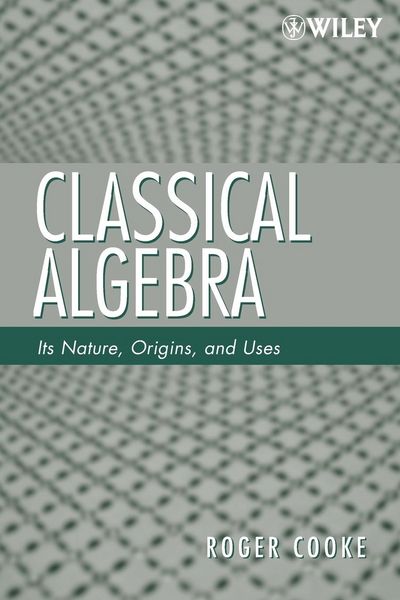
Produktbild: Classical Algebra

Classical Algebra Its Nature, Origins, and Uses

94,99 €

inkl. gesetzl. MwSt., Versandkostenfrei


Beschreibung

Produktdetails

Einband

Taschenbuch

Erscheinungsdatum

01.03.2008

Abbildungen

Drawings: 3 B&W, 0 Color; Graphs: 11 B&W, 0 Color

Verlag

John Wiley & Sons Inc

Seitenzahl

224

Maße (L/B/H)

23,4/15,6/1,2 cm

Gewicht

342 g

Auflage

1. Auflage

Sprache

Englisch

ISBN

978-0-470-25952-8

Beschreibung

Rezension

Winner of the 2008 CHOICE Outstanding Academic Title Award
 
"The book is written in an utmost lucid and cultured style, basically accessible to anyone with a general interest in mathematics, and a valuable contribution to the overall popularization of algebra into the bargain." (Zentralblatt Math, 2008)
 
"Cooke does a superb job of beginning to bridge the gulf between quadratic equations and group theory." (CHOICE, September 2008)
 
"Classical Algebra deserves a large audience, and should be in every undergraduate library." (MAA Reviews, June 2, 2008)

Produktdetails

Einband

Taschenbuch

Erscheinungsdatum

01.03.2008

Abbildungen

Drawings: 3 B&W, 0 Color; Graphs: 11 B&W, 0 Color

Verlag

John Wiley & Sons Inc

Seitenzahl

224

Maße (L/B/H)

23,4/15,6/1,2 cm

Gewicht

342 g

Auflage

1. Auflage

Sprache

Englisch

ISBN

978-0-470-25952-8

Herstelleradresse

Libri GmbH
Europaallee 1
36244 Bad Hersfeld
DE

Email: gpsr@libri.de

Ein neues Kapitel für Ihre Bücher

Ein neues Kapitel für Ihre Bücher

Schenken Sie Ihren alten Schätzen ein zweites Leben und erhalten Sie dafür eine Thalia Geschenkkarte.

Jetzt verkaufen
Jetzt verkaufen

Noch keine Bewertungen vorhanden

Verfassen Sie die erste Bewertung zu diesem Artikel

Helfen Sie anderen Kundinnen und Kunden durch Ihre Meinung.

Kundinnen und Kunden meinen

Bewertungen (0)

Die Leseprobe wird geladen.
  • Produktbild: Classical Algebra
  • Preface
     
    Part 1. Numbers and Equations.
     
    Lesson 1. What Algebra Is.
     
    1. Numbers in disguise.
     
    2. Arithmetic and algebra.
     
    3. The environment of algebra: Number systems.
     
    4. Important concepts and principles in this lesson.
     
    5. Problems and questions.
     
    6. Further reading.
     
    Lesson 2. Equations and Their Solutions.
     
    1. Polynomial equations, coefficients, and roots.
     
    2. The classification of equations.
     
    3. Numerical and formulaic approaches to equations.
     
    4. Important concepts and principles in this lesson.
     
    5. Problems and questions.
     
    6. Further reading.
     
    Lesson 3. Where Algebra Comes From.
     
    1. An Egyptian problem.
     
    2. A Mesopotamian problem.
     
    3. A Chinese problem.
     
    4. An Arabic problem.
     
    5. A Japanese problem.
     
    6. Problems and questions.
     
    7. Further reading.
     
    Lesson 4. Why Algebra Is Important.
     
    1. Example: An ideal pendulum.
     
    2. Problems and questions.
     
    3. Further reading.
     
    Lesson 5. Numerical Solution of Equations.
     
    1. A simple but crude method.
     
    2. Ancient Chinese methods of calculating.
     
    3. Systems of linear equations.
     
    4. Polynomial equations.
     
    5. The cubic equation.
     
    6. Problems and questions.
     
    7. Further reading.
     
    Part 2. The Formulaic Approach to Equations.
     
    Lesson 6. Combinatoric Solutions I: Quadratic Equations.
     
    1. Why not set up tables of solutions?.
     
    2. The quadratic formula.
     
    3. Problems and questions.
     
    4. Further reading.
     
    Lesson 7. Combinatoric Solutions II: Cubic Equations.
     
    1. Reduction from four parameters to one.
     
    2. Graphical solutions of cubic equations.
     
    3. Efforts to find a cubic formula.
     
    4. Alternative forms of the cubic formula.
     
    5. The \irreducible case.
     
    6. Problems and questions.
     
    7. Further reading.
     
    Part 3. Resolvents.
     
    Lesson 8. From Combinatorics to Resolvents.
     
    1. Solution of the irreducible case using complex numbers.
     
    2. The quartic equation.
     
    3. Viµete's solution of the irreducible case of the cubic.
     
    4. The Tschirnhaus solution of the cubic equation.
     
    5. Lagrange's reflections on the cubic equation.
     
    6. Problems and questions.
     
    7. Further reading.
     
    Lesson 9. The Search for Resolvents.
     
    1. Coefficients and roots.
     
    2. A unified approach to equations of all degrees.
     
    3. A resolvent for the general quartic equation.
     
    4. The state of polynomial algebra in 1770.
     
    5. Permutations enter algebra.
     
    6. Permutations of the variables in a function.
     
    7. Problems and questions.
     
    8. Further reading.
     
    Part 4. Abstract Algebra.
     
    Lesson 10. Existence and Constructibility of Roots.
     
    1. Proof that the complex numbers are algebraically closed.
     
    2. Solution by radicals: General considerations.
     
    3. Abel's proof.
     
    4. Problems and questions.
     
    5. Further reading.
     
    Lesson 11. The Breakthrough: Galois Theory.
     
    1. An example of a solving an equation by radicals.
     
    2. Field automorphisms and permutations of roots.
     
    3. A sketch of Galois theory.
     
    4. Solution by radicals.
     
    5. Some simple examples for practice.
     
    6. The story of polynomial algebra: a recap.
     
    7. Problems and questions.
     
    8. Further reading.
     
    Epilogue: Modern Algebra.
    &n