• Produktbild: Collaborative and Distributed Chemical Engineering. From Understanding to Substantial Design Process Support
  • Produktbild: Collaborative and Distributed Chemical Engineering. From Understanding to Substantial Design Process Support
- 10%

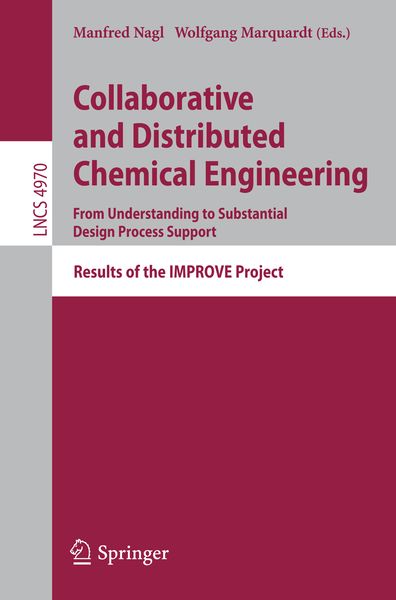
Collaborative and Distributed Chemical Engineering. From Understanding to Substantial Design Process Support Results of the IMPROVE Project

10% sparen

95,99 € UVP 106,99 €

inkl. gesetzl. MwSt., Versandkostenfrei


Beschreibung

Produktdetails

Einband

Taschenbuch

Erscheinungsdatum

18.07.2008

Herausgeber

Manfred Nagl + weitere

Verlag

Springer Berlin

Seitenzahl

851

Maße (L/B/H)

23,5/15,5/4,6 cm

Gewicht

1300 g

Auflage

2008

Sprache

Englisch

ISBN

978-3-540-70551-2

Beschreibung

Portrait

Prof. Dr.-Ing. habil. Manfred Nagl ist Inhaber des Lehrstuhls Informatik III an der Rheinisch-Westfälischen Technischen Hochschule Aachen.

Produktdetails

Einband

Taschenbuch

Erscheinungsdatum

18.07.2008

Herausgeber

Verlag

Springer Berlin

Seitenzahl

851

Maße (L/B/H)

23,5/15,5/4,6 cm

Gewicht

1300 g

Auflage

2008

Sprache

Englisch

ISBN

978-3-540-70551-2

Herstelleradresse

Springer-Verlag KG
Sachsenplatz 4-6
1201 Wien
AT

Email: GPSR Kontakt

Ein neues Kapitel für Ihre Bücher

Ein neues Kapitel für Ihre Bücher

Schenken Sie Ihren alten Schätzen ein zweites Leben: Einfach Barcode scannen, Versandetikett ausdrucken, Bücher verschicken und Thalia Geschenkkarte erhalten.

Jetzt verkaufen
Jetzt verkaufen

Noch keine Bewertungen vorhanden

Verfassen Sie die erste Bewertung zu diesem Artikel

Helfen Sie anderen Kundinnen und Kunden durch Ihre Meinung.

Kundinnen und Kunden meinen

Bewertungen (0)

  • Produktbild: Collaborative and Distributed Chemical Engineering. From Understanding to Substantial Design Process Support
  • Produktbild: Collaborative and Distributed Chemical Engineering. From Understanding to Substantial Design Process Support
  • Goals, Approach, Functionality of Resulting Tools, and Project Structure.- A Model-Driven Approach for A-posteriori Tool Integration.- A Scenario Demonstrating Design Support in Chemical Engineering.- The Interdisciplinary IMPROVE Project.- Application Domain Modeling.- An Introduction to Application Domain Modeling.- Product Data Models.- Document Models.- Work Process Models.- Decision Models.- Integrated Application Domain Models for Chemical Engineering.- New Tool Functionality and Underlying Concepts.- Using Developers’ Experience in Cooperative Design Processes.- Incremental and Interactive Integrator Tools for Design Product Consistency.- Multimedia and VR Support for Direct Communication of Designers.- An Adaptive and Reactive Management System for Project Coordination.- Platform Functionality.- Goal-Oriented Information Flow Management in Development Processes.- Service Management for Development Tools.- Integration Aspects.- Scenario-Based Analysis of Industrial Work Processes.- Integrative Simulation of Work Processes.- An Integrated Environment for Heterogeneous Process Modeling and Simulation.- Design Support of Reaction and Compounding Extruders.- Synergy by Integrating New Functionality.- Usability Engineering.- Software Integration and Framework Development.- Steps towards a Formal Process/Product Model.- From Application Domain Models to Tools: The Sketch of a Layered Process/Product Model.- Work Processes and Process-Centered Models and Tools.- Model Dependencies, Fine-Grained Relations, and Integrator Tools.- Administration Models and Management Tools.- Process/Product Model: Status and Open Problems.- Transfer to Practice.- Industrial Cooperation Resulting in Transfer.- Ontology-Based Integration and Management of Distributed Design Data.- Computer-Assisted Work Process Modeling in Chemical Engineering.- Simulation-Supported Workflow Optimization in Process Engineering.- Management and Reuse of Experience Knowledge in Extrusion Processes.- Tools for Consistency Management between Design Products.- Dynamic Process Management Based upon Existing Systems.- Service-Oriented Architectures and Application Integration.- Evaluation.- Review from a Design Process Perspective.- Review from a Tools’ Perspective.- Review from an Industrial Perspective.- Review from Academic Success Perspective.