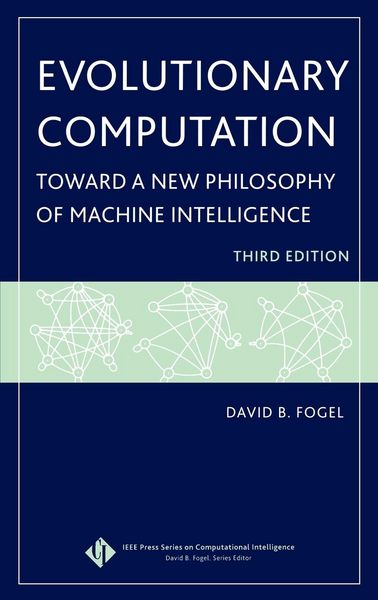
Evolutionary Computation Toward a New Philosophy of Machine Intelligence
-
Sprache:Englisch
-
Verlag:John Wiley & Sons
161,99 €
inkl. gesetzl. MwSt.,
Beschreibung
Produktdetails
Einband
Gebundene Ausgabe
Erscheinungsdatum
01.01.2006
Abbildungen
Drawings: 150 B&W, 0 Color
Verlag
John Wiley & SonsSeitenzahl
296
Maße (L/B/H)
24/16,1/2,1 cm
Gewicht
613 g
Auflage
3rd edition
Sprache
Englisch
ISBN
978-0-471-66951-7
The Third Edition of this internationally acclaimed publication provides the latest theory and techniques for using simulated evolution to achieve machine intelligence. As a leading advocate for evolutionary computation, the author has successfully challenged the traditional notion of artificial intelligence, which essentially programs human knowledge fact by fact, but does not have the capacity to learn or adapt as evolutionary computation does.
Readers gain an understanding of the history of evolutionary computation, which provides a foundation for the author s thorough presentation of the latest theories shaping current research. Balancing theory with practice, the author provides readers with the skills they need to apply evolutionary algorithms that can solve many of today s intransigent problems by adapting to new challenges and learning from experience. Several examples are provided that demonstrate how these evolutionary algorithms learn to solve problems. In particular, the author provides a detailed example of how an algorithm is used to evolve strategies for playing chess and checkers.
As readers progress through the publication, they gain an increasing appreciation and understanding of the relationship between learning and intelligence. Readers familiar with the previous editions will discover much new and revised material that brings the publication thoroughly up to date with the latest research, including the latest theories and empirical properties of evolutionary computation.
The Third Edition also features new knowledge-building aids. Readers will find a host of new and revised examples. New questions at the end of each chapter enable readers to test their knowledge. Intriguing assignments that prepare readers to manage challenges in industry and research have been added to the end of each chapter as well.
This is a must-have reference for professionals in computer and electrical engineering; it provides them with the very latest techniques and applications in machine intelligence. With its question sets and assignments, the publication is also recommended as a graduate-level textbook.
Ein neues Kapitel für Ihre Bücher
Ein neues Kapitel für Ihre Bücher
Schenken Sie Ihren alten Schätzen ein zweites Leben und erhalten Sie dafür eine Thalia Geschenkkarte.
Noch keine Bewertungen vorhanden
Verfassen Sie die erste Bewertung zu diesem Artikel
Helfen Sie anderen Kundinnen und Kunden durch Ihre Meinung.
Kurze Frage zu unserer Seite
Vielen Dank für Ihr Feedback
Wir nutzen Ihr Feedback, um unsere Produktseiten zu verbessern. Bitte haben Sie Verständnis, dass wir Ihnen keine Rückmeldung geben können. Falls Sie Kontakt mit uns aufnehmen möchten, können Sie sich aber gerne an unseren Kund*innenservice wenden.
zum Kundenservice