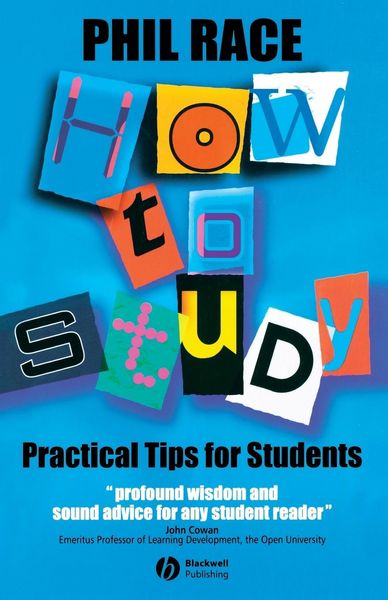
Produktbild: How to Study

How to Study Practical Tips for University Students

49,99 €

inkl. gesetzl. MwSt., Versandkostenfrei


Beschreibung

Produktdetails

Einband

Taschenbuch

Erscheinungsdatum

01.09.2003

Verlag

John Wiley & Sons Inc

Seitenzahl

248

Maße (L/B/H)

21,6/14/1,4 cm

Gewicht

337 g

Sprache

Englisch

ISBN

978-1-4051-0693-1

Beschreibung

Rezension

"Phil Race has a rare talent for expressing profound wisdom and sound advice in words which his readers find easy to understand and in suggestions which they can and do readily follow to good effect. He does this, again, in his new book - which is not so much a book as a rich library of booklets within one volume. These should guide any student reader through all the different and difficult demands which the university experience generates. ... he has linked chains of advice points into splendid plans of attack for use in dealing with each new challenge. I especially liked the plans for essay writing and coping with examinations, because they contained so much that I wish I had been told as a student, expressed in terms I wish I could have passed on to my own students." John Cowan, Emeritus Professor of Learning Development, the Open University

"I was very disorganised at university so a lot of what is in How to Study left me wincing. It is spot on. Taking control of learning and taking responsibility can be the hardest parts of successful university study. Phil Race shows what is possible with forward planning. Not everyone needs all the tips but all of us I suspect could have done with some of them. And every little helps." Sally Hunt, General Secretary, AUT

"I believe that this is an excellent resource which would, I am sure, be of benefit to all students trying to cope with the demands of higher education." Graham Henderson, Vice Chancellor, University of Teesside

This book is much more than a manual. It is a self-help guide to students of all ages and can be used either by dipping in and out, or reading it, as I did, systematically from cover to cover. I wish I had had a book like this when I was a student and would certainly recommend it to anyone." Susan Bassnett, pro-Vice Chancellor, University of Warwick

"A very readable and enjoyable study guide" Karen Monaghan, BSc (Hons) Psychology - 3rd Year, Glasgow Caledonian University & BPS/SMG Member s Liaison Officer 2002/3 - 2003/4

Featured in The Bookseller s Back to School issue, Friday June 13 2003

Produktdetails

Einband

Taschenbuch

Erscheinungsdatum

01.09.2003

Verlag

John Wiley & Sons Inc

Seitenzahl

248

Maße (L/B/H)

21,6/14/1,4 cm

Gewicht

337 g

Sprache

Englisch

ISBN

978-1-4051-0693-1

Herstelleradresse

Libri GmbH
Europaallee 1
36244 Bad Hersfeld
DE

Email: GPSR Kontakt

Ein neues Kapitel für Ihre Bücher

Ein neues Kapitel für Ihre Bücher

Schenken Sie Ihren alten Schätzen ein zweites Leben und erhalten dafür eine Thalia Geschenkkarte.

Jetzt verkaufen
Jetzt verkaufen

Noch keine Bewertungen vorhanden

Verfassen Sie die erste Bewertung zu diesem Artikel

Helfen Sie anderen Kundinnen und Kunden durch Ihre Meinung.

Kundinnen und Kunden meinen

Bewertungen (0)

  • Produktbild: How to Study
  • 1. Taking Charge Of Your Studies.
    2. The Week Before You Start Your Course.

    3. Finding Out Where You re At.

    4. Exploring How You Learn.

    5. Organising Your Studies.

    6. Where To Study.

    7. Task Management.

    8. Time Management.

    9. Getting Started On a Task.

    10. Maintaining Your Momentum.

    11. Experimenting With Learning Skills.

    12. Facing up to Peaks and Troughs.

    13. Working in Groups.

    14. Using Your Lecturers.

    15. Using Other People.

    16. Giving Your Seminar.

    17. Using Open Learning Materials.

    18. Overcoming Problems.

    19. Notemaking Versus Notetaking.

    20. Developing Your Speed Reading.

    21. Active Reading.

    22. Assessed Coursework.

    23. Summarising.

    24. Using Questions.

    25. Problem Solving.

    26. Improving Your Memory.

    27. Increasing Your Motivation.

    28. Getting at Assessment Criteria.

    29. Using Your Syllabus.

    30. Writing Essays.

    31. Writing Up Practical Work.

    32. Maximising Your Tutorials.

    33. Getting the Most From Field Courses.

    34. Using Vacations.

    35. Passing Vivas.

    36. Using Your Tutors After You ve Left.

    37. Using Advice.

    38. Revision.

    39. Making Projects Productive.

    40. Using Old Exam Papers.

    41. Before Your Exam.

    42. At The Start Of Your Exam.

    43. Writing Your Exam Answers.

    44. Near The End Of Your Exam.

    45. After An Exam.

    46. Preparing For Your Re-sit.

    47. Using a Word Processor.

    48. Filling in Application Forms.

    49. Writing Your Curriculum Vitae.

    50. Preparing For An Interview.

    51. Giving a Good Interview.