KI-Beratung Beta

Produktbild: The Boston Consulting Group on Strategy

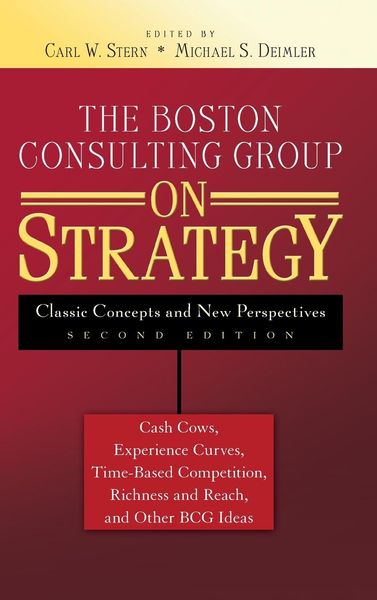
The Boston Consulting Group on Strategy Classic Concepts and New Perspectives

39,99 €

inkl. gesetzl. MwSt., Versandkostenfrei


Beschreibung

Produktdetails

Einband

Gebundene Ausgabe

Erscheinungsdatum

09.06.2006

Herausgeber

Michael S. Deimler + weitere

Verlag

John Wiley & Sons

Seitenzahl

432

Maße (L/B/H)

23,5/15,7/2,8 cm

Gewicht

778 g

Farbe

Bordeaux / Vanille

Auflage

2. Auflage

Sprache

Englisch

ISBN

978-0-471-75722-1

Beschreibung

Rezension

"Essential reading for anyone with a serious interest in strategy." ( Long Range Planning , 40/2007)

Produktdetails

Einband

Gebundene Ausgabe

Erscheinungsdatum

09.06.2006

Herausgeber

Verlag

John Wiley & Sons

Seitenzahl

432

Maße (L/B/H)

23,5/15,7/2,8 cm

Gewicht

778 g

Farbe

Bordeaux / Vanille

Auflage

2. Auflage

Sprache

Englisch

ISBN

978-0-471-75722-1

Herstelleradresse

Libri GmbH
Europaallee 1
36244 Bad Hersfeld
DE

Email: gpsr@libri.de

Ein neues Kapitel für Ihre Bücher

Ein neues Kapitel für Ihre Bücher

Schenken Sie Ihren alten Schätzen ein zweites Leben und erhalten Sie dafür eine Thalia Geschenkkarte.

Jetzt verkaufen
Jetzt verkaufen

Noch keine Bewertungen vorhanden

Verfassen Sie die erste Bewertung zu diesem Artikel

Helfen Sie anderen Kundinnen und Kunden durch Ihre Meinung.

Kundinnen und Kunden meinen

Bewertungen (0)

Die Leseprobe wird geladen.
  • Produktbild: The Boston Consulting Group on Strategy
  • Foreword.
     
    Preface.
     
    Acknowledgments.
     
    PART ONE: The Nature of Business Strategy.
     
    Strategic and Natural Competition, Bruce D. Henderson, 1980.
     
    PART TWO: The Development of Business Strategy.
     
    Foundations.
     
    The Experience Curve Reviewed: History, Bruce D. Henderson, 1973.
     
    The Experience Curve Reviewed: Why Does It Work? Bruce D. Henderson, 1974.
     
    The Experience Curve Reviewed: Price Stability, Bruce D. Henderson, 1974.
     
    The Pricing Paradox, Bruce D. Henderson, 1970.
     
    The Market-Share Paradox, Bruce D. Henderson, 1970.
     
    More Debt or None? Bruce D. Henderson, 1972.
     
    The Rule of Three and Four, Bruce D. Henderson, 1976.
     
    The Product Portfolio, Bruce D. Henderson, 1970.
     
    The Real Objectives, Bruce D. Henderson, 1976.
     
    Milestones.
     
    Life Cycle of the Industry Leader, Bruce D. Henderson, 1972.
     
    The Evils of Average Costing, Richard K. Lochridge, 1975.
     
    Specialization or the Full Product Line, Michael C. Goold, 1979.
     
    Stalemate: The Problem, John S. Clarkeson, 1984.
     
    Business Environments, Richard K. Lochridge, 1981.
     
    Revolution on the Factory Floor, Thomas M. Hout and George Stalk Jr., 1982.
     
    Time--The Next Source of Competitive Advantage, George Stalk Jr., 1988.
     
    Competing on Capabilities: The New Rules of Corporate Strategy, George Stalk Jr., Philip B. Evans, and Lawrence E. Shulman, 1992.
     
    Strategy and the New Economics of Information, Philip B. Evans and Thomas S. Wurster, 1997.
     
    Collaboration Rules, Philip Evans and Bob Wolf, 2005.
     
    PART THREE: The Practice of Business Strategy.
     
    The Customer: Segmentation and Value Creation.
     
    Segmentation and Strategy, Seymour Tilles, 1974.
     
    Strategic Sectors, Bruce D. Henderson, 1975.
     
    Specialization, Richard K. Lochridge, 1981.
     
    Specialization: Cost Reduction or Price Realization, Anthony J. Habgood, 1981.
     
    Segment-of-One(r) Marketing, Richard Winger and David Edelman, 1989.
     
    Discovering Your Customer, Michael J. Silverstein and Philip Siegel, 1991.
     
    Total Brand Management, David C. Edelman and Michael J. Silverstein, 1993.
     
    Pricing Myopia, Philippe Morel, George Stalk Jr., Peter Stanger, and Peter Wetenhall, 2003.
     
    Trading Up, Michael J. Silverstein and Neil Fiske, 2003 and 2005.
     
    Trading Down: Living Large on $150 a Day, Lucy Brady and Michael J. Silverstein, 2005.
     
    Innovation and Growth.
     
    From the Insight Out, Michael J. Silverstein, 1995.
     
    Capitalizing on Anomalies, Lawrence E. Shulman, 1997.
     
    Breaking Compromises, George Stalk Jr., David K. Pecaut, and Benjamin Burnett, 1997.
     
    A New Product Every Week? Lessons from Magazine Publishing, Gary Reiner and Shikhar Ghosh, 1988.
     
    Innovating for Cash, James P. Andrew and Harold L. Sirkin, 2003.
     
    Acquiring Your Future, Mark Blaxill and Kevin Rivette, 2004.
     
    Deconstruction of Value Chains.
     
    The New Vertical Integration, John R. Frantz and Thomas M. Hout, 1993.
     
    The Deconstruction of Value Chains, Carl W. Stern, 1998.
     
    How Deconstruction Drives De-Averaging, Philip B. Evans, 1998.
     
    Thinking Strategically about E-Commerce, Philip B. Evans and Thomas S. Wurster, 1999.
     
    From "Clicks and Mortar" to "Clicks and Bricks," Philip B. Evans and Thomas S. Wurster, 2000.
     
    Thermidor: The Internet Revolution and After, Philip B. Evans, 2001.
     
    The Online Employee, Michael S. Deimler and Morten T. Hansen, 2001.
     
    Richer Sourcing, Philip B. Evans and Bob Wolf, 2004.
     
    The Real Contest between America and China, Thomas