KI-Beratung Beta

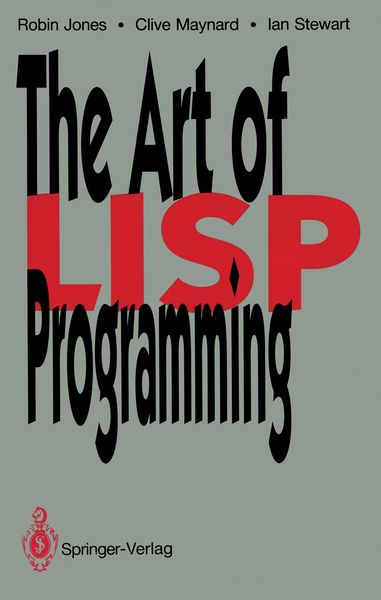
  • Produktbild: The Art of Lisp Programming
  • Produktbild: The Art of Lisp Programming

The Art of Lisp Programming

53,99 €

inkl. gesetzl. MwSt., Versandkostenfrei


Beschreibung

Produktdetails

Einband

Taschenbuch

Erscheinungsdatum

20.12.1989

Abbildungen

XIV, 169 p. 20 illus.

Verlag

Springer Berlin

Seitenzahl

169

Maße (L/B/H)

24,2/17/1,1 cm

Gewicht

326 g

Sprache

Englisch

ISBN

978-3-540-19568-9

Beschreibung

Produktdetails

Einband

Taschenbuch

Erscheinungsdatum

20.12.1989

Abbildungen

XIV, 169 p. 20 illus.

Verlag

Springer Berlin

Seitenzahl

169

Maße (L/B/H)

24,2/17/1,1 cm

Gewicht

326 g

Sprache

Englisch

ISBN

978-3-540-19568-9

Herstelleradresse

Springer-Verlag GmbH
Tiergartenstr. 17
69121 Heidelberg
DE

Email: ProductSafety@springernature.com

Ein neues Kapitel für Ihre Bücher

Ein neues Kapitel für Ihre Bücher

Schenken Sie Ihren alten Schätzen ein zweites Leben und erhalten Sie dafür eine Thalia Geschenkkarte.

Jetzt verkaufen
Jetzt verkaufen

Noch keine Bewertungen vorhanden

Verfassen Sie die erste Bewertung zu diesem Artikel

Helfen Sie anderen Kundinnen und Kunden durch Ihre Meinung.

Kundinnen und Kunden meinen

Bewertungen (0)

  • Produktbild: The Art of Lisp Programming
  • Produktbild: The Art of Lisp Programming
  • 1 Some Basic Ideas.- Lists.- Representing Lists.- The Interpreter.- Functions.- Two More Primitives.- Constants and Variables.- S-Expressions.- Postscript.- Exercises 1.- Answers.- 2 List Functions.- Splitting Lists.- car and cdr.- Setting Up Lists.- setq.- A Piece of Pedantry.- Head and Tail Revisited.- cons.- Postscript.- Exercises 2.- Answers.- 3 Predicates.- cond.- Boolean Functions.- Exercises 3.- Answers.- 4 Recursion.- Powers.- Boolean Functions Revisited.- eq.- Meanwhile Back at the Problem....- null.- AND and OR.- flat.- first.- rest.- The Fly in the Ointment.- append and list.- Postscript.- Exercises 4.- Answers.- 5 A Look Back (and Forward).- Variables: a Sense of Place.- Variable Scope.- Variable Binding.- Free Variables.- Lexical Scoping.- A Software Engineering Problem.- setq.- System Variables.- Exercises 5.- Answers.- 6 Sets and Lists.- Sets of Numbers.- The Set Functions.- Intersection.- disjoint-p.- Subsets.- Complement.- Union.- Exercises 6.- Answers.- 7 Input.- read.- read-line.- Single Characters.- More About #.- Yes or No Responses.- Using the read Primitives.- Exercises 7.- Answers.- 8 Output.- format.- The Control String.- Printing Values.- Format Directives.- Using Arguments as Parameters.- Tabs.- Other Output Functions.- The Telephone Index Again.- The read-eval-print Loop.- The Program-Data Distinction.- Exercises 8.- Answers.- 9 Iterative Constructs.- loop.- return.- do.- The Size of a List.- Iteration v. Recursion.- dotimes.- dolist.- Mapping.- mapcar.- Exercises 9.- Answers.- 10 More About Program Control.- if.- when.- unless.- case.- Synonyms.- Defaults.- Some New Control Constructs.- let.- flet.- progl to progrc.- The Lambda Notation.- Exercises 10.- Answers.- 11 File Handling.- Pathnames.- merge-pathnames.- Streams.- Opening and ClosingFiles.- Keyword Arguments.- The Body.- Other Keyword Arguments.- Getting the File Back.- EOF-ERROR-P and EOF-VALUE.- Exercises 11.- Answers.- 12 Data Structures.- Association Lists.- pairlis.- The Dot Notation.- assoc.- rassoc.- aeons.- setf.- Database Manipulation.- Trees.- Binary Trees.- The Searching Problem.- Implementing a Binary Tree.- Growing a Tree.- Searching the Tree.- Stacks.- push.- pop.- Exercises 12.- Answers.- 13 Arrays, Strings and Structures.- Arrays.- Changing an Array Element.- Multidimensional Arrays.- Strings.- char.- string=.- string