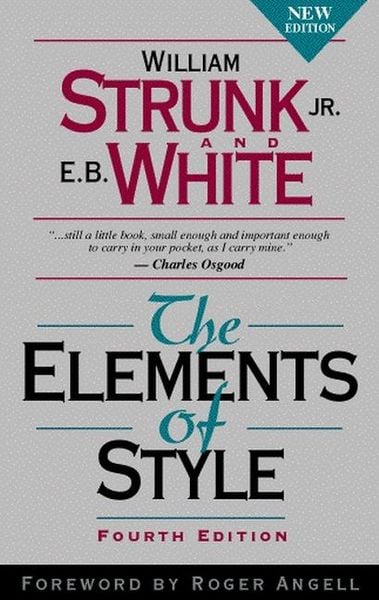
The Elements of Style
-
- Hardcover ausgewählt
- Taschenbuch
- eBook
-
Sprache:Englisch
-
Verlag:B&T
- Spectrum Ink Publishing 19,99 €
- Singer 17,99 €
- General Press 25,99 €
- Www.bnpublishing.net 17,99 €
- Sanage Publishing House Llp 27,99 €
- Franklin Classics Trade Press 34,99 €
- Creative Media Partners, LLC 33,99 €
- HarperCollins 26,99 €
- Smk Books 26,99 €
- B&T 27,99 € ausgewählt
- Abhishek Publications 28,99 €
- Chump Change 18,99 €
- Repro India Limited 33,99 €
- Gröls Verlag 16,90 €
27,99 €
inkl. gesetzl. MwSt.,
Beschreibung
Produktdetails
Einband
Gebundene Ausgabe
Erscheinungsdatum
24.08.1999
Verlag
B&TSeitenzahl
128
Maße (L/B/H)
13,1/20,7/1,5 cm
Gewicht
250 g
Auflage
4th Revised edition
Sprache
Englisch
ISBN
978-0-205-31342-6
"You know the authors' names. You recognize the title. You've probably used this book yourself. This is The Elements of Style, the classic style manual, now in a fourth edition. A new Foreword by Roger Angell reminds readers that the advice of Strunk & White is as valuable today as when it was first offered.This book's unique tone, wit and charm have conveyed the principles of English style to millions of readers. Use the fourth edition of "the little book" to make a big impact with writing. "
Ein neues Kapitel für Ihre Bücher
Ein neues Kapitel für Ihre Bücher
Schenken Sie Ihren alten Schätzen ein zweites Leben und erhalten Sie dafür eine Thalia Geschenkkarte.
Noch keine Bewertungen vorhanden
Verfassen Sie die erste Bewertung zu diesem Artikel
Helfen Sie anderen Kundinnen und Kunden durch Ihre Meinung.
Kurze Frage zu unserer Seite
Vielen Dank für Ihr Feedback
Wir nutzen Ihr Feedback, um unsere Produktseiten zu verbessern. Bitte haben Sie Verständnis, dass wir Ihnen keine Rückmeldung geben können. Falls Sie Kontakt mit uns aufnehmen möchten, können Sie sich aber gerne an unseren Kund*innenservice wenden.
zum Kundenservice