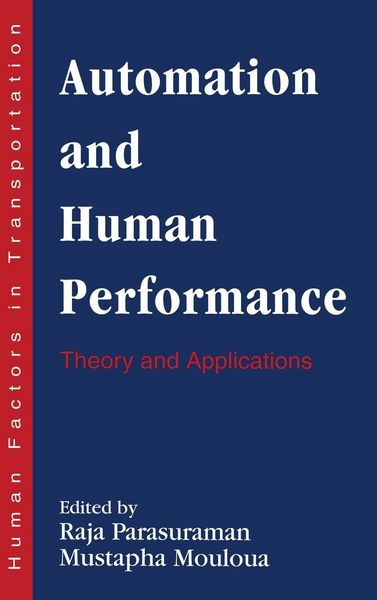
Automation and Human Performance Theory and Applications
-
- Hardcover ausgewählt
- Taschenbuch
- eBook
-
Sprache:Englisch
267,99 €
inkl. gesetzl. MwSt.,
Beschreibung
Produktdetails
Einband
Gebundene Ausgabe
Erscheinungsdatum
01.06.1996
Herausgeber
Parasuraman Raja + weitereVerlag
Taylor and FrancisSeitenzahl
536
Maße (L/B/H)
23,5/15,7/3,3 cm
Gewicht
918 g
Sprache
Englisch
ISBN
978-0-8058-1616-7
There is perhaps no facet of modern society where the influence of computer automation has not been felt. Flight management systems for pilots, diagnostic and surgical aids for physicians, navigational displays for drivers, and decision-aiding systems for air-traffic controllers, represent only a few of the numerous domains in which powerful new automation technologies have been introduced. The benefits that have been reaped from this technological revolution have been many. At the same time, automation has not always worked as planned by designers, and many problems have arisen--from minor inefficiencies of operation to large-scale, catastrophic accidents. Understanding how humans interact with automation is vital for the successful design of new automated systems that are both safe and efficient. The influence of automation technology on human performance has often been investigated in a fragmentary, isolated manner, with investigators conducting disconnected studies in different domains. There has been little contact between these endeavors, although principles gleaned from one domain may have implications for another. Also, with a few exceptions, the research has tended to be empirical and only theory-driven. In recent years, however, various groups of investigators have begun to examine human performance in automated systems in general and to develop theories of human interaction with automation technology. This book presents the current theories and assesses the impact of automation on different aspects of human performance. Both basic and applied research is presented to highlight the general principles of human-computer interaction in several domains where automation technologies are widely implemented. The major premise is that a broad-based, theory-driven approach will have significant implications for the effective design of both current and future automation technologies. This volume will be of considerable value to researchers in human factors, human-computer interaction, aviation and cognitive psychology, industrial engineering--and related disciplines as well as computer scientists, aeronautical, biomedical, and mechanical engineers. In addition, it should interest others involved in the design and manufacture of automation technologies. Part I covers broad theoretical perspectives and concepts in automation research. Part II assesses the impact of automation on different aspects of human performance, including monitoring, mental workload, situational awareness, vigilance, decision making, and supervisory control. Aspects of team performance in automated systems are also discussed. Part III examines issues related to human performance in different domains where automation technologies have been introduced including: aviation, different modes of transportation, motor vehicles on the road, maritime operations, medical systems, quality control and maintenance, and oil and gas pipeline operations. Part IV speculates on the future relationship between humans and automation and explores this relationship in the context of understanding the "teleology," or grand purpose in design, of automation technology.
Ein neues Kapitel für Ihre Bücher
Ein neues Kapitel für Ihre Bücher
Schenken Sie Ihren alten Schätzen ein zweites Leben und erhalten Sie dafür eine Thalia Geschenkkarte.
Noch keine Bewertungen vorhanden
Verfassen Sie die erste Bewertung zu diesem Artikel
Helfen Sie anderen Kundinnen und Kunden durch Ihre Meinung.
Kurze Frage zu unserer Seite
Vielen Dank für Ihr Feedback
Wir nutzen Ihr Feedback, um unsere Produktseiten zu verbessern. Bitte haben Sie Verständnis, dass wir Ihnen keine Rückmeldung geben können. Falls Sie Kontakt mit uns aufnehmen möchten, können Sie sich aber gerne an unseren Kund*innenservice wenden.
zum Kundenservice