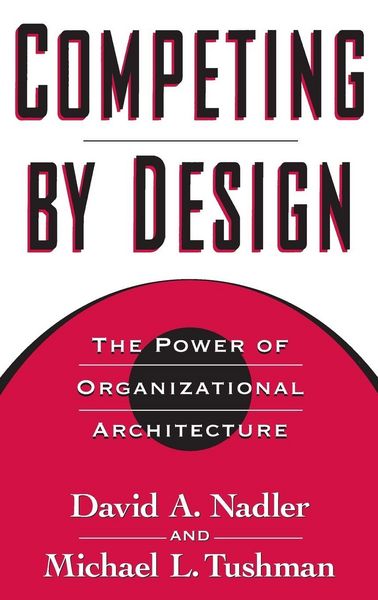
Competing by Design The Power of Organizational Architecture
66,99 €
inkl. gesetzl. MwSt.,
Beschreibung
Produktdetails
Einband
Gebundene Ausgabe
Erscheinungsdatum
01.07.1997
Abbildungen
line figures
Verlag
Oxford University PressSeitenzahl
254
Maße (L/B/H)
24/16,1/2 cm
Gewicht
596 g
Auflage
2nd edition
Sprache
Englisch
ISBN
978-0-19-509917-1
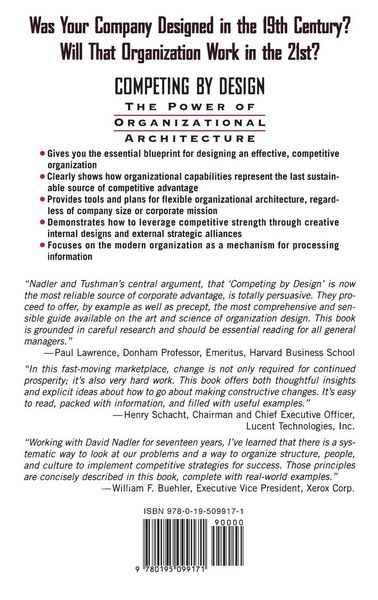
If the defining goal of modern-day business can be isolated to just one item, it would be the search for competitive advantage. And, as everyone in business knows, it's a lot harder than it used to be. On the one hand, competition is more intense than ever--technological innovation, consumer expectations, government deregulation, all combine to create more opportunities for new competitors to change the basic rules of the game. On the other hand, most of the old reliable sources of competitive advantage are drying up: the hallowed strategies employed by GM, IBM, and AT&T to maintain their seemingly unassailable positions of dominance in the 1960s and 70s are as obsolete as the calvary charge. So in this volatile, unstable environment, where can competitive advantage be found? As David Nadler and Michael Tushman show, the last remaining source of truly sustainable competitive advantage lies in `organizational capabilities': the unique ways each organization structures its work and motivates its people to achieve clearly articulated strategic objectives. For too long, too many managers have thought about "organization" merely in terms of rearranging the boxes and lines on an organizational chart--but as Competing by Design clearly illustrates, organizational strength is found far beyond one-dimensional diagrams. Managers must, argue Nadler and Tushman, understand the concepts and learn the skills involved in designing their organization to exploit their inherent strengths. All the reengineering, restructuring, and downsizing in the world will merely destabilize a company if the change doesn't address the fundamental patterns of performance--and if the change doesn't recognize the unique core competencies of that company. In this landmark volume, the authors draw upon specific cases to illustrate the design process in practice as they provide a set of powerful, yet simple tools, for using strategic organization design to gain competitive advantage. They present a design process, explore key decisions managers face, and list the guiding principles for incorporating the design function as a continuing and integral process in organizations that are looking to the future. In 1918, Henry Ford's Dearborn assembly plant was the model of the new assembly-line technology. Today, the assembly plant is an aging relic, but, incredibly, the organizational architecture it spawned lives on in steep hierarchies, centralized bureaucracies, and narrowly defined jobs. As companies are coming to realize they can't compete successfully in the 21st century with organizations based on 19th century ideas, Competing by Design shows clearly and persuasively why--and, most importantly how--to harness the power of organizational architecture to unleash the competitive strengths embedded in each organization.
Ein neues Kapitel für Ihre Bücher
Ein neues Kapitel für Ihre Bücher
Schenken Sie Ihren alten Schätzen ein zweites Leben und erhalten Sie dafür eine Thalia Geschenkkarte.
Noch keine Bewertungen vorhanden
Verfassen Sie die erste Bewertung zu diesem Artikel
Helfen Sie anderen Kundinnen und Kunden durch Ihre Meinung.
Kurze Frage zu unserer Seite
Vielen Dank für Ihr Feedback
Wir nutzen Ihr Feedback, um unsere Produktseiten zu verbessern. Bitte haben Sie Verständnis, dass wir Ihnen keine Rückmeldung geben können. Falls Sie Kontakt mit uns aufnehmen möchten, können Sie sich aber gerne an unseren Kund*innenservice wenden.
zum Kundenservice