
• Produktbild: Doing Justice Better
  • Produktbild: Doing Justice Better

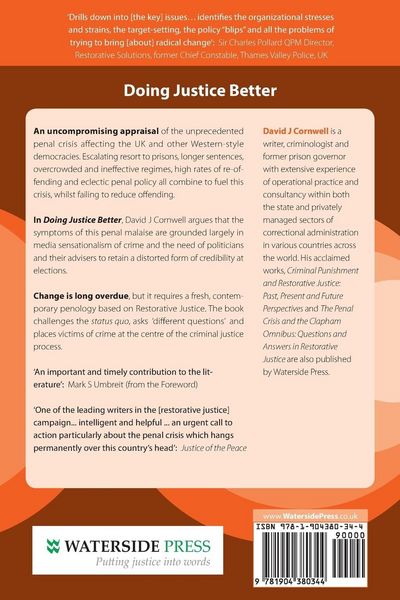
Doing Justice Better The Politics of Restorative Justice

48,99 €

inkl. gesetzl. MwSt., Versandkostenfrei


Beschreibung

Produktdetails

Einband

Taschenbuch

Erscheinungsdatum

01.07.2007

Verlag

Waterside Press

Seitenzahl

210

Maße (L/B/H)

23,4/15,6/1,2 cm

Gewicht

327 g

Sprache

Englisch

ISBN

978-1-904380-34-4

Beschreibung

Produktdetails

Einband

Taschenbuch

Erscheinungsdatum

01.07.2007

Verlag

Waterside Press

Seitenzahl

210

Maße (L/B/H)

23,4/15,6/1,2 cm

Gewicht

327 g

Sprache

Englisch

ISBN

978-1-904380-34-4

Herstelleradresse

Libri GmbH
Europaallee 1
36244 Bad Hersfeld
DE

Email: Libri GmbH

Ein neues Kapitel für Ihre Bücher

Ein neues Kapitel für Ihre Bücher

Schenken Sie Ihren alten Schätzen ein zweites Leben: Einfach Barcode scannen, Versandetikett ausdrucken, Bücher verschicken und Thalia Geschenkkarte erhalten.

Jetzt verkaufen
Jetzt verkaufen

Noch keine Bewertungen vorhanden

Verfassen Sie die erste Bewertung zu diesem Artikel

Helfen Sie anderen Kundinnen und Kunden durch Ihre Meinung.

Kundinnen und Kunden meinen

Bewertungen (0)

Die Leseprobe wird geladen.
  • Produktbild: Doing Justice Better
  • Produktbild: Doing Justice Better
  • CONTENTSAcknowledgementsDedicationPrefaceForeword by Mark S. Umbreit, PhDIntroductionThe Need for this Book'Restorative Justice' and 'Community Justice': A Recipe for Confusion?The Necessity for ChangeThe Politics of Justice: A British Perspective'Instrumentalism' in Criminal JusticeThe Structure of this BookDoing Justice Better: What Restorative Justice ProposesChapter1. The Politics of Restorative Justice, Critique, Analysis And the Basis of the Discussion Sketching the Contemporary BackgroundThe Motivation for ChangeThe Challenge of Restorative Justice2. Making Justice Restorative: The Need for a New PenologyStarting to Think the UnthinkableWhy a New Penology?The Need for a New Concept of RehabilitationThe Demands of Restorative Justice on OffendersThe Demands of Restorative Justice on Victims and CommunitiesThe Demands of Restorative Justice on Legal SystemsUnlocking the Door to a New Penology3. Victims' Voices: The Place of Victims in a Restorative Justice SettingSome Preliminary ObservationsCrime as the Creator of ObligationsCrime Violates Victims and CommunitiesThe Mythical Nature of Victim's RightsObligations Involve 'Putting Things Right'Victim Participation in Criminal Justice ProcessesWhy Victims Matter4. Penal Politics, Reparation and Restoration: Towards a Pragmatic PositionThe Contemporary Politics of Criminal JusticePolitics, Power and Penological RhetoricRetribution and Reparation: Penetrating the Linguistic MazeReparation, Restoration and Reintegration: Virtue out of NecessityReparation and Restoration: A Bridge Too Far?Towards a New Image of Corrections5. Making Prisons Reparative and Restorative: Designing for Outcomes in Custodial CorrectionsA Very Uncertain Starting PointThe Legacy of the PenitentiaryChanging the Ethos and Social Purpose of PrisonsThe Concept of Reparative PrisonsDesigning Prison Facilities for Reparative OutcomesOperating Regimes for Reparative OutcomesMaking Prisons Community-FriendlyAccommodating the Unrepentant and Incorrigible:A Different Approach to Custodial Corrections6. Community Justice: The Potential for Expanding Non-Custodial CorrectionsThe Politics of Community Penology: Preliminary ObservationsChanging Public Attitudes and Punishment RhetoricMaking Community Corrections CredibleThe Coulsfield Report 2004, and Rethinking Crime and PunishmentHalliday and Punishment in the Community: Confusion and CompromiseThe Finnish Perspective and its ImplicationsCommunity Corrections in a 'Cul-de-Sac'Can Restorative Justice Resolve this Impasse?7. Doing Justice Better: Making Restorative Justice WorkShifting the Criminal Justice ParadigmRestorative Justice Poses Different QuestionsThinking Differently about Crime and PunishmentProcedural ConsiderationsVictim Inclusiveness: The Hallmark of Restorative JusticeReparation and Pragmatism: Means Towards EndsReparative Custody: Socially Responsible ExclusionPurposeful Community PenologyMoving Towards 'Joined-Up' CorrectionsConclusionPostscriptBibliographyIndex