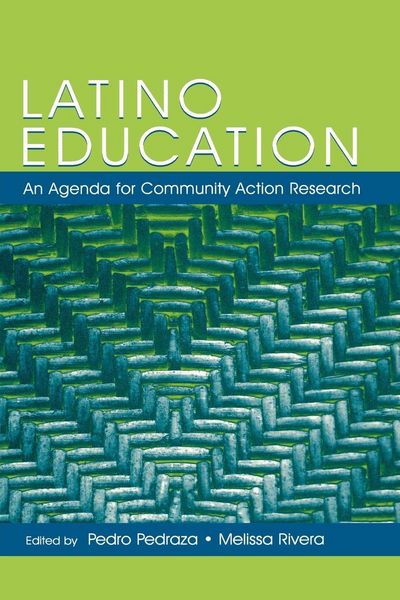
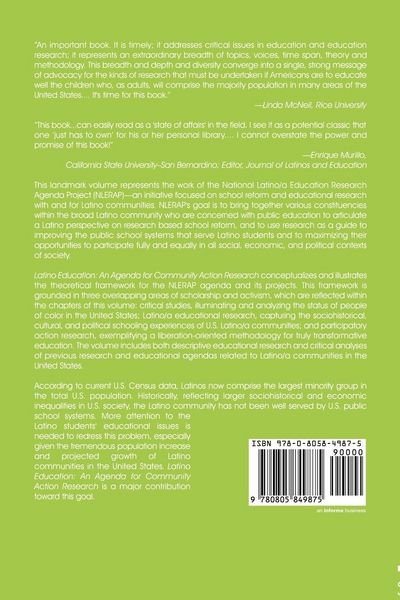
Contents: Foreword. Preface. Part I: Introduction--Creating the Collective Vision.P. Pedraza, M. Rivera, Origins of the National Latino/a Education Research and Policy Project (NLERAP). C.I. Mercado, L.J. Santamaría, A New Vision for Latino/a Education: A Comparative Perspective on Research Agendas. Part II: Sociohistorical Revisioning.V-M. MacDonald, K. Monkman, Setting the Context: Historical Perspectives on Latino/a Education. B.M. Flores, The Intellectual Presence of the Deficit View of Spanish-Speaking Children in the Educational Literature During the 20th Century. M. Montero-Sieburth, Explanatory Models of Latino Education During the Reform Movement of the 1980s. Part III: Exposing the Colonizing Effects of Reform.H.R. Cordero-Guzmán, Latinos and Education: A Statistical Portrait. R. González, Standards-Based Reform and the Latino/a Community: Opportunities for Advocacy. R. Rueda, Student Learning and Assessment: Setting an Agenda. T.I. Márquez-López, California's Standards Movement: How English Learners Have Been Left Out of the Equation for Success. J.G.A. Grinberg, K.P. Goldfarb, E. Saavedra,Con Pasíon y Con Coraje: The Schooling of Latino/a Students and Their Teachers' Education. Part IV: Collapsing the Paradox, Imagining New Possibilities.C. Tejeda, K.D. Gutierrez, Fighting the Backlash: Decolonizing Perspectives and Pedagogies in Neocolonial Times. L.C. Moll, R. Ruiz, The Educational Sovereignty of Latino/a Students in the United States. O.A. Vásquez, Social Action and the Politics of Collaboration. A. De Jesús, Theoretical Perspectives on the Underachievement of Latino/a Students in U.S. Schools: Toward a Framework for Culturally Additive Schooling. Part V: Actualizing the Future.N.M. Hidalgo, Latino/a Families' Epistemology. R.V. Padilla, Latino/a Education in the 21st Century. R. Rocco, Democracy, Education, and Human Rights in the United States: Strategies of Latino/a Empowerment. Part VI: Realizing the Power of Community Action.P. Pedraza, Reflections on Collaborative Research and the NLERAP Process. S. Nieto, Afterword: A Project of Hope: Defining a New Agenda for Latino/a Education in the 21st Century. Appendices: NLERAP: Education Research Framework and Agenda. Incorporating Latino Communities into Educational Research: Statement on Methodology.