KI-Beratung Beta

  • Produktbild: Mathematics and Computation in Music
  • Produktbild: Mathematics and Computation in Music
Band 37

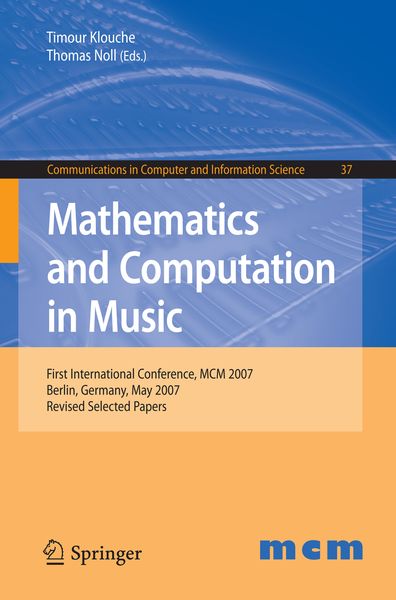
Mathematics and Computation in Music First International Conference, MCM 2007, Berlin, Germany, May 18-20, 2007. Revised Selected Papers

49,99 €

inkl. gesetzl. MwSt., Versandkostenfrei


Beschreibung

Produktdetails

Einband

Taschenbuch

Erscheinungsdatum

26.10.2009

Abbildungen

XI, 530 p.

Herausgeber

Timour Klouche + weitere

Verlag

Springer Berlin

Seitenzahl

530

Maße (L/B/H)

23,5/15,5/3 cm

Gewicht

814 g

Auflage

2009

Sprache

Englisch

ISBN

978-3-642-04578-3

Beschreibung

Produktdetails

Einband

Taschenbuch

Erscheinungsdatum

26.10.2009

Abbildungen

XI, 530 p.

Herausgeber

Verlag

Springer Berlin

Seitenzahl

530

Maße (L/B/H)

23,5/15,5/3 cm

Gewicht

814 g

Auflage

2009

Sprache

Englisch

ISBN

978-3-642-04578-3

Herstelleradresse

Springer-Verlag KG
Sachsenplatz 4-6
1201 Wien
AT

Email: ProductSafety@springernature.com

Ein neues Kapitel für Ihre Bücher

Ein neues Kapitel für Ihre Bücher

Schenken Sie Ihren alten Schätzen ein zweites Leben und erhalten Sie dafür eine Thalia Geschenkkarte.

Jetzt verkaufen
Jetzt verkaufen

Noch keine Bewertungen vorhanden

Verfassen Sie die erste Bewertung zu diesem Artikel

Helfen Sie anderen Kundinnen und Kunden durch Ihre Meinung.

Kundinnen und Kunden meinen

Bewertungen (0)

  • Produktbild: Mathematics and Computation in Music
  • Produktbild: Mathematics and Computation in Music
  • Mathematical Modeling and Computation in Music.- Rhythm and Transforms, Perception and Mathematics.- Visible Humour — Seeing P.D.Q. Bach’s Musical Humour Devices in The Short-Tempered Clavier on the Spiral Array Space.- Category-Theoretic Consequences of Denotators as a Universal Data Format.- Normal Form, Successive Interval Arrays, Transformations and Set Classes: A Re-evaluation and Reintegration.- A Model of Musical Motifs.- Melodic Clustering within Motivic Spaces: Visualization in OpenMusic and Application to Schumann’s Träumerei.- Topological Features of the Two-Voice Inventions.- Comparing Computational Approaches to Rhythmic and Melodic Similarity in Folksong Research.- Automatic Modulation Finding Using Convex Sets of Notes.- On Pitch and Chord Stability in Folk Song Variation Retrieval.- Bayesian Model Selection for Harmonic Labelling.- The Flow of Harmony as a Dynamical System.- Tonal Implications of Harmonic and Melodic Tn-Types.- Calculating Tonal Fusion by the Generalized Coincidence Function.- Predicting Music Therapy Clients’ Type of Mental Disorder Using Computational Feature Extraction and Statistical Modelling Techniques.- Nonlinear Dynamics, the Missing Fundamental, and Harmony.- Dynamic Excitation Impulse Modification as a Foundation of a Synthesis and Analysis System for Wind Instrument Sounds.- Non-linear Circles and the Triple Harp: Creating a Microtonal Harp.- Applying Inner Metric Analysis to 20th Century Compositions.- Tracking Features with Comparison Sets in Scriabin’s Study op. 65/3.- Computer Aided Analysis of Xenakis-Keren.- Automated Extraction of Motivic Patterns and Application to the Analysis of Debussy’s Syrinx.- Pitch Symmetry and Invariants in Webern’s Sehr Schnell from Variations Op.27.- Computational AnalysisWorkshop: Comparing Four Approaches to Melodic Analysis.- Computer-Aided Investigation of Chord Vocabularies: Statistical Fingerprints of Mozart and Schubert.- The Irrelative System in Tonal Harmony.- Mathematical Approaches to Music Analysis and Composition.- Mathematics and the Twelve-Tone System: Past, Present, and Future.- Approaching Musical Actions.- A Transformational Space for Elliott Carter’s Recent Complement-Union Music.- Networks.- From Mathematica to Live Performance: Mapping Simple Programs to Music.- Nonlinear Dynamics of Networks: Applications to Mathematical Music Theory.- Form, Transformation and Climax in Ruth Crawford Seeger’s String Quartet, Mvmt. 3.- A Local Maximum Phrase Detection Method for Analyzing Phrasing Strategies in Expressive Performances.- Subgroup Relations among Pitch-Class Sets within Tetrachordal K-Families.- K-Net Recursion in Perlean Hierarchical Structure.- Webern’s Twelve-Tone Rows through the Medium of Klumpenhouwer Networks.- Isographies of Pitch-Class Sets and Set Classes.- The Transmission of Pythagorean Arithmetic in the Context of the Ancient Musical Tradition from the Greek to the Latin Orbits During the Renaissance: A Computational Approach of Identifying and Analyzing the Formation of Scales in the De Harmonia Musicorum Instrumentorum Opus (Milan, 1518) of Franchino Gaffurio (1451–1522).- Combinatorial and Transformational Aspects of Euler’s Speculum Musicum.- Structures Ia Pour Deux Pianos by Boulez: Towards Creative Analysis Using OpenMusic and Rubato.- The Sieves of Iannis Xenakis.- Tonal, Atonal and Microtonal Pitch-Class Categories.- Using Mathematica to Compose Music and Analyze Music with Information Theory.- Mathematical Approaches to Music Theory.- A Diatonic Chord with Unusual Voice-LeadingCapabilities.- Mathematical and Musical Properties of Pairwise Well-Formed Scales.- Eine Kleine Fourier Musik.- WF Scales, ME Sets, and Christoffel Words.- Interval Preservation in Group- and Graph-Theoretical Music Theories: A Comparative Study.- Pseudo-diatonic Scales.- Affinity Spaces and Their Host Set Classes.- The Step-Class Automorphism Group in Tonal Analysis.- A Linear Algebraic Approach to Pitch-Class Set Genera.