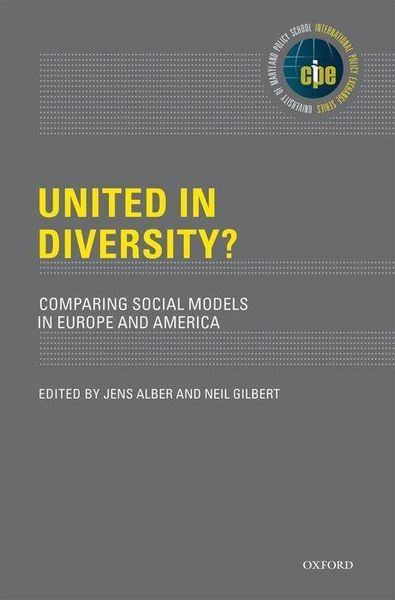
United in Diversity? Comparing Social Models in Europe and America
94,99 €
inkl. gesetzl. MwSt.,
Beschreibung
Produktdetails
Einband
Gebundene Ausgabe
Erscheinungsdatum
07.10.2009
Abbildungen
numerous tables and figures
Herausgeber
Jens Alber + weitereVerlag
Oxford University PressSeitenzahl
464
Maße (L/B/H)
24,1/16,7/4,3 cm
Gewicht
836 g
Sprache
Englisch
ISBN
978-0-19-537663-0
Since the advent of the European Union, politicians have increasingly emphasized the notion of a European social model as an alternative to the American form of market capitalism, which is seen as promoting economic growth without regard for solidarity and social progress. As this political discourse has advanced, social scientists and academic policy analysts have raised questions concerning the extent to which the E.U. and U.S. social models exist outside the minds of diplomats and politicians seeking to stitch together a common identity. How much unity is there still within Europe after the Eastern enlargements have considerably increased economic and cultural diversity? To whatever extent one might discern a distinct set of commonalities that represent the core of a European approach, how different are the European characteristics of social, economic, and political life from those of America?
Addressing these issues, this book systematically analyzes how much European countries and the United States have in common and how much variation we find within the enlarged European Union in eight central spheres of socio-economic and political life: employment, equality/mobility, educational opportunity, integration of immigrants, democratic functioning, political participation, rights to welfare, and levels of public spending. Drawing on empirical analyses by U.S. and European scholars who represent multi-disciplinary backgrounds, each of these topics is put under scrutiny. The results of this study illuminate points of convergence and divergence as seen from the perspectives of scholars from both sides of the Atlantic.
Ein neues Kapitel für Ihre Bücher
Ein neues Kapitel für Ihre Bücher
Schenken Sie Ihren alten Schätzen ein zweites Leben und erhalten Sie dafür eine Thalia Geschenkkarte.
Noch keine Bewertungen vorhanden
Verfassen Sie die erste Bewertung zu diesem Artikel
Helfen Sie anderen Kundinnen und Kunden durch Ihre Meinung.
Kurze Frage zu unserer Seite
Vielen Dank für Ihr Feedback
Wir nutzen Ihr Feedback, um unsere Produktseiten zu verbessern. Bitte haben Sie Verständnis, dass wir Ihnen keine Rückmeldung geben können. Falls Sie Kontakt mit uns aufnehmen möchten, können Sie sich aber gerne an unseren Kund*innenservice wenden.
zum Kundenservice