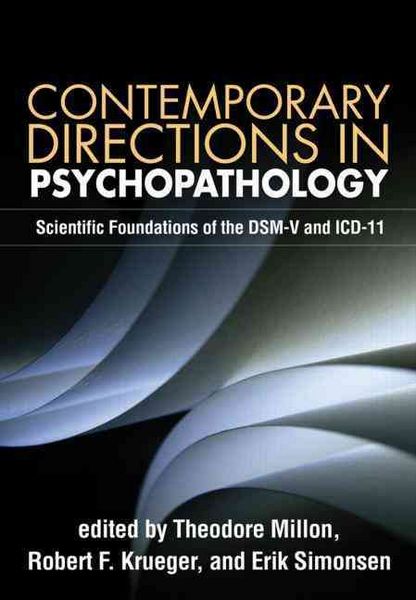
I. Historical and Cultural Perspectives 1. A PrÃ(c)cis of Psychopathological History 2. Themes in the Evolution of the 20th-Century DSMs 3. On the Wisdom of Considering Culture and Context in Psychopathology 4. Cultural Issues in the Coordination of DSM-V and ICD-11 5. A Sociocultural Conception of the Borderline Personality Disorder Epidemic II. Conceptual Issues in Classification 6. Philosophical Issues in the Classification of Psychopathology 7. Classification Considerations in Psychopathology and Personology 8. Diagnostic Taxa as Open Concepts: Metatheoretical and Statistical Questions about Reliability and Construct Validity in the Grand Strategy of Nosological Revision 9. Contemplations on Meehl (1986): The Territory, PaulâEUR(TM)s Map, and Our Progress in Psychopathology Classification (or, the Challenge of Keeping Up with a Beacon 30 Years Ahead of the Field) 10. Issues of Construct Validity in Psychological Diagnoses 11. The Meaning of Comorbidity among Common Mental Disorders 12. The Connections between Personality and Psychopathology 13. Is It True That Mental Disorders Are So Common, and So Commonly Co-Occur? 14. Taking Disorder Seriously: A Critique of Psychiatric Criteria for Mental Disorders from the Harmful-Dysfunction Perspective III. Methodological Approaches to Categories, Dimensions, and Prototypes 15. On the Substantive Grounding and Clinical Utility of Categories versus Dimensions 16. A Short History of a Psychiatric Diagnostic Category That Turned Out to Be a Disease 17. Concepts and Methods for Researching Categories and Dimensions in Psychiatric Diagnosis 18. The Integration of Categorical and Dimensional Approaches to Psychopathology 19. Dimensionalizing Existing Personality Disorder Categories 20. An Empirically Based Prototype Diagnostic System for DSM-V and ICD-11 21. The Millon Personality Spectrometer: A Tool for Personality Spectrum Analyses, Diagnoses, and Treatments IV. Innovative Theoretical and Empirical Proposals 22. Neuroscientific Foundations of Psychopathology 23. Using Evolutionary Principles for Deducing Normal and Abnormal Personality Patterns 24. Biopsychosocial Models and Psychiatric Diagnosis 25. Reactivating the Psychodynamic Approach to the Classification of Psychopathology 26. A Life Course Approach to Psychoses: Outcome and Cultural Variation 27. The Interpersonal Nexus of Personality and Psychopathology 28. Reconceptualizing Autism Spectrum Disorders as Autism-Specific Learning Disabilities and Styles 29. Describing Relationship Patterns in DSM-V: A Preliminary Proposal 30. On the Diversity of the Borderline Syndromes