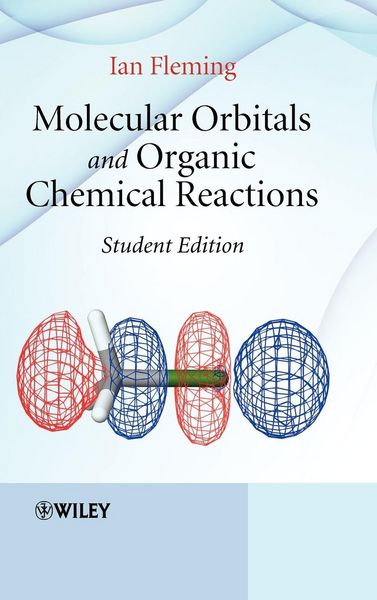
Molecular Orbitals Student
-
- Hardcover ausgewählt
- Taschenbuch
- eBook
-
Sprache:Englisch
-
Verlag:John Wiley & Sons Inc
173,99 €
inkl. gesetzl. MwSt.,
Beschreibung
Produktdetails
Einband
Gebundene Ausgabe
Erscheinungsdatum
14.12.2009
Verlag
John Wiley & Sons IncSeitenzahl
378
Maße (L/B/H)
23,5/15,7/2,5 cm
Gewicht
699 g
Sprache
Englisch
ISBN
978-0-470-74660-8
Molecular orbital theory is used by chemists to describe the arrangement of electrons in chemical structures. It is also a theory capable of giving some insight into the forces involved in the making and breaking of chemical bonds-the chemical reactions that are often the focus of an organic chemist's interest. Organic chemists with a serious interest in understanding and explaining their work usually express their ideas in molecular orbital terms, so much so that it is now an essential component of every organic chemist's skills to have some acquaintance with molecular orbital theory.
Molecular Orbitals and Organic Chemical Reactions is both a simplified account of molecular orbital theory and a review of its applications in organic chemistry; it provides a basic introduction to the subject and a wealth of illustrative examples. In this book molecular orbital theory is presented in a much simplified, and entirely non-mathematical language, accessible to every organic chemist, whether student or research worker, whether mathematically competent or not. Topics covered include:
- Molecular Orbital Theory
- Molecular Orbitals and the Structures of Organic Molecules
- Chemical Reactions - How Far and How Fast
- Ionic Reactions - Reactivity
- Ionic Reactions - Stereochemistry
- Pericyclic Reactions
- Radical Reactions
- Photochemical Reactions
Molecular Orbitals and Organic Chemical Reactions: Student Edition serves in a sense as a second edition of the author's influential earlier book Frontier Orbitals and Organic Chemical Reactions, but has been completely rewritten, greatly enlarging the chapters on molecular orbital theory itself, and on the effect of orbital interactions on the structures of organic molecules. There is more on the theoretical basis for the principle of hard and soft acids and bases, and a whole chapter on the stereochemistry of the fundamental organic reactions. Correlation diagrams have been added to the discussion of pericyclic chemistry, and a great deal more in that, the largest chapter. A number of new topics, both omissions from the earlier book and work that has taken place in the intervening years, are included, and there are more words of caution in discussing frontier orbital theory itself.
Molecular Orbitals and Organic Chemical Reactions: Student Edition is an invaluable textbook on this important subject for students of organic, physical organic and computational chemistry.
Ein neues Kapitel für Ihre Bücher
Ein neues Kapitel für Ihre Bücher
Schenken Sie Ihren alten Schätzen ein zweites Leben und erhalten dafür eine Thalia Geschenkkarte.
Noch keine Bewertungen vorhanden
Verfassen Sie die erste Bewertung zu diesem Artikel
Helfen Sie anderen Kundinnen und Kunden durch Ihre Meinung.
Kurze Frage zu unserer Seite
Vielen Dank für Ihr Feedback
Wir nutzen Ihr Feedback, um unsere Produktseiten zu verbessern. Bitte haben Sie Verständnis, dass wir Ihnen keine Rückmeldung geben können. Falls Sie Kontakt mit uns aufnehmen möchten, können Sie sich aber gerne an unseren Kund*innenservice wenden.
zum Kundenservice