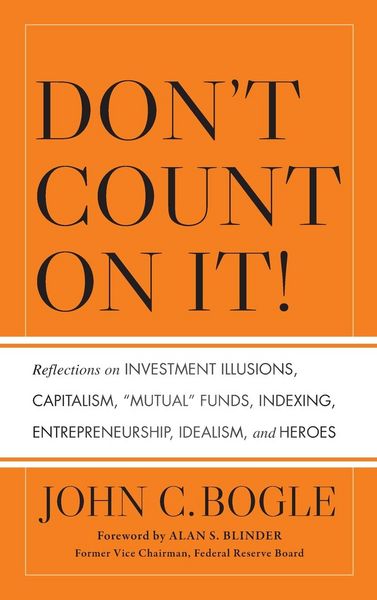
Don't Count on It! Reflections on Investment Illusions, Capitalism, "Mutual" Funds, Indexing, Entrepreneurship, Idealism, and Heroes
28,99 €
inkl. gesetzl. MwSt.,
Beschreibung
Produktdetails
Einband
Gebundene Ausgabe
Erscheinungsdatum
02.11.2010
Abbildungen
Charts: 55 B&W, 0 Color; Tables: 20 B&W, 0 Color
Verlag
John Wiley & SonsSeitenzahl
640
Maße (L/B/H)
23,5/15,7/3,9 cm
Gewicht
1066 g
Auflage
1. Auflage
Sprache
Englisch
ISBN
978-0-470-64396-9
"This collection of Jack Bogle's writings couldn't be more timely. The clarity of his thinking--and his insistence on the relevance of ethical standards--are totally relevant as we strive to rebuild a broken financial system. For too many years, his strong voice has been lost amid the cacophony of competing self-interests, misdirected complexity, and unbounded greed. Read, learn, and support Jack's mission to reform the industry that has been his life's work."
--PAUL VOLCKER, Chairman of the President's Economic Recovery Advisory Board and former Chairman of the Federal Reserve (1979-1987)
"Jack Bogle has given investors throughout the world more wisdom and plain financial 'horse sense' than any person in the history of markets. This compendium of his best writings, particularly his post-crisis guidance, is absolutely essential reading for investors and those who care about the future of our society."
--ARTHUR LEVITT, former Chairman, U.S. Securities and Exchange Commission
"Jack Bogle is one of the most lucid men in finance."
--NASSIM N.TALEB, PhD, author of The Black Swan
"Jack Bogle is one of the financial wise men whose experience spans the post-World War II years. This book, encompassing his insights on financial behavior, pitfalls, and remedies, with a special focus on mutual funds, is an essential read. We can only benefit from his observations."
--HENRY KAUFMAN, President, Henry Kaufman & Company, Inc.
"It was not an easy sell. The joke at first was that only finance professors invested in Vanguard's original index fund. But what a triumph it has been. And what a focused and passionate drive it took: it is a zero-sum game and only costs are certain. Thank you, Jack."
--JEREMY GRANTHAM, Cofounder and Chairman, GMO
"On finance, Jack Bogle thinks unconventionally. So, this sound rebel turns out to be right most of the time. Meanwhile, many of us sometimes engage in self-deception. So, this book will set us straight. And in the last few pages, Jack writes, and I agree, that Peter Bernstein was a giant. So is Jack Bogle."
--JEAN-MARIE EVEILLARD, Senior Adviser, First Eagle Investment Management
Insights into investing and leadership from the founder of The Vanguard Group
Throughout his legendary career, John Bogle-founder of the Vanguard mutual fund group and creator of the first index mutual fund-has helped investors build wealth the right way, while, at the same time, leading a tireless campaign to restore common sense to the investment world.
A collection of essays based on speeches delivered to professional groups and college students in recent years, in Don't Count on It is organized around eight themes
* Illusion versus reality in investing
* Indexing to market returns
* Failures of capitalism
* The flawed structure of the mutual fund industry
* The spirit of entrepreneurship
* What is enough in business, and in life
* Advice to America's future leaders
* The unforgettable characters who have shaped his career
Widely acclaimed for his role as the conscience of the mutual fund industry and a relentless advocate for individual investors, in Don't Count on It, Bogle continues to inspire, while pushing the mutual fund industry to measure up to their promise.
Ein neues Kapitel für Ihre Bücher
Ein neues Kapitel für Ihre Bücher
Schenken Sie Ihren alten Schätzen ein zweites Leben und erhalten Sie dafür eine Thalia Geschenkkarte.
Noch keine Bewertungen vorhanden
Verfassen Sie die erste Bewertung zu diesem Artikel
Helfen Sie anderen Kundinnen und Kunden durch Ihre Meinung.
Kurze Frage zu unserer Seite
Vielen Dank für Ihr Feedback
Wir nutzen Ihr Feedback, um unsere Produktseiten zu verbessern. Bitte haben Sie Verständnis, dass wir Ihnen keine Rückmeldung geben können. Falls Sie Kontakt mit uns aufnehmen möchten, können Sie sich aber gerne an unseren Kund*innenservice wenden.
zum Kundenservice