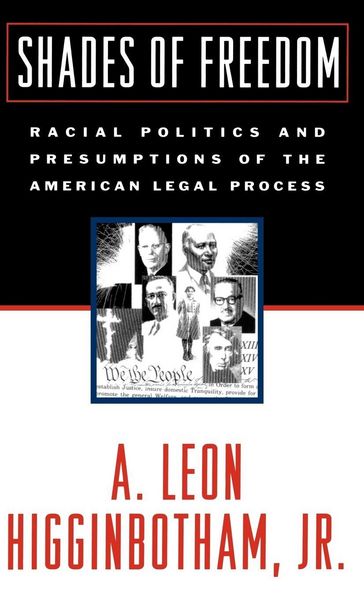
Shades of Freedom Racial Politics and Presumptions of the American Legal Process Race and the American Legal Process, Volume II
-
- Hardcover ausgewählt
- Taschenbuch
- eBook
-
Sprache:Englisch
131,99 €
inkl. gesetzl. MwSt.,
Beschreibung
Produktdetails
Einband
Gebundene Ausgabe
Erscheinungsdatum
24.10.1996
Abbildungen
16 pp plates
Verlag
Oxford University PressSeitenzahl
352
Maße (L/B/H)
24,1/16,2/3 cm
Gewicht
694 g
Sprache
Englisch
ISBN
978-0-19-503822-4
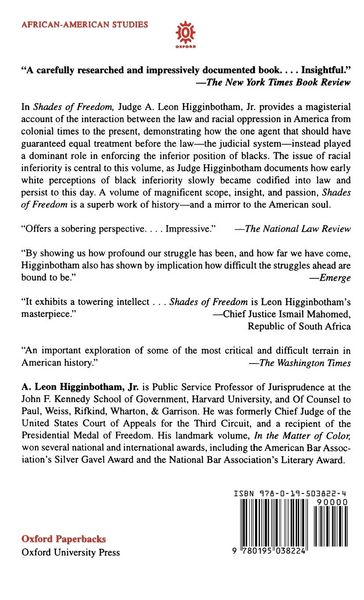
In Shades of Freedom, Higginbotham provides a magisterial account of the interaction between law and racial oppression in America from colonial times to the present, demonstrating how the one agent that was entrusted to guarantee equal justice under the law - the judicial system - instead, more often played a dominant role in enforcing the inferior position of blacks, and, on some occasions, eradicated racial injustice. The precept of racial inferiority is central to this volume, as Higginbotham documents how early white perceptions of black inferiority slowly became codified into law. Perhaps the most powerful and insightful aspects center on a pair of famous Supreme Court cases, which Higgingbotham uses to portray race relations at two vital moments in our history. The Dred Scott decision of 1857 declared that under the United States Constitution, blacks were "so far inferior that they had no rights which the white man was bound to respect". Higginbotham reveals the tragedy that, after the Civil War, and even during the Reconstruction period, the courts construed the new Constitutional amendments with such hostility that the dream of freedom was buried by judges with black robes, politicians posing as statesmen, and vigilantes in white hooded robes. In the Plessy v. Ferguson decision of 1896, which Higginbotham terms "one of the most catastrophic racial decisions ever rendered", the Supreme Court legitimized racial segregation under the deceptive rationale of "separate but equal", which, in practice, became always separate and never equal. Higginbotham also documents the eloquent voices that opposed the openly racist workings of the system, from Reconstruction Congressman John R. Lynch to Supreme Court Justice John Marshall Harlan to African-American scholar W. E. B. Du Bois and Charles Hamilton Houston, William Hastie, and a few other lawyers - both black and white, Jew and Gentile - who confronted the legitimization of racism. To establish the nexus to decades of racism in the past, he asserts that, even today, racial bias still permeates the American consciousness. He shows how six recent events reveal that many public perceptions of black inferiority persist to this day.
Ein neues Kapitel für Ihre Bücher
Ein neues Kapitel für Ihre Bücher
Schenken Sie Ihren alten Schätzen ein zweites Leben und erhalten Sie dafür eine Thalia Geschenkkarte.
Noch keine Bewertungen vorhanden
Verfassen Sie die erste Bewertung zu diesem Artikel
Helfen Sie anderen Kundinnen und Kunden durch Ihre Meinung.
Kurze Frage zu unserer Seite
Vielen Dank für Ihr Feedback
Wir nutzen Ihr Feedback, um unsere Produktseiten zu verbessern. Bitte haben Sie Verständnis, dass wir Ihnen keine Rückmeldung geben können. Falls Sie Kontakt mit uns aufnehmen möchten, können Sie sich aber gerne an unseren Kund*innenservice wenden.
zum Kundenservice