KI-Beratung Beta

Produktbild: Conceptual Modeling – ER 2010
Band 6412

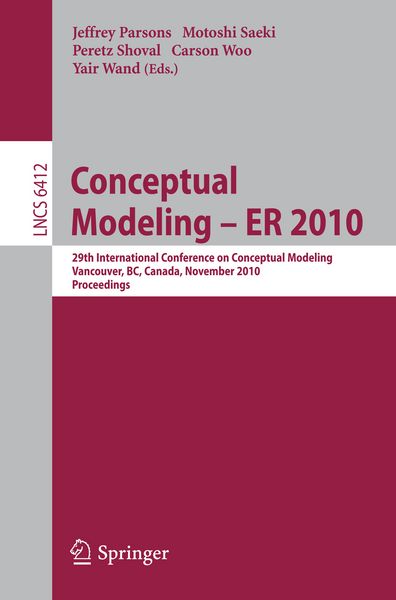
Conceptual Modeling – ER 2010 29th International Conference on Conceptual Modeling, Vancouver, BC, Canada, November 1-4, 2010, Proceedings

58,99 €

inkl. gesetzl. MwSt., Versandkostenfrei


Beschreibung

Produktdetails

Einband

Taschenbuch

Erscheinungsdatum

19.10.2010

Abbildungen

XIV, 490 p. 163 illus.

Herausgeber

Jeffrey Parsons + weitere

Verlag

Springer Berlin

Seitenzahl

490

Maße (L/B/H)

1,6/15,5/23,8 cm

Gewicht

769 g

Sprache

Englisch

ISBN

978-3-642-16372-2

Beschreibung

Produktdetails

Einband

Taschenbuch

Erscheinungsdatum

19.10.2010

Abbildungen

XIV, 490 p. 163 illus.

Herausgeber

Verlag

Springer Berlin

Seitenzahl

490

Maße (L/B/H)

1,6/15,5/23,8 cm

Gewicht

769 g

Sprache

Englisch

ISBN

978-3-642-16372-2

Herstelleradresse

Springer Nature Customer Service Center GmbH
Europaplatz 3
69115 Heidelberg
DE
ProductSafety@springernature.com

Ein neues Kapitel für Ihre Bücher

Ein neues Kapitel für Ihre Bücher

Schenken Sie Ihren alten Schätzen ein zweites Leben und erhalten Sie dafür eine Thalia Geschenkkarte.

Jetzt verkaufen
Jetzt verkaufen

Noch keine Bewertungen vorhanden

Verfassen Sie die erste Bewertung zu diesem Artikel

Helfen Sie anderen Kundinnen und Kunden durch Ihre Meinung.

Kundinnen und Kunden meinen

Bewertungen (0)

  • Produktbild: Conceptual Modeling – ER 2010
  • Business Process Modeling.- Meronymy-Based Aggregation of Activities in Business Process Models.- Leveraging Business Process Models for ETL Design.- Adaptation in Open Systems: Giving Interaction Its Rightful Place.- Requirements Engineering and Modeling 1.- Information Use in Solving a Well-Structured IS Problem: The Roles of IS and Application Domain Knowledge.- Finding Solutions in Goal Models: An Interactive Backward Reasoning Approach.- The Model Role Level – A Vision.- Requirements Engineering and Modeling 2.- Establishing Regulatory Compliance for Information System Requirements: An Experience Report from the Health Care Domain.- Decision-Making Ontology for Information System Engineering.- Reasoning with Optional and Preferred Requirements.- Data Evolution and Adaptation.- A Conceptual Approach to Database Applications Evolution.- Automated Co-evolution of Conceptual Models, Physical Databases, and Mappings.- A SchemaGuide for Accelerating the View Adaptation Process.- Operations on Spatio-temporal Data.- Complexity of Reasoning over Temporal Data Models.- Using Preaggregation to Speed Up Scaling Operations on Massive Spatio-temporal Data.- Situation Prediction Nets.- Model Abstraction, Feature Modeling, and Filtering.- Granularity in Conceptual Modelling: Application to Metamodels.- Feature Assembly: A New Feature Modeling Technique.- A Method for Filtering Large Conceptual Schemas.- Integration and Composition.- Measuring the Quality of an Integrated Schema.- Contextual Factors in Database Integration — A Delphi Study.- Building Dynamic Models of Service Compositions with Simulation of Provision Resources.- Consistency, Satisfiability and Compliance Checking.- Maintaining Consistency of Probabilistic Databases: A Linear Programming Approach.- FullSatisfiability of UML Class Diagrams.- On Enabling Data-Aware Compliance Checking of Business Process Models.- Using Ontologies for Query Answering.- Query Answering under Expressive Entity-Relationship Schemata.- SQOWL: Type Inference in an RDBMS.- Querying Databases with Taxonomies.- Document and Query Processing.- What Is Wrong with Digital Documents? A Conceptual Model for Structural Cross-Media Content Composition and Reuse.- Classification of Index Partitions to Boost XML Query Performance.- Specifying Aggregation Functions in Multidimensional Models with OCL.- Demos and Posters.- The CARD System.- AuRUS: Automated Reasoning on UML/OCL Schemas.- How the Structuring of Domain Knowledge Helps Casual Process Modelers.- SPEED: A Semantics-Based Pipeline for Economic Event Detection.- Prediction of Business Process Model Quality Based on Structural Metrics.- Modelling Functional Requirements in Spatial Design.- Business Processes Contextualisation via Context Analysis.- A Generic Perspective Model for the Generation of Business Process Views.- Extending Organizational Modeling with Business Services Concepts: An Overview of the Proposed Architecture.