• Produktbild: Strange Non-Death of Neoliberalism
  • Produktbild: Strange Non-Death of Neoliberalism

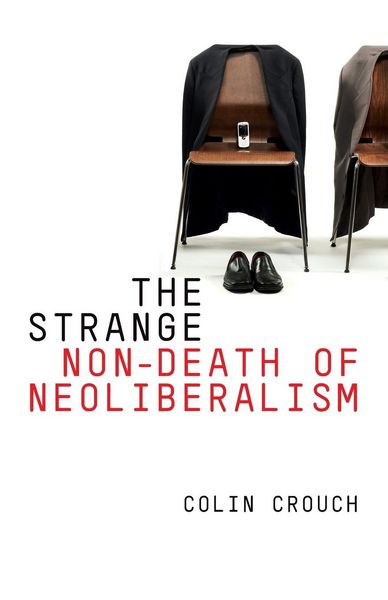
Strange Non-Death of Neoliberalism

32,99 €

inkl. gesetzl. MwSt., Versandkostenfrei


Beschreibung

Produktdetails

Einband

Taschenbuch

Erscheinungsdatum

01.08.2011

Verlag

John Wiley & Sons

Seitenzahl

212

Maße (L/B/H)

21,5/13,9/1,7 cm

Gewicht

290 g

Auflage

1. Auflage

Sprache

Englisch

ISBN

978-0-7456-5221-4

Beschreibung

Rezension

"A highly approachable and illuminating argument in political economy ... The story is packed with thought-provoking reframings: financial irresponsibility is now a 'collective good'; and 'the idea of a "job"' now seems very weird to me indeed."
The Guardian
 
"This highly accessible book makes its case persuasively."
Times Higher Education
 
"a valuable book that not only gives a very good overview of neo-liberalism and its failings, but also points to government errors and serves as a good primer in such things as imperfect information in markets."
Irish Journal of Sociology
 
"A rich and powerful book. It pushes towards an analysis of neoliberalism not as the set of liberalizing forces that it depicts itself as being, but rather as a grouping of impulses that have both hampered government and weakened market competition."
Crooked Timber
 
"An excellent contribution to the study of political economy that directly resolves the puzzle it has identified."
Transfer: European Review of Labour and Research
"A well-reasoned and tightly argued analysis of our present predicament. Although written for the intelligent general reader, rather than subject specialists, his insights constantly provoke and illuminate. Far from being merely a dry dissection of neoliberal theory, the book also addresses how to make corporations behave better."
LSE Politics Blog
 
"Takes forward and moves beyond Karl Polanyi's (1957) analysis of state/market relationsto match the changing conditions of the twenty-first century."
Journal of Contemporary European Studies
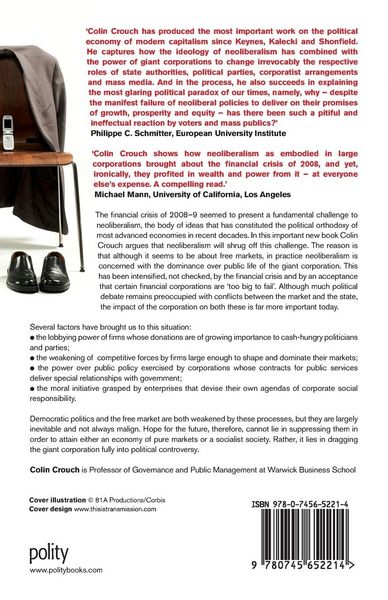
"The most important work on the political economy of modern capitalism since Keynes, Kalecki and Schonfield."
Philippe C. Schmitter, European University Institute
 
"Colin Crouch shows how neoliberalism as embodied in large corporations brought about the Great Recession of 2007 and yet, ironically, they profited in wealth and power from it - at everyone else's expense. A compelling read."
Michael Mann, University of California, Los Angeles
 
"An excellent contribution to the debate about neoliberalism. Crouch gives us a tightly reasoned and well balanced critique of the neoliberal philosophy that contributed significantly to the 2008 financial crisis. And his call for a more frank discussion in civil society of the moral and ethical assumptions behind neoliberalism is a refreshing addition to the traditional call for simply bringing the state back in to tame market forces."
John L. Campbell, Dartmouth College

Produktdetails

Einband

Taschenbuch

Erscheinungsdatum

01.08.2011

Verlag

John Wiley & Sons

Seitenzahl

212

Maße (L/B/H)

21,5/13,9/1,7 cm

Gewicht

290 g

Auflage

1. Auflage

Sprache

Englisch

ISBN

978-0-7456-5221-4

Herstelleradresse

Libri GmbH
Europaallee 1
36244 Bad Hersfeld
DE

Email: GPSR Kontakt

Ein neues Kapitel für Ihre Bücher

Ein neues Kapitel für Ihre Bücher

Schenken Sie Ihren alten Schätzen ein zweites Leben und erhalten dafür eine Thalia Geschenkkarte.

Jetzt verkaufen
Jetzt verkaufen

Noch keine Bewertungen vorhanden

Verfassen Sie die erste Bewertung zu diesem Artikel

Helfen Sie anderen Kundinnen und Kunden durch Ihre Meinung.

Kundinnen und Kunden meinen

Bewertungen (0)

Die Leseprobe wird geladen.
  • Produktbild: Strange Non-Death of Neoliberalism
  • Produktbild: Strange Non-Death of Neoliberalism
  • Acknowledgements vi

    Preface vii

    About this Book xi

    1 The Previous Career of Neoliberalism 1

    2 The Market and Its Limitations 24

    3 The Corporate Takeover of the Market 49

    4 Private Firms and Public Business 71

    5 Privatized Keynesianism: Debt in Place of Discipline 97

    6 From Corporate Political Entanglement to Corporate Social Responsibility 125

    7 Values and Civil Society 144

    8 What s Left of What s Right? 162

    References 181

    Further Reading 184

    Index 187