KI-Beratung Beta

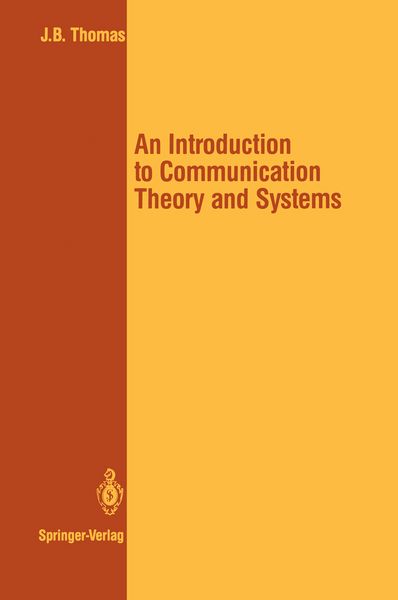
  • Produktbild: An Introduction to Communication Theory and Systems
  • Produktbild: An Introduction to Communication Theory and Systems

An Introduction to Communication Theory and Systems

49,99 €

inkl. gesetzl. MwSt., Versandkostenfrei


Beschreibung

Produktdetails

Einband

Taschenbuch

Erscheinungsdatum

08.12.1987

Abbildungen

XI, 349 p.

Verlag

Springer Us

Seitenzahl

349

Maße (L/B/H)

23,5/15,5/2 cm

Gewicht

552 g

Auflage

Softcover reprint of the original 1st ed. 1988

Sprache

Englisch

ISBN

978-0-387-96672-4

Beschreibung

Produktdetails

Einband

Taschenbuch

Erscheinungsdatum

08.12.1987

Abbildungen

XI, 349 p.

Verlag

Springer Us

Seitenzahl

349

Maße (L/B/H)

23,5/15,5/2 cm

Gewicht

552 g

Auflage

Softcover reprint of the original 1st ed. 1988

Sprache

Englisch

ISBN

978-0-387-96672-4

Herstelleradresse

Springer-Verlag KG
Sachsenplatz 4-6
1201 Wien
AT

Email: ProductSafety@springernature.com

Ein neues Kapitel für Ihre Bücher

Ein neues Kapitel für Ihre Bücher

Schenken Sie Ihren alten Schätzen ein zweites Leben und erhalten Sie dafür eine Thalia Geschenkkarte.

Jetzt verkaufen
Jetzt verkaufen

Noch keine Bewertungen vorhanden

Verfassen Sie die erste Bewertung zu diesem Artikel

Helfen Sie anderen Kundinnen und Kunden durch Ihre Meinung.

Kundinnen und Kunden meinen

Bewertungen (0)

  • Produktbild: An Introduction to Communication Theory and Systems
  • Produktbild: An Introduction to Communication Theory and Systems
  • 1-Introduction.- 1.1-Communication Systems.- 1.2-Statistical Communication Theory.- 1.3-Additional Reading.- 2-Probability and Random Variables.- 2.1-Introductory Remarks.- 2.2-Elements of Set Theory.- 2.3-A Classical Concept of Probability.- 2.4-Elements of Combinatorial Analysis.- 2.5-The Axiomatic Foundation of Probability Theory.- 2.6-Finite Sample Spaces.- 2.7-Fields,?-Fields, and Infinite Sample Spaces.- 2.8-Independence.- 2.9-Random Variables, Discrete and Continuous.- 2.10-Distribution Functions and Densities.- 2.11-The Transformation of Random Variables.- 2.12-Expectation.- 2.13-Moments.- 2.14-The Chebychev Inequality.- 2.15-Generating Functions.- 2.16-The Binomial Distribution.- 2.17- The Poisson Distribution.- 2.18- The Normal or Gaussian Distribution.- 2.19- Limit Theorems.- 2.20- Bivariate Distributions.- 2.21- The Bivariate Normal Distribution.- 2.22- The Multivariate Normal Distribution.- 2.23- Linear Transformations on Normal Random Variables.- Problems.- References.- 3-Random Processes and Spectral Analysis.- 3.1- Definition.- 3.2- Stationarity.- 3.3- Correlation Functions.- 3.4- Time Averages and Ergodicity.- 3.5- Convergence of Random Variables.- 3.6- Fourier Transforms.- 3.7- Integrals of Random Processes.- 3.8- Power Spectra.- 3.9- Shot Noise.- 3.10- Random Events in Time.- 3.11- The Mean and Autocorrelation Function of Shot Noise.- 3.12- The Amplitude Distribution of Shot Noise.- Problems.- References.- 4-Linear Filtering of Stationary Processes:Steady-State Analysis.- 4.1-Introduction.- 4.2-Discrete-Time Filters.- 4.3-Continuous-Time Filters.- 4.4-Complete Statistical Description of the Output of a Linear System.- 4.5-The Orthogonal Decomposition of Random Processes; Fourier Series.- 4.6-The Karhunen-Loeve Expansion.- 4.7-Optimal Truncation Properties of the Karhunen-Loeve Expansion.- 4.8-The Sampling Theorem.- 4.9-Narrow-Band Systems.- 4.10-Narrow-Band Systems with Added Sinusoids.- Problems.- References.- 5-Optimum Linear Systems: Steady-State Synthesis.- 5.1-Introduction.- I -The Matched Filter For Continuous-Time Inputs.- 5.2-Derivation.- 5.3-The Unrealizable Matched Filter in Continuous Time.- 5.4-Spectral Factorization for Continuous-Parameter Random Processes.- 5.5-Solution of the Integral Equation for the Continuous- Time Matched Filter.- II -The Matched Filter for Discrete-Time Inputs.- 5.6-Derivation.- 5.7-The Unrealizable Matched Filter in Discrete Time.- 5.8-Spectral Factorization for Discrete-Parameter Random Processes.- 5.9-Solution of the Integral Equation for the Discrete-Time Matched Filter.- III -The Linear Least-Mean-Squared-Error Filter for Continuous-Time Inputs.- 5.10-Formulation of the LLMSE Filtering and Prediction Problem in Continuous Time.- 5.11-The Unrealizable LLMSE Filter in Continuous Time.- 5.12-Solution of the Integral Equation for the Continuous- Time LLMSE Filter.- 5.13-The Mean-Squared Error for the Continuous-Time Case.- 5.14-The Pure Prediction Problem for the Continuous-Time Case.- IV-The Linear Least-Mean-Squared-Error Filter for Discrete-Time Inputs.- 5.15-Formulation of the LLMSE Filtering and Prediction Problem in Discrete Time.- 5.16-The Unrealizable LLMSE Filter in Discrete Time.- 5.17-Solution of the Integral Equation for the Discrete-Time LLMSE Filter.- 5.18-The Mean-Squared Error for the Discrete-Time Case.- 5.19-The Pure Prediction Problem for the Discrete-Time Case.- Problems.- Appendices.- Appendix A -The Riemann-Stieltjes Integral.- Appendix B -The Dirac Delta Function.- Appendix C -The Transformation of Coordinates.- Appendix D -Fourier Series and the Fourier and Laplace Transforms.- Appendix E -Some Inequalities Including Schwarz’s Inequality.- Appendix F -The Calculus of Variations.- Table-The Unit Normal Distribution.