KI-Beratung Beta

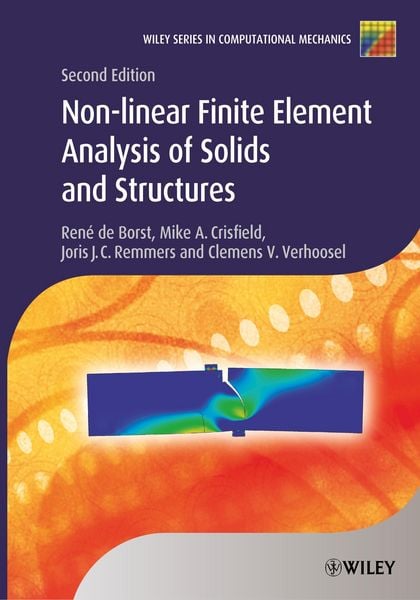
Produktbild: Nonlinear Finite Element Analysis of Solids and Structures

Nonlinear Finite Element Analysis of Solids and Structures

141,99 €

inkl. gesetzl. MwSt., Versandkostenfrei


Beschreibung

Produktdetails

Einband

Gebundene Ausgabe

Erscheinungsdatum

11.09.2012

Verlag

John Wiley & Sons

Seitenzahl

544

Maße (L/B/H)

25/17,5/3,3 cm

Gewicht

1106 g

Auflage

2nd Revised edition

Sprache

Englisch

ISBN

978-0-470-66644-9

Beschreibung

Produktdetails

Einband

Gebundene Ausgabe

Erscheinungsdatum

11.09.2012

Verlag

John Wiley & Sons

Seitenzahl

544

Maße (L/B/H)

25/17,5/3,3 cm

Gewicht

1106 g

Auflage

2nd Revised edition

Sprache

Englisch

ISBN

978-0-470-66644-9

Herstelleradresse

Libri GmbH
Europaallee 1
36244 Bad Hersfeld
DE

Email: gpsr@libri.de

Ein neues Kapitel für Ihre Bücher

Ein neues Kapitel für Ihre Bücher

Schenken Sie Ihren alten Schätzen ein zweites Leben und erhalten Sie dafür eine Thalia Geschenkkarte.

Jetzt verkaufen
Jetzt verkaufen

Noch keine Bewertungen vorhanden

Verfassen Sie die erste Bewertung zu diesem Artikel

Helfen Sie anderen Kundinnen und Kunden durch Ihre Meinung.

Kundinnen und Kunden meinen

Bewertungen (0)

Die Leseprobe wird geladen.
  • Produktbild: Nonlinear Finite Element Analysis of Solids and Structures
  • Preface xi
     
    Series Preface xiii
     
    Notation xv
     
    About the Code xxi
     
    PART I BASIC CONCEPTS AND SOLUTION TECHNIQUES
     
    1 Preliminaries 3
     
    1.1 A Simple Example of Non-linear Behaviour 3
     
    1.2 A Review of Concepts from Linear Algebra 5
     
    1.3 Vectors and Tensors 12
     
    1.4 Stress and Strain Tensors 17
     
    1.5 Elasticity 23
     
    1.6 The PyFEM Finite Element Library 25
     
    References 29
     
    2 Non-linear Finite Element Analysis 31
     
    2.1 Equilibrium and Virtual Work 31
     
    2.2 Spatial Discretisation by Finite Elements 33
     
    2.3 PyFEM: Shape Function Utilities 38
     
    2.4 Incremental-iterative Analysis 41
     
    2.5 Load versus Displacement Control 50
     
    2.6 PyFEM: A Linear Finite Element Code with Displacement Control 53
     
    References 62
     
    3 Geometrically Non-linear Analysis 63
     
    3.1 Truss Elements 64
     
    3.2 PyFEM: The Shallow Truss Problem 76
     
    3.3 Stress and Deformation Measures in Continua 85
     
    3.4 Geometrically Non-linear Formulation of Continuum Elements 91
     
    3.5 Linear Buckling Analysis 100
     
    3.6 PyFEM: A Geometrically Non-linear Continuum Element 103
     
    References 110
     
    4 Solution Techniques in Quasi-static Analysis 113
     
    4.1 Line Searches 113
     
    4.2 Path-following or Arc-length Methods 116
     
    4.3 PyFEM: Implementation of Riks' Arc-length Solver 124
     
    4.4 Stability and Uniqueness in Discretised Systems 129
     
    4.5 Load Stepping and Convergence Criteria 134
     
    4.6 Quasi-Newton Methods 138
     
    References 141
     
    5 Solution Techniques for Non-linear Dynamics 143
     
    5.1 The Semi-discrete Equations 143
     
    5.2 Explicit Time Integration 144
     
    5.3 PyFEM: Implementation of an Explicit Solver 149
     
    5.4 Implicit Time Integration 152
     
    5.5 Stability and Accuracy in the Presence of Non-linearities 156
     
    5.6 Energy-conserving Algorithms 161
     
    5.7 Time Step Size Control and Element Technology 164
     
    References 165
     
    PART II MATERIAL NON-LINEARITIES
     
    6 Damage Mechanics 169
     
    6.1 The Concept of Damage 169
     
    6.2 Isotropic Elasticity-based Damage 171
     
    6.3 PyFEM: A Plane-strain Damage Model 175
     
    6.4 Stability, Ellipticity and Mesh Sensitivity 179
     
    6.5 Cohesive-zone Models 185
     
    6.6 Element Technology: Embedded Discontinuities 190
     
    6.7 Complex Damage Models 198
     
    6.8 Crack Models for Concrete and Other Quasi-brittle Materials 201
     
    6.8.1 Elasticity-based Smeared Crack Models 201
     
    6.8.2 Reinforcement and Tension Stiffening 206
     
    6.9 Regularised Damage Models 210
     
    References 215
     
    7 Plasticity 219
     
    7.1 A Simple Slip Model 219
     
    7.2 Flow Theory of Plasticity 223
     
    7.3 Integration of the Stress-strain Relation 239
     
    7.4 Tangent Stiffness Operators 249
     
    7.5 Multi-surface Plasticity 252
     
    7.6 Soil Plasticity: Cam-clay Model 267
     
    7.7 Coupled Damage-Plasticity Models 270
     
    7.8 Element Technology: Volumetric Locking 271
     
    References 277
     
    8 Time-dependent Material Models 281
     
    8.1 Linear Visco-elasticity 281
     
    8.2 Creep Models 287
     
    8.3 Visco-plasticity 289
     
    References 303
     
    PART III STRUCTURAL ELEMENTS
     
    9 Beams and Arches 307
     
    9.1 A Shallow Arch 307
     
    9.2 PyFEM: A Kirchhoff Beam Element 317
     
    9.3 Corotational Elements 321
     
    9.4 A Two-dimensional Isoparametric Degenerate Continuum Beam Element 328
     
    9.5 A T