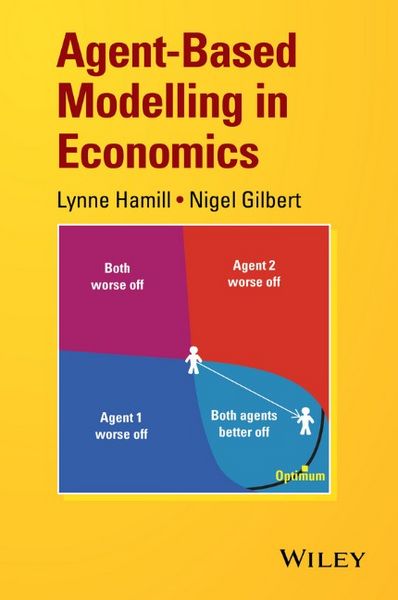
Agent-Based Modelling in Economics
58,99 €
inkl. gesetzl. MwSt.,
Beschreibung
Produktdetails
Einband
Gebundene Ausgabe
Erscheinungsdatum
26.01.2016
Verlag
John Wiley & Sons IncSeitenzahl
256
Maße (L/B/H)
23,3/14,6/2 cm
Gewicht
453 g
Auflage
1. Auflage
Sprache
Englisch
ISBN
978-1-118-45607-1
Lynne Hamill and Nigel Gilbert, Centre for Research in Social Simulation (CRESS), University of Surrey, UK
New methods of economic modelling have been sought as a result of the global economic downturn in 2008.This unique book highlights the benefits of an agent-based modelling (ABM) approach. It demonstrates how ABM can easily handle complexity: heterogeneous people, households and firms interacting dynamically. Unlike traditional methods, ABM does not require people or firms to optimise or economic systems to reach equilibrium. ABM offers a way to link micro foundations directly to the macro situation.
Key features:
* Introduces the concept of agent-based modelling and shows how it differs from existing approaches.
* Provides a theoretical and methodological rationale for using ABM in economics, along with practical advice on how to design and create the models.
* Each chapter starts with a short summary of the relevant economic theory and then shows how to apply ABM.
* Explores both topics covered in basic economics textbooks and current important policy themes; unemployment, exchange rates, banking and environmental issues.
* Describes the models in pseudocode, enabling the reader to develop programs in their chosen language.
* Supported by a website featuring the NetLogo models described in the book.
Agent-based Modelling in Economics provides students and researchers with the skills to design, implement, and analyze agent-based models. Third year undergraduate, master and doctoral students, faculty and professional economists will find this book an invaluable resource.
Ein neues Kapitel für Ihre Bücher
Ein neues Kapitel für Ihre Bücher
Schenken Sie Ihren alten Schätzen ein zweites Leben und erhalten Sie dafür eine Thalia Geschenkkarte.
Noch keine Bewertungen vorhanden
Verfassen Sie die erste Bewertung zu diesem Artikel
Helfen Sie anderen Kundinnen und Kunden durch Ihre Meinung.
Kurze Frage zu unserer Seite
Vielen Dank für Ihr Feedback
Wir nutzen Ihr Feedback, um unsere Produktseiten zu verbessern. Bitte haben Sie Verständnis, dass wir Ihnen keine Rückmeldung geben können. Falls Sie Kontakt mit uns aufnehmen möchten, können Sie sich aber gerne an unseren Kund*innenservice wenden.
zum Kundenservice