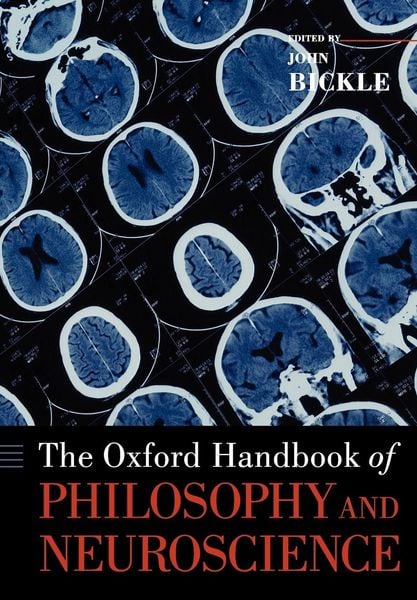
The Oxford Handbook of Philosophy and Neuroscience
-
- Hardcover
- Taschenbuch ausgewählt
- eBook
-
Sprache:Englisch
56,99 €
inkl. gesetzl. MwSt.,
Beschreibung
Produktdetails
Einband
Taschenbuch
Erscheinungsdatum
01.01.2013
Herausgeber
Bickle JohnVerlag
Oxford AcademicSeitenzahl
656
Maße (L/B/H)
24,4/17/3,6 cm
Gewicht
1114 g
Sprache
Englisch
ISBN
978-0-19-996550-2
The Oxford Handbook of Philosophy and Neuroscience is a state-of-the-art collection of interdisciplinary research spanning philosophy (of science, mind, and ethics) and current neuroscience. Containing chapters written by some of the most prominent philosophers working in this area, and in some cases co-authored with neuroscientists, this volume reflects both the breadth and depth of current work in this exciting field. Topics include the nature of explanation in neuroscience; whether and how current neuroscience is reductionistic; consequences of current research on the neurobiology of learning and memory, perception and sensation, neurocomputational modeling, and neuroanatomy; the burgeoning field of neuroethics and the neurobiology of motivation that increasingly informs it; implications from neurology and clinical neuropsychology, especially in light of some bizarre symptoms involving misrepresentations of self; the extent and consequences of multiple realization in actual neuroscience; the new field of neuroeudamonia; and the neurophilosophy of subjectivity. This volume will interest philosophers working in numerous fields who wish to see how current neuroscience is being brought to bear directly on philosophical issues. It will also be of interest to neuroscientists who wish to learn how the research programs of some of their colleagues are being enriched by interaction with philosophers, and finally to those working in any interdisciplinary field who wish to see how two seemingly disparate disciplines--one traditional and humanistic, the other new and scientific--are being brought together to both disciplines' mutual benefit.
Ein neues Kapitel für Ihre Bücher
Ein neues Kapitel für Ihre Bücher
Schenken Sie Ihren alten Schätzen ein zweites Leben und erhalten Sie dafür eine Thalia Geschenkkarte.
Noch keine Bewertungen vorhanden
Verfassen Sie die erste Bewertung zu diesem Artikel
Helfen Sie anderen Kundinnen und Kunden durch Ihre Meinung.
Kurze Frage zu unserer Seite
Vielen Dank für Ihr Feedback
Wir nutzen Ihr Feedback, um unsere Produktseiten zu verbessern. Bitte haben Sie Verständnis, dass wir Ihnen keine Rückmeldung geben können. Falls Sie Kontakt mit uns aufnehmen möchten, können Sie sich aber gerne an unseren Kund*innenservice wenden.
zum Kundenservice