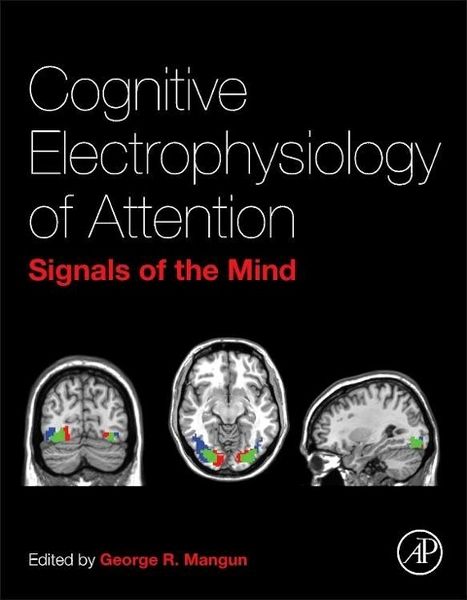
Produktbild: Cognitive Electrophysiology of Attention

Cognitive Electrophysiology of Attention Signals of the Mind

105,99 €

inkl. gesetzl. MwSt., Versandkostenfrei


Beschreibung

Produktdetails

Einband

Gebundene Ausgabe

Erscheinungsdatum

22.10.2013

Herausgeber

George R. Mangun

Verlag

Academic Press

Seitenzahl

304

Maße (L/B/H)

28,4/21,7/2,2 cm

Gewicht

1175 g

Sprache

Englisch

ISBN

978-0-12-398451-7

Beschreibung

Rezension

"Although this would generally not be a read-from-page-to-page composite, this book is elemental in that it builds on itself from chapter to chapter. It would not be advised to take on research of this strength without some background information on the topics of bias, neurophysiology, and mental health." --Doody

"Editor Mangun presents this text on the neural mechanisms of attention in three parts, drawing on EEG, ERP, fMRI, and neural population research. Part I discusses spatial attention,.Part II addresses higher-order processes of feature and object attention,...Part III explores the interaction of attention with cognitive processes,." --ProtoView.com, February 2014

Portrait

The Physiology of Cladocera is a much-needed summary of foundational information on these increasingly important model organisms. This unique and valuable summary is based on the world's literature, including Russian research not widely available until now. It offers systematically arranged data on the physiology of Cladocera, assisting with explanation of their life and distribution, as well as discussion on directions of future research. Special expert contributions in genetics, immunology, and cytology round out the physiological chapters and provide comprehensive insight into the state of knowledge of Cladocera and its underlying mechanisms.

Cladocera crustaceans make up a significant part of the natural communities and biological productivity of fresh waters. In recent decades, they have become globally studied for many purposes, including systematics, genetic, molecular, ecological and evolutionary biology studies. They are also used as "sentinel" organisms for assessing water quality and the environment. In addition, the genome of Daphnia (a genus within Cladocera) was recently sequenced and published, giving this system a much wider exposure. It has also led to a rapidly growing awareness of the importance of understanding physiological processes as they relate to evolutionary and ecological genomics and ecogenomic toxicology.

Despite the increasing use of Cladocera in research and study, physiological background information on these creatures is fragmentary. Hundreds of unconnected publications have been accumulated on their physiology, and a synthesis and general representation of the literature has been much needed for the many researchers working with this organism. The Physiology of Cladocera stands alone as a valuable and comprehensive offering in this area for many researchers and students.

Produktdetails

Einband

Gebundene Ausgabe

Erscheinungsdatum

22.10.2013

Herausgeber

George R. Mangun

Verlag

Academic Press

Seitenzahl

304

Maße (L/B/H)

28,4/21,7/2,2 cm

Gewicht

1175 g

Sprache

Englisch

ISBN

978-0-12-398451-7

Herstelleradresse

Libri GmbH
Europaallee 1
36244 Bad Hersfeld
DE

Email: gpsr@libri.de

Ein neues Kapitel für Ihre Bücher

Ein neues Kapitel für Ihre Bücher

Schenken Sie Ihren alten Schätzen ein zweites Leben: Einfach Barcode scannen, Versandetikett ausdrucken, Bücher verschicken und Thalia Geschenkkarte erhalten.

Jetzt verkaufen
Jetzt verkaufen

Kundinnen und Kunden meinen

0 Bewertungen

Informationen zu Bewertungen

Zur Abgabe einer Bewertung ist eine Anmeldung im Konto notwendig. Die Authentizität der Bewertungen wird von uns nicht überprüft. Wir behalten uns vor, Bewertungstexte, die unseren Richtlinien widersprechen, entsprechend zu kürzen oder zu löschen.

Die Bewertungen sind nach Format, Anzahl Sterne und Datum sortiert.

Verfassen Sie die erste Bewertung zu diesem Artikel

Helfen Sie anderen Kund*innen durch Ihre Meinung

Kundinnen und Kunden meinen

0 Bewertungen filtern

Die Leseprobe wird geladen.
  • Produktbild: Cognitive Electrophysiology of Attention
  • Section 1: Spatial Attention
    1. Profiling the Spatial Focus of Visual Attention
    2. How the Brain Prevents and Terminates Shifts of Attention
    3. Neuronal and Neural-Population Mechanisms of Voluntary Visual-Spatial Attention
    4. Sequential Effects in the Central Cue Posner Paradigm - On-line Bayesian Learning
    5. ERP-fMRI Combination for the Study of Visual Perception and Spatial Attention
    6. Source Localization of Visual Stimuli in Peripersonal Space
    7. Involuntary Cross-Modal Spatial Attention Influences Visual Perception

    Section 2: Feature and Object Attention
    8. Object-Category Processing, Perceptual Awareness, and the Role of Attention during Motion-Induced Blindness
    9. Feature- and Object-Based Attention: Electrophysiological and Hemodynamic Correlates
    10. Neural Mechanisms of Feature-Based Attention
    11. Effects of Preparatory Attention to Non-Spatial Features in the Visual Cortex
    12. The Neural Basis of Color Binding to an Attended Object
    13. Switching Attention between the Local and Global Levels in Visual Objects
    14. Contour Integration: Sensory, Perceptual, and Attention-Based ERP Components
    15. Attentional Control of Multisensory Integration is Preserved in Aging

    Section 3: Attention and Cognitive Processes
    16. An Evolutionary Perspective on Attentional Processes
    17. Stimulus-Preceding Negativity (SPN) And Attention to Rewards
    18. A Neural Measure of Item Individuation
    19. Selective Attention, Processing Load, and Semantics: Insights from Human Electrophysiology
    20. Altered N400 Congruity Effects in Parkinson's Disease Without Dementia
    21. Oscillations and Behavior: The Role of Phase-Amplitude Coupling in Cognition