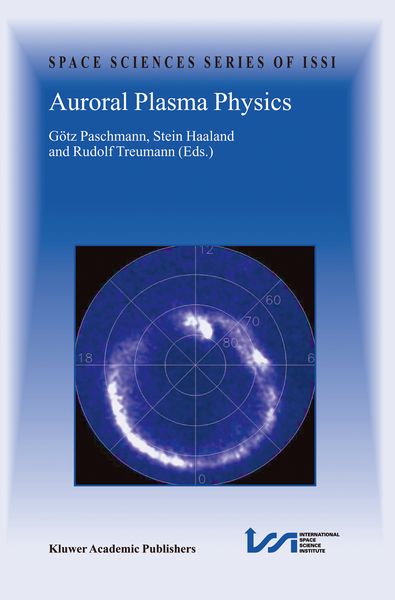
Produktbild: Auroral Plasma Physics
Band 15 - 13%

Auroral Plasma Physics

13% sparen

101,99 € UVP 117,69 €

inkl. gesetzl. MwSt., Versandkostenfrei


Beschreibung

Produktdetails

Einband

Taschenbuch

Erscheinungsdatum

03.10.2013

Herausgeber

Götz Paschmann + weitere

Verlag

Springer Netherland

Seitenzahl

486

Maße (L/B/H)

24/16/2,8 cm

Gewicht

797 g

Auflage

Softcover reprint of the original 1st ed. 2003

Sprache

Englisch

ISBN

978-94-010-3786-0

Beschreibung

Produktdetails

Einband

Taschenbuch

Erscheinungsdatum

03.10.2013

Herausgeber

Verlag

Springer Netherland

Seitenzahl

486

Maße (L/B/H)

24/16/2,8 cm

Gewicht

797 g

Auflage

Softcover reprint of the original 1st ed. 2003

Sprache

Englisch

ISBN

978-94-010-3786-0

Herstelleradresse

Springer-Verlag KG
Sachsenplatz 4-6
1201 Wien
AT

Email: GPSR Kontakt

Ein neues Kapitel für Ihre Bücher

Ein neues Kapitel für Ihre Bücher

Schenken Sie Ihren alten Schätzen ein zweites Leben: Einfach Barcode scannen, Versandetikett ausdrucken, Bücher verschicken und Thalia Geschenkkarte erhalten.

Jetzt verkaufen
Jetzt verkaufen

Noch keine Bewertungen vorhanden

Verfassen Sie die erste Bewertung zu diesem Artikel

Helfen Sie anderen Kundinnen und Kunden durch Ihre Meinung.

Kundinnen und Kunden meinen

Bewertungen (0)

  • Produktbild: Auroral Plasma Physics
  • 1. Introduction.- 1.1 Visible Aurorae.- 1.2 Ionospheric Framework.- 1.3 Magnetospheric Framework.- 1.4 Magnetosphere-Ionosphere Coupling.- 1.5 Large Scale Magnetospheric Flows and Dynamics.- 1.6 An Overview of the Book.- 2. Remote Sensing of Auroral Arcs.- 2.1 Quiet Auroral Arc.- 2.2 Diffuse and Pulsating Aurora.- 2.3 Proper Motion of Auroral Arcs.- 2.4 Physical Characteristics.- 2.5 Auroral Morphology.- 2.6 Distortions in Auroral Arcs.- 2.7 Black Aurora.- 3. Theoretical Building Blocks.- 3.1 The Conducting Ionosphere.- 3.1.1 Ionospheric Conductivity.- 3.1.2 Conductivity from Electron Precipitation.- 3.2 Magnetospheric Current Sources.- 3.2.1 Generalized Ohm’s Law.- 3.2.2 Field-Aligned Current Generation.- 3.2.3 Energy Release, Transport and Conversion.- 3.2.4 Magnetospheric Driving of the Ionosphere.- 3.3 Parallel Electric Fields.- 3.3.1 Current-Voltage Relation in the Upward j? Regions.- 3.3.2 Current-Voltage Relation in the Downward j? Regions.- 3.3.3 The Nature of E?.- 3.3.4 Static Magnetosphere-Ionosphere Coupling.- 3.4 Dynamic Magnetosphere-Ionosphere Coupling.- 3.4.1 Ideal MHD Alfvén Waves.- 3.4.2 Reflection of Alfvén Waves.- 3.4.3 Two-Fluid Shear-Alfvén Waves.- 3.5 Wave-Particle Interactions.- 3.5.1 Anomalous Resistivity.- 3.5.2 Transverse Ion Heating.- 3.5.3 Pitch Angle Diffusion.- 3.5.4 Phase-Space Holes.- 4. In Situ Measurements in the Auroral Plasma.- 4.1 Upward Current Region Processes.- 4.1.1 Electron Acceleration.- 4.1.2 Ion Beams and the Density Cavity.- 4.1.3 Electric Field Signature and Structure.- 4.1.4 Limitations of the Quasistatic Arc Model.- 4.2 Downward Current Region Processes.- 4.2.1 Upgoing Electrons.- 4.2.2 Ion Conics and Ion Precipitation.- 4.2.3 Electric Fields.- 4.2.4 Current-Voltage Relations.- 4.2.5 Limitations of a Quasistatic Model.- 4.3 Waves and Radiation.- 4.3.1 Beam Modification: AKR, VLF, BBELF, ESW.- 4.3.2 Ion Effects: EMIC, EIC, IAW, ELF.- 4.3.3 Diagnostic Wave Signatures.- 4.4 Time-Dependent Alfvénic Processes.- 4.4.1 Wave Impedance.- 4.4.2 Dispersive Travelling Alfvén Waves.- 4.4.3 Standing Alfvén Waves.- 4.5 Specific Regions.- 4.5.1 Nightside Polar Cap Boundary.- 4.5.2 Polar Cusp.- 4.5.3 Other Auroral Dispersion Signatures.- 4.5.4 Diffuse Aurora.- 4.5.5 Subauroral Ion Drifts.- 5. Statistics and Mapping of Auroral Features.- 5.1 Statistical and Empirical Studies of Auroral Distributions.- 5.1.1 Ionospheric Observations and Empirical Models.- 5.1.2 Auroral Luminosity.- 5.1.3 Auroral In Situ Observations.- 5.2 Mapping Auroral Features to the Magnetosphere.- 5.2.1 Topological Magnetic Mapping.- 5.2.2 Assimilative Mapping and Synoptic Maps.- 5.2.3 Morphological Mapping.- 5.2.4 Mapping Complications.- 6. ELECTRODYNAMICS OF AURORAL FORMS.- 6.1 Eveningside Discrete Arcs.- 6.1.1 The Arc as Part of a Quasi-Static Current Circuit.- 6.1.2 Relation to the High Altitude Electric Field.- 6.1.3 A Synoptic Case Study of an Evening Arc.- 6.2 Westward Traveling Surge.- 6.2.1 Three-Dimensional Ionospheric Current System.- 6.2.2 Associated Particle Precipitation.- 6.3 Omega Bands.- 6.3.1 Three-Dimensional Ionospheric Current System.- 6.3.2 Particle Precipitation.- 6.3.3 Conjugate Magnetospheric Observations.- 6.4 Auroral Streamers.- 6.4.1 Ground Magnetic Signatures.- 6.4.2 Current Systems.- 6.4.3 Role of Bursty Bulk Flows.- 6.5 Polar Cap Aurora.- 6.5.1 Polar Auroral Arc.- 6.5.2 IMF Dependence.- 6.5.3 Plasma Sources.- 6.5.4 Global Electrodynamics.- 7. Theoretical Models.- 7.1 Static E? Models.- 7.1.1 Numerical Simulations.- 7.1.2 Theory and Data.- 7.2 Boundary Layer Coupling to the Ionosphere.- 7.3 Current and Voltage Generators.- 7.3.1 Pure Current or Voltage Generators.- 7.3.2 Generator Conductivity Models.- 7.3.3 Tau Generator Model.- 7.3.4 Dynamic Generator Models.- 7.4 Resonant Alfvén Waves.- 7.4.1 Resonant Mode Coupling.- 7.4.2 Field Line Resonances.- 7.4.3 Ionospheric Alfvén Resonator.- 7.5 Propagating Arc Models.- 7.5.1 Ionospheric Feedback Models.- 7.5.2 Propagating Arcs and Magnetic Energy.- 7.5.3 Stationary Alfvén Waves.- 7.6 Transient Acceleration.- 7.7.1 Large-Scale Features and Magnetospheric Sources.- 7.7.2 The Substorm Current Wedge.- 7.7.3 Formation of the Auroral Bulge.- 7.7.4 Energy Flow and Conversion.- 7.7.5 Stress Transmission.- 7.7.5 Small-Scale Source Regions.- 7.8 Essential Elements of an Integrated Theory.- 7.8.1 Outline.- 7.8.2 Energy Flow.- 7.8.3 Current Filamentation.- 7.8.4 Feedback on Generator.- 7.8.5 Global Impact of the Aurora.- 8 DYNAMIC COUPLING TO THE MAGNETOSPHERE.- 8.1 Magnetosphere as an Auroral Precipitation Source.- 8.2 Magnetospheric Energy Circulation.- 8.2.1 Pseudobreakups.- 8.2.2 Magnetospheric Substorms.- 8.2.3 Magnetic Storms.- 8.2.4 Steady Magnetospheric Convection.- 8.2.5 Magnetospheric Energy Budget.- 8.3 Magnetospheric Control.- 8.3.1 Impulsive Plasma Acceleration.- 8.3.2 Pulsed Reconnection.- 8.3.3 Sporadic Narrow Plasma Jets.- 8.3.4 BBF Signatures in the Aurora.- 8.4 Ionospheric Control.- 8.4.1 Ionospheric Effects on the Magnetosphere.- 8.4.2 Pseudobreakups and Ionospheric State.- 8.4.3 Effects of the Neutral Wind.- 8.5 Open Issues.- 9. The Aurora as a Universal Phenomenon.- 9.1 Aurora on Other Planets.- 9.1.1 Solar System Planets.- 9.1.2 Aurora on Exoplanets.- 9.2 Auroral Acceleration in Astrophysical Objects.- 9.2.1 A Condensed Auroral Theory.- 9.2.2 Application to Solar Flares.- 9.2.3 Cataclysmic Variables.- 9.2.4 Accreting Neutron Stars.- References.- Author Addresses.