KI-Beratung Beta

Gutscheinbedingungen

Gültig bis 21.10.2026 | Gültig für nicht preisgebundene fremdsprachige Bücher | Einzelne Artikel können ausgeschlossen sein | Online auf thalia.de und in der Thalia App einlösbar | Click & Collect nur mit Online-Zahlung (Paypal/Kreditkarte) vorab | Nicht kombinierbar mit anderen Gutscheinen oder Preisaktionen | Nur einmal pro Einkauf einlösbar | Gutschein wird auf max. 500€ Bestellwert angerechnet | Keine Barauszahlung | Nicht gültig für Versandkosten und Services

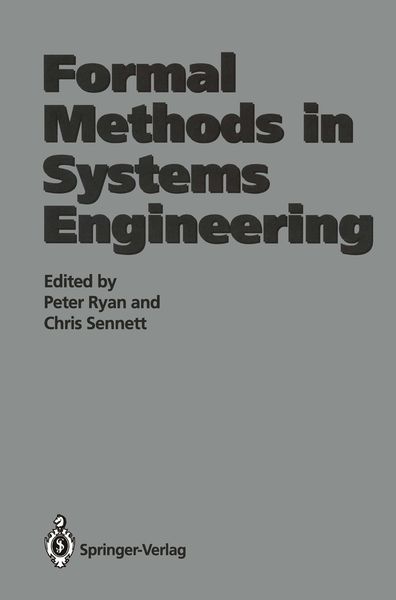
  • Produktbild: Formal Methods in Systems Engineering
  • Produktbild: Formal Methods in Systems Engineering

Formal Methods in Systems Engineering

53,99 €

inkl. gesetzl. MwSt., Versandkostenfrei


Beschreibung

Produktdetails

Einband

Taschenbuch

Erscheinungsdatum

16.06.1993

Abbildungen

XI, 195 p.

Herausgeber

Peter Ryan + weitere

Verlag

Springer Berlin

Seitenzahl

195

Maße (L/B/H)

23,5/15,5/1,2 cm

Gewicht

324 g

Auflage

1st Edition

Sprache

Englisch

ISBN

978-3-540-19751-5

Beschreibung

Produktdetails

Einband

Taschenbuch

Erscheinungsdatum

16.06.1993

Abbildungen

XI, 195 p.

Herausgeber

Verlag

Springer Berlin

Seitenzahl

195

Maße (L/B/H)

23,5/15,5/1,2 cm

Gewicht

324 g

Auflage

1st Edition

Sprache

Englisch

ISBN

978-3-540-19751-5

Herstelleradresse

Springer-Verlag GmbH
Tiergartenstr. 17
69121 Heidelberg
DE

Email: ProductSafety@springernature.com

Ein neues Kapitel für Ihre Bücher

Ein neues Kapitel für Ihre Bücher

Schenken Sie Ihren alten Schätzen ein zweites Leben und erhalten Sie dafür eine Thalia Geschenkkarte.

Jetzt verkaufen
Jetzt verkaufen

Noch keine Bewertungen vorhanden

Verfassen Sie die erste Bewertung zu diesem Artikel

Helfen Sie anderen Kundinnen und Kunden durch Ihre Meinung.

Kundinnen und Kunden meinen

Bewertungen (0)

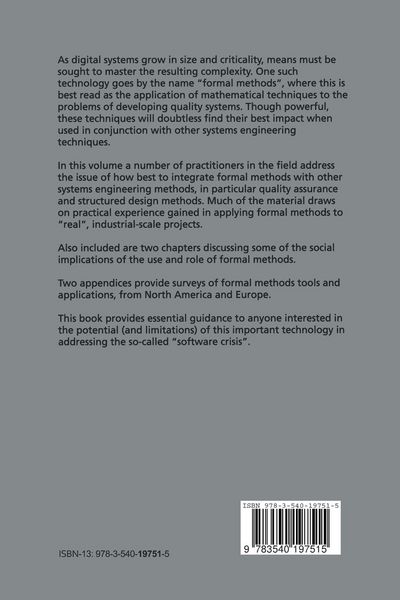
  • Produktbild: Formal Methods in Systems Engineering
  • Produktbild: Formal Methods in Systems Engineering
  • 1 Introduction.- 1.1 What Are Formal Methods?.- 1.2 Formal Methods and Mathematics.- 1.3 What Good Are Formal Methods?.- 1.4 The Myth of Control.- 1.5 Hyperprogramming.- 1.6 Recommendations.- 2 Formal Methods of Software Development: Painted into the Corner of High-Integrity Computing?.- 2.1 The Dominant Rationale for Formal Methods.- 2.2 Some Pragmatic Objections to Formal Methods.- 2.3 Dissolving Resistance to Formal Methods?.- 2.4 A Brief Sketch of Formal Methods in High-Integrity Computing.- 2.5 The Projects.- 2.6 The Formal Methods Community in High-Integrity Computing.- 2.7 The Information Networks.- 2.8 Does the Use of Formal Methods Within High-Integrity Computing Perpetuate its “Myths”?.- 3 The Social Negotiation of Proof: An Analysis and a Further Prediction.- 3.1 Background.- 3.2 VIPER.- 3.3 Disputing “Proof”.- 3.4 Formal Proof and Rigorous Argument.- 3.5 A Further Prediction.- 3.6 Conclusion.- 4 On Constructing Large Software Systems.- 4.1 Introduction.- 4.2 People.- 4.3 Frames.- 4.4 Sets.- 4.5 Programs.- 4.6 Proof.- 4.7 Tools.- 4.8 Conclusion.- 4.9 Acknowledgments.- 5 Composition of Descriptions: A Progress Report.- 5.1 Introduction.- 5.2 Why Compose Descriptions ?.- 5.3 What is Described?.- 5.4 What is a Description?.- 5.5 What is Composition?.- 5.6 Description Reuse.- 5.7 Conclusion.- 6 Integrating Methods in Practice.- 6.1 Introduction.- 6.2 Development and Development Methods.- 6.3 Aspects of Specification.- 6.4 Aspects of Design.- 6.5 Implications for Research and Development.- 7 Formal Methods and Product Documentation.- 7.1 Introduction.- 7.2 The Fully Formalised Software Product.- 7.3 The Elements of Product Documentation.- 7.4 Product Documentation and the Product Range.- 7.5 Product Documentation and Product Development.- 7.6 ProductDocumentation and Customers.- 7.7 Developing from a Fully Formalised Base.- 7.8 New Requirements.- 7.9 Errors Detected Before Release.- 7.10 Errors Detected After Release.- 7.11 How to Get There.- 7.12 Summary.- 7.13 Acknowledgments.- 8 Software Quality: A Modelling and Measurement View.- 8.1 Software Quality Needs.- 8.2 Modelling Software Experiences.- 8.3 Model Evolution.- 8.4 An Organization for Packaging Experience Models for Reuse.- 8.5 Conclusions.- 9 Modelling Working Group Summary.- 9.1 Description.- 9.2 Discussion Topics.- 9.3 Discussion.- 9.4 How Does Mathematical Modelling Help to Increase our Understanding of Digital Systems?.- 9.5 What is Required to Validate that a Mathematical Model Describes a Digital System Accurately?.- 9.6 Conclusions.- 10 Quality Assurance Working Group.- 10.1 Group Description.- 10.2 Quality Assurance vs. Quality Control.- 10.3 What Is a Formal Method?.- 10.4 Integration of Formal Methods and Quality Control.- 10.5 A Plan to Integrate Formal Methods into QC/QA.- 11 Design Methods Working Group.- 11.1 Description.- 11.2 The Context of Formal Methods.- 11.3 The Role of Proof in Assurance.- 11.4 Analytical Capabilities of Formal Methods.- 11.5 Foundational Capabilities of Formal Methods.- 11.6 The Role of Formal Methods with Respect to the Software Development Process.- 11.7 Formal Methods During Development and Implementation.- 11.8 Education.- 11.9 Tools.- 12 Conclusions.- A Survey of Formal Methods Tools.- B Survey of Formal Methods Applications.- C Acronyms and Trademarks.- List of Contributors.