
KI-Beratung Beta

  • Produktbild: Regulation of Immune Gene Expression
  • Produktbild: Regulation of Immune Gene Expression
Band 13

Regulation of Immune Gene Expression

97,99 €

inkl. gesetzl. MwSt., Versandkostenfrei


Beschreibung

Produktdetails

Einband

Taschenbuch

Erscheinungsdatum

04.02.2012

Abbildungen

XIV, 360 p.

Verlag

Humana Press

Seitenzahl

360

Maße (L/B/H)

23,5/15,5/2,1 cm

Gewicht

569 g

Auflage

Softcover reprint of the original 1st ed. 1986

Sprache

Englisch

ISBN

978-1-4612-9399-6

Beschreibung

Produktdetails

Einband

Taschenbuch

Erscheinungsdatum

04.02.2012

Abbildungen

XIV, 360 p.

Verlag

Humana Press

Seitenzahl

360

Maße (L/B/H)

23,5/15,5/2,1 cm

Gewicht

569 g

Auflage

Softcover reprint of the original 1st ed. 1986

Sprache

Englisch

ISBN

978-1-4612-9399-6

Herstelleradresse

Springer-Verlag GmbH
Tiergartenstr. 17
69121 Heidelberg
DE

Email: ProductSafety@springernature.com

Ein neues Kapitel für Ihre Bücher

Ein neues Kapitel für Ihre Bücher

Schenken Sie Ihren alten Schätzen ein zweites Leben und erhalten Sie dafür eine Thalia Geschenkkarte.

Jetzt verkaufen
Jetzt verkaufen

Noch keine Bewertungen vorhanden

Verfassen Sie die erste Bewertung zu diesem Artikel

Helfen Sie anderen Kundinnen und Kunden durch Ihre Meinung.

Kundinnen und Kunden meinen

Bewertungen (0)

  • Produktbild: Regulation of Immune Gene Expression
  • Produktbild: Regulation of Immune Gene Expression
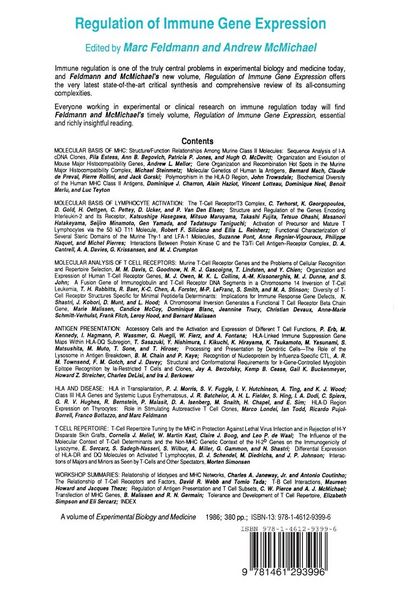
  • A. Molecular Basis of MHC.- Structure/Function Relationships Among Murine Class II Molecules: Sequence Analysis of l-A cDNA Clones.- Organization and Evolution of Mouse Major Histocompatibility Genes.- Gene Organization and Recombination Hot Spots in the Murine Major Histocompatibility Complex.- Molecular Genetics of Human la Antigens.- Polymorphism in the HLA-D Region.- Biochemical Diversity of the Human MHC Class II Antigens.- B. Molecular Basis of Lymphocyte Activation.- The T-Cell Receptor/T3 Complex.- Structure and Regulation of the Genes Encoding lnterleukin-2 and Its Receptor.- Activation of Precursor and Mature T Lymphocytes via the 50 kD T11 Molecule.- Functional Characterization of Several Steric Domains of the Murine Thy-1 and LFA-1 Molecules.- Interactions Between Protein Kinase C and the T3/T Cell Antigen-Receptor Complex.- C. Molecular Analysis of T Cell Receptors.- Murine T-Cell Receptor Genes and the Problems of Cellular Recognition and Repertoire Selection.- Organization and Expression of Human T-Cell Receptor Genes.- A Fusion Gene of Immunoglobulin and T-Cell Receptor DNA Segments in a Chromosome 14 Inversion of T-Cell Leukemia.- Diversity of T-Cell Receptor Structures Specific for Minimal Peptide/la Determinants: Implications for Immune Response Gene Defects.- A Chromosomal Inversion Generates a Functional T Cell Receptor ? Chain Gene.- D. Antigen Presentation.- Accessory Cells and the Activation and Expression of Different T Cell Functions.- HLA-Linked Immune Suppression Gene Maps Within HLA-DQ Subregion.- Processing and Presentation by Dendritic Cells—The Role of the Lysosome in Antigen Breakdown.- Recognition of Nucleoprotein by Influenza-Specific CTL.- Structural and Conformational Requirements for Ir-Gene-Controlled Myoglobin EpitopeRecognition by la-Restricted T Cells and Clones.- E. Hla and Disease.- HLA in Transplantation.- Class III HLA Genes and Systemic Lupus Erythematosus.- HLA-D Region Expression on Thyrocytes: Role in Stimulating Autoreactive T Cell Clones.- F. T Cell Repertoire.- T-Cell Repertoire Tuning by the MHC in Protection Against Lethal Vims Infection and in Rejection of H-Y Disparate Skin Grafts.- The Influence of the Molecular Context of T-Cell Determinants and the Non-MHC Genetic Context of the H-2b Genes on the Immunogenicity of Lysozyme.- Differential Expression of HLA-DR and DQ Molecules on Activated T Lymphocytes.- Interactions of Majors and Minors as Seen by T-Cells and Other Spectators.- Workshop Summaries.- Relationship of Idiotypes and MHC Networks.- The Relationship of T-Cell Receptors and Factors.- T-B Cell Interactions.- Regulation of Antigen Presentation and T Cell Subsets.- Transfection of MHC Genes.- Tolerance and Development of T Cell Repertoire.