KI-Beratung Beta

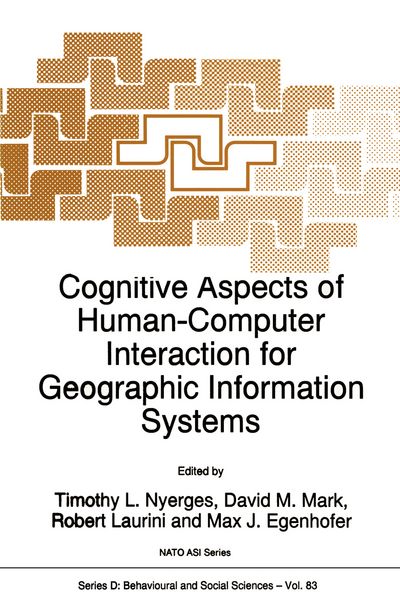
  • Produktbild: Cognitive Aspects of Human-Computer Interaction for Geographic Information Systems
  • Produktbild: Cognitive Aspects of Human-Computer Interaction for Geographic Information Systems
Band 83

Cognitive Aspects of Human-Computer Interaction for Geographic Information Systems

Aus der Reihe NATO Science Series D:

187,99 €

inkl. gesetzl. MwSt., Versandkostenfrei


Beschreibung

Produktdetails

Einband

Taschenbuch

Erscheinungsdatum

11.10.2012

Abbildungen

XI, 435 p.

Herausgeber

T.L. Nyerges + weitere

Verlag

Springer Netherland

Seitenzahl

435

Maße (L/B/H)

24/16/2,5 cm

Gewicht

711 g

Auflage

Softcover reprint of the original 1st edition 1995

Sprache

Englisch

ISBN

978-94-010-4049-5

Beschreibung

Produktdetails

Einband

Taschenbuch

Erscheinungsdatum

11.10.2012

Abbildungen

XI, 435 p.

Herausgeber

Verlag

Springer Netherland

Seitenzahl

435

Maße (L/B/H)

24/16/2,5 cm

Gewicht

711 g

Auflage

Softcover reprint of the original 1st edition 1995

Sprache

Englisch

ISBN

978-94-010-4049-5

Herstelleradresse

Springer-Verlag GmbH
Tiergartenstr. 17
69121 Heidelberg
DE

Email: ProductSafety@springernature.com

Ein neues Kapitel für Ihre Bücher

Ein neues Kapitel für Ihre Bücher

Schenken Sie Ihren alten Schätzen ein zweites Leben und erhalten Sie dafür eine Thalia Geschenkkarte.

Jetzt verkaufen
Jetzt verkaufen

Noch keine Bewertungen vorhanden

Verfassen Sie die erste Bewertung zu diesem Artikel

Helfen Sie anderen Kundinnen und Kunden durch Ihre Meinung.

Kundinnen und Kunden meinen

Bewertungen (0)

  • Produktbild: Cognitive Aspects of Human-Computer Interaction for Geographic Information Systems
  • Produktbild: Cognitive Aspects of Human-Computer Interaction for Geographic Information Systems
  • Section 1: Introduction.- 1.1 Cognitive Aspects of Human-Computer Interaction for Geographic Information Systems: An Introduction.- 1.2 An Overview of HCI for GIS.- Section 2: Spatial Cognition and HCI for GIS.- 2.1 Spatial Concepts and Cognitive Models for Geographic Information Use.- 2.2 Primitives of Spatial Knowledge.- 2.3 HCI Aspects of a Framework for the Qualitative Representation of Space.- 2.4 Cognitive Issues in the Evolution of GIS User Knowledge.- Section 3: User Behavior.- 3.1 Process Tracing Methods in the Decision Sciences.- 3.2 Cognitive Modelling: Experiences in Human-Computer Interaction.- 3.3 7 ± 2 Questions and Answers about Metaphors for GIS User Interfaces.- 3.4 Feet on the Ground: Studying User-GIS Interaction in the Workplace.- Section 4: User Interfaces.- 4.1 Towards Visual Interfaces for Multi-Source Updating of Geographic Information.- 4.2 Definition of a Visual Language for GIS.- 4.3 Human-Computer Interaction Aspects of Visual-Interactive Locational Analysis.- 4.4 Some Cognitive and Technical Aspects of Hypermaps.- 4.5 Human-Computer Interaction Considerations in Terrain Modelling and Visualization.- 4.6 GIS & Multimedia Applications to Support Environmental Impact Assessment and Local Planning.- 4.7 The Natural Representation of Mapping and Surveying Data: Applying the Virtual Worlds Paradigm.- Section 5: Cross-Cultural Influences.- 5.1 Cultural Differences and Cultural Aspects in GIS.- 5.2 Protocol Analysis for Cross-Cultural GIS Design: The Importance of Encoding Resolution.- Section 6: Collaborative GIS — Computer Supported Cooperative Work.- 6.1 Understanding Collaborative Use of GIS Through Social Cognition.- 6.2 Geographic Interaction in the City Planning Context: Beyond the Multimedia Prototype.- 6.3 Cognitive Task PerformanceUsing a Spatial Decision Support System for Groups.- Section 7: Task Analysis and Design Methodologies.- 7.1 Tasks and Task Descriptions for GIS.- 7.2 A Conceptual Framework for Improving Human-Computer Interaction in Locational Decision-Making.- 7.3 A Task Analysis Approach to the Visualization of Geographic Data.- 7.4 Geographic Information Systems, Work Analysis, and System Design.- 7.5 Cognitive Ergonomics Analysis Methodology.- Section 8: Research Directions : Reports from the Discussion Groups.- Section 8: Research Directions : Reports from the Discussion Groups.- Appendix: NATO Advanced Research Workshop Participants.