
KI-Beratung Beta

  • Produktbild: Mechanisms of Lymphocyte Activation and Immune Regulation V
  • Produktbild: Mechanisms of Lymphocyte Activation and Immune Regulation V
Band 365

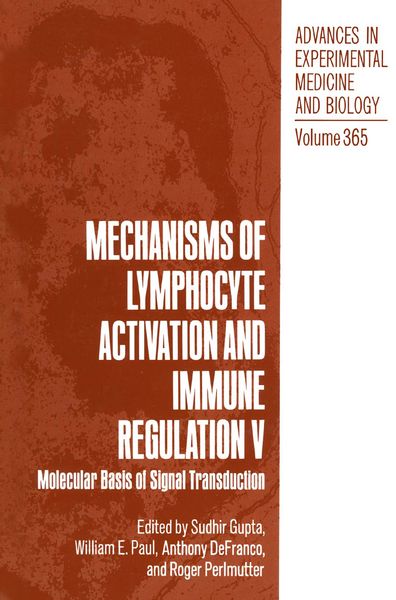
Mechanisms of Lymphocyte Activation and Immune Regulation V Molecular Basis of Signal Transduction

146,99 €

inkl. gesetzl. MwSt., Versandkostenfrei


Beschreibung

Produktdetails

Einband

Taschenbuch

Erscheinungsdatum

06.06.2013

Abbildungen

IX, 264 p.

Herausgeber

Sudhir Gupta + weitere

Verlag

Springer Us

Seitenzahl

264

Maße (L/B/H)

23,5/15,5/1,6 cm

Gewicht

423 g

Auflage

Softcover reprint of the original 1st ed. 1994

Sprache

Englisch

ISBN

978-1-4899-0989-3

Beschreibung

Produktdetails

Einband

Taschenbuch

Erscheinungsdatum

06.06.2013

Abbildungen

IX, 264 p.

Herausgeber

Verlag

Springer Us

Seitenzahl

264

Maße (L/B/H)

23,5/15,5/1,6 cm

Gewicht

423 g

Auflage

Softcover reprint of the original 1st ed. 1994

Sprache

Englisch

ISBN

978-1-4899-0989-3

Herstelleradresse

Springer-Verlag GmbH
Tiergartenstr. 17
69121 Heidelberg
DE

Email: ProductSafety@springernature.com

Ein neues Kapitel für Ihre Bücher

Ein neues Kapitel für Ihre Bücher

Schenken Sie Ihren alten Schätzen ein zweites Leben und erhalten Sie dafür eine Thalia Geschenkkarte.

Jetzt verkaufen
Jetzt verkaufen

Noch keine Bewertungen vorhanden

Verfassen Sie die erste Bewertung zu diesem Artikel

Helfen Sie anderen Kundinnen und Kunden durch Ihre Meinung.

Kundinnen und Kunden meinen

Bewertungen (0)

  • Produktbild: Mechanisms of Lymphocyte Activation and Immune Regulation V
  • Produktbild: Mechanisms of Lymphocyte Activation and Immune Regulation V
  • Section I: Signaling by Antigen Receptors of B Cells.- Signaling and Internalisation Function of the B Cell Antigen Receptor Complex.- Mechanism of B Cell Antigen Receptor Function: Transmembrane Signaling and Triggering of Apoptosis.- B-Cell Activation by Wild Type and Mutant Ig-? Cytoplasmic Domains.- Accessory Molecules Which Influence Signaling Through B Lymphocyte Antigen Receptors.- Section II: Signaling by Antigen Receptors of T Cells.- Analysis of the (YXXL/I)2 Signalling Motifs Found in the Cytoplasmic Segment of the Mouse CD3-? Chain.- Molecular and Genetic Insights Into T Cell Antigen Receptor Signal Transduction.- Signal Transduction During T Cell Development.- The Regulation and Function of p21Ras in Signal Transduction by the T Cell Antigen Receptor.- Immunological Tolerance by Antigen-Induced Apoptosis of Mature T Lymphocytes.- Section III: Signaling Components of Lymphocytes.- Properties of Ca Currents Activated by T Cell Receptor Signaling.- The Role of Syk in Cell Signaling.- Nonreceptor Tyrosine Kinases in Aggregation-Mediated Cell Activation.- Control of Lymphopoiesis by Non-Receptor Protein Tyrosine Kinases.- Involvement of Nonreceptor Protein Tyrosine Kinases in Multichain Immune Recognition Receptor Signal Transduction.- Phorbol Myristate Acetate-Induced Changes in Protein Kinase C Isozymes (?, ?, and ?) in Human T Cell Subsets.- Specific CD45 Isoforms Regulate T Cell Ontogeny and Are Functionally Distinct in Modifying Immune Activation.- Cloning and Characterization of NF-ATc and NF-ATp: The Cytoplasmic Components of NF-AT.- Section IV: Signaling VIA Fc Receptors and Cytokine Receptors.- Quantitative Aspects of Receptor Aggregation.- Fc Receptor Signaling.- Proximal Signals and the Control of S-Phase Entry in Interleukin-2-Stimulated TLymphocytes.- The IL-4 Receptor — Signaling Mechanisms.- Function of the Common ? Subunit of the GM-CSF/IL-3/IL-5 Receptors.- Section V: Molecular Basis of X-Linked Immunodeficiencies.- Sharing of a Common ? Chain, ?c, by the IL-2, IL-4, and IL-7 Receptors: Implications for X-Linked Severe Combined Immunodeficiency.- X-Linked Agammaglobulinemia and Bruton’s Tyrosine Kinase.- The Role of CD40 Ligand in Human Disease.- Involvement of the Protein Tyrosine Phosphatase PTP1C in Cellular Physiology, Autoimmunity and Oncogenesis.- Contributors.