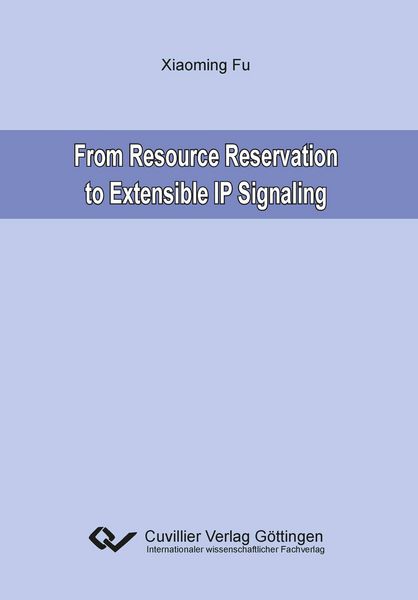
From Resource Reservation to Extensible IP Signaling
-
- Taschenbuch ausgewählt
- eBook
-
Sprache:Englisch
26,99 €
inkl. gesetzl. MwSt.,
Beschreibung
Produktdetails
Einband
Taschenbuch
Erscheinungsdatum
07.03.2014
Verlag
Cuvillier VerlagSeitenzahl
174
Maße (L/B/H)
21/14,8/1 cm
Gewicht
234 g
Auflage
1. Auflage
Sprache
Englisch
ISBN
978-3-95404-601-0
In recent years, the tremendous growth of the Internet and the increasing demand of user applications have resulted in a number of architectural changes to the Internet infrastructure. By its original, the Internet based on the packet-switched technology has been designed for delivering packets in a best effort fashion: the end systems do not need to inform the network prior to transmitting their IP packets, whole routers simply perform routing and forwarding of these packets without distinguishing from each other. However, this design has been challenged due to the new requirements which have been dramatically different from over 30 years ago. For example, to realize the bandwidth and connectivity on demand for the service providers, a signaling protocol seems to be critical. Signaling is not a new topic. In the telecommunication industry, signaling is common and can be dated back to when circuit switches first replaced human telephone operators. Even the modern Signaling System No. 7 (SS7) [187] began its development in the mid 1970's, based on the idea that relies on a separate control element (i.e., the SS6 signal switches) to signal to other control element to set up, manage and release voice trunk lines required to make a call. Based on the signaling standard for ISDN [8], ITU-T standardized a Q.2931 signaling protocol [9] which allows ATM nodes to exchange control of information, request the use of network resources, or negotiate for the use of circuit parameters, for instance, mapping between an input set and an output set of virtual circuit parameters, for instance, mapping between an input set and an output set of virtual circuit identifiers (VCIs) and virtual path identifiers (VPIs). Essentially, signaling protocols manages states in network nodes. They generally reflect some requirements of an end-to-end session/call to the traverses nodes. Thus, they need to be maintained properly, especially when network "conditions" change (e.g., some link or node fails, or the traversing route changes). The task of a signaling protocol involves establishing, maintaining and removing network control states, traversing from one end system to another through the network. Hence, the concept of signaling protocol discussed in this book mainly targets at network control state singnaling.
Ein neues Kapitel für Ihre Bücher
Ein neues Kapitel für Ihre Bücher
Schenken Sie Ihren alten Schätzen ein zweites Leben und erhalten Sie dafür eine Thalia Geschenkkarte.
Noch keine Bewertungen vorhanden
Verfassen Sie die erste Bewertung zu diesem Artikel
Helfen Sie anderen Kundinnen und Kunden durch Ihre Meinung.
Kurze Frage zu unserer Seite
Vielen Dank für Ihr Feedback
Wir nutzen Ihr Feedback, um unsere Produktseiten zu verbessern. Bitte haben Sie Verständnis, dass wir Ihnen keine Rückmeldung geben können. Falls Sie Kontakt mit uns aufnehmen möchten, können Sie sich aber gerne an unseren Kund*innenservice wenden.
zum Kundenservice